User login
AVAHO
div[contains(@class, 'header__large-screen')]
div[contains(@class, 'read-next-article')]
div[contains(@class, 'nav-primary')]
nav[contains(@class, 'nav-primary')]
section[contains(@class, 'footer-nav-section-wrapper')]
footer[@id='footer']
div[contains(@class, 'main-prefix')]
section[contains(@class, 'nav-hidden')]
div[contains(@class, 'ce-card-content')]
nav[contains(@class, 'nav-ce-stack')]

New Cancer Surgical Tech Gets Positive Vote, But Some Cite Safety Concerns
A majority of the US Food and Drug Administration’s Medical Imaging Drugs Advisory Committee (MIDAC) on March 5 voted in support of LUMISIGHT’s (pegulicianine) benefit-risk profile.
LUMISIGHT is an optical imaging agent used in combination with Lumicell Direct Visualization System (DVS), a fluorescence-guided imaging system. The technology, developed by Lumicell Inc., helps surgeons identify cancer that may remain in the breast after they’ve completed the main resection of tissue.
Following MIDAC’s positive vote, the FDA will move on to reviewing Lumicell’s new drug application for LUMISIGHT and its premarket approval application for Lumicell DVS.
“We are proud of the efforts and look forward to the next steps as we work with the FDA to finalize the approval process so that women with breast cancer can access the therapy,” Jorge Ferrer, PhD, Lumicell’s chief scientific officer, said in an interview.
However, Freya Schnabel, MD, professor of surgery and director of breast surgery at NYU Perlmutter Cancer Center, said there are some “real concerns” with the technology. She expressed surprise at MIDAC’s overall favorable vote.
In a recently published study, she noted that the use of pegulicianine fluorescence-guided surgery (pFGS) did not meet the prespecified threshold for sensitivity.
“It did meet thresholds for removal of residual tumor and specificity — but this is still basically a negative study, and a low sensitivity raises concerns regarding false negative readings,” she said in an interview. “I’m surprised [the committee] is supportive in light of this result. Also, the technique is logistically challenging, as patients need to be injected 2 to 6 hours before their surgeries, very challenging timing for patients having ambulatory procedures.”
The study, published in the April 2023 NEJM Evidence, analyzed 357 patients who received 1.0 mg/kg intravenous pegulicianine followed by lumpectomy. Tumor left behind after standard lumpectomy was removed in 27 of 357 patients through use of pFGS. Of the 27, 22 patients had cavity orientations deemed “negative” on standard margin evaluation, according to the study. A margin is described as negative or clean when there are no further cancer cells at the edge of the tissue, suggesting that all of the cancer has been removed. Second surgeries were avoided by pFGS in 9 of 62 patients with positive margins, the analysis found.
On per-margin analysis, pFGS specificity was 85.2%, and sensitivity was 49.3%. While the sensitivity endpoint missed the lower boundary of the 95% confidence interval, the LUM system exceeded the specificity endpoint of 60% with a point estimate of 86%, and an accuracy of 84% for imaging residual cancer in the lumpectomy cavity, coinvestigator E. Shelley Hwang, MD, MPH, said during the MIDAC meeting.
“The pivotal study was an adequate and well-controlled study demonstrating the effectiveness of the LUM system to detect residual cancer in the lumpectomy cavity, following the standard of care procedure,” she said. “These results also demonstrate clinical benefit that improves the current standard of care. This is the first and only imaging system that provides results in the lumpectomy cavity in real time, allowing surgeons to use this information at the time of the initial procedure.”
Is the Technology Safe?
Pegulicianine is an imaging agent that contains a fluorescent dye. The agent is given to patients as a 3-minute intravenous infusion 2 to 6 hours before surgery.
After removal of the main tumor specimen, the surgeon inserts a handheld probe into the breast cavity and in combination with the detection software, searches for residual cancer that may have been left behind, Dr. Ferrer explained during the MIDAC meeting.
If the software identifies areas suspicious for residual cancer, those areas display in red on an overhead screen. The surgeon then takes a targeted shave to resect the suspicious tissue. Once the tissue has been removed, the surgeon can rescan the cavity with the probe to ensure a more complete resection has been performed. Use of the LUM system typically takes surgeons less than 7 minutes to use, Dr. Ferrer said.
In the study, a total of 406 patients received the intravenous pegulicianine, but 14 patients were withdrawn before randomization. After a standard lumpectomy procedure, 357 patients were assigned to the pFGS group and 35 patients to the control group.
Of the 406 patients, pegulicianine administration was stopped for adverse events in 6 patients (1.5%). Two patients had grade 3 serious adverse events related to pegulicianine; one had hypersensitivity, and one had an anaphylactic reaction. The other four pegulicianine-related adverse events included allergic reaction, milder hypersensitivity, nausea, and pegulicianine extravasation.
Dr. Schnabel said these reactions are worrisome. While any effort to reduce the need for patients to have more than one surgery to complete a breast conserving approach would be a “real advance,” Dr. Schnabel said she would not feel comfortable using pFGS in her own practice if approved by the FDA as is.
“This is clearly a major issue in terms of incorporating this technique into practice,” she said. “I could go on, but in light of the above, I’m surprised that [the committee] is supportive. I would hope for some refinement of the technique to reduce the risks to patients and improve the results before I’d consider utilizing this approach.”
During the MIDAC meeting, Dr. Ferrer said the company takes the safety events seriously and has developed mitigation strategies to further reduce the risk of patient hypersensitivity. These strategies include: clear labeling that informs users of anaphylaxis risk, incorporating a new section into the device training program to address warnings and precautions, an enhanced pharmacovigilance program to closely track and report hypersensitivity events, and a postmarket study to access the incidence rate and risk of such events in a broader population.
Several MIDAC members raised questions about the adverse reactions observed and about the safety of the technology.
David B. Hackney, MD, a neuroradiologist at Beth Israel Deaconess Medical Center in Boston, questioned the recommendation that patients only be monitored for 15 minutes after the injection.
“Since you don’t have enough data to know how long after injection reactions could occur, why not keep them under monitoring until after the surgery is over?” he said.
Barbara Smith, MD, PhD, lead investigator of the study, explained that per the protocol, there would be frequent monitoring, with a nurse at bedside, and patients would be monitored after injection, on their way to the procedure, and afterward.
She suggested, during the meeting, that more intense monitoring early in the process would be beneficial as that is when investigators observed side effects believed to be attributed to LUMISIGHT.
MIDAC member Kimberly E. Applegate, MD, a retired radiology professor, asked about the learning curve for surgeons and how long it generally takes for physicians to become familiar with the system.
Coinvestigator Kelly Hunt, MD, explained that all surgeons who participated in the trial completed a training program.
“Certainly, there’s a learning curve anytime we introduce new technology in the operating room,” she said. “Surgeons said it usually takes about three procedures before they’re comfortable with the system, including the camera and the software.”
During a presentation period by FDA officials, Anil Rajpal, MD, MPH, FDA, Deputy Division Director for Safety, said it’s important that prescribing information for LUMISIGHT communicate the risk of anaphylaxis and other hypersensitivity reactions, the need to monitor patients, and the need for the appropriate available personnel, medications, and equipment.
“This would be done by warnings and precautions and a boxed warning,” he said. “Note, that [such warnings] would only communicate the risks, it would not further characterize the risk.”
Committee Expresses Support
During a subsequent vote among committee members, most expressed support for the technology and its benefits. Sixteen members voted in support, one abstained, and two voted against the benefit-risk profile.
Andrea Richardson, MD, PhD, professor of pathology at Johns Hopkins in Baltimore, said she voted yes because the incremental benefits of avoiding additional surgeries outweigh the small risk of anaphylaxis.
Henry Royal, MD, MIDAC chair and professor of radiology at Washington University School of Medicine in St. Louis, agreed.
“Even though the benefit of this is on average, quite small, the benefit to the woman who has positive margins that’s converted to negative margins because of use of [LUMISIGHT] is really quite great,” he said. “The risk from this procedure is certainly very manageable.”
Harold J. Burstein, MD, PhD, a professor of medicine at Harvard Medical School and oncologist at Dana-Farber Cancer Institute in Boston, voted against the benefit-risk profile. He said the technology merits more research and that he does not believe it was proven the technology reduces the risk of reoperation.
“I think it’s a great technology,” he said. “I would like to see a well-conducted, randomized, phase III study with the endpoint of reoperation,” he said. “That would really prove the usefulness and benefit of the intervention in my mind.”
Chengjie Xiong, PhD, professor of biostatistics at Washington University School of Medicine in St. Louis, chose to abstain from voting because he said there was not enough data.
The FDA will now complete its review of Lumicell’s new drug application for LUMISIGHT and review of its premarket approval application for Lumicell DVS. The FDA review team has 6-10 months to make a decision. As part of the process, the FDA will evaluate clinical data, travel to clinical study sites to conduct inspections, and assemble a final action package for a senior FDA official to make a final decision.
If deemed safe and effective, the FDA will then work with Lumicell on developing and refining prescribing information.
Dr. Ferrer said his team expects to receive FDA approval in the coming weeks and will continue to work collaboratively with the FDA to expedite approval where possible.
The purpose of the MIDAC is to review and evaluate data about the safety and effectiveness of marketed and investigational human drug products for use in diagnostic and therapeutic procedures using radioactive pharmaceuticals and make appropriate recommendations to the FDA Commissioner.
A majority of the US Food and Drug Administration’s Medical Imaging Drugs Advisory Committee (MIDAC) on March 5 voted in support of LUMISIGHT’s (pegulicianine) benefit-risk profile.
LUMISIGHT is an optical imaging agent used in combination with Lumicell Direct Visualization System (DVS), a fluorescence-guided imaging system. The technology, developed by Lumicell Inc., helps surgeons identify cancer that may remain in the breast after they’ve completed the main resection of tissue.
Following MIDAC’s positive vote, the FDA will move on to reviewing Lumicell’s new drug application for LUMISIGHT and its premarket approval application for Lumicell DVS.
“We are proud of the efforts and look forward to the next steps as we work with the FDA to finalize the approval process so that women with breast cancer can access the therapy,” Jorge Ferrer, PhD, Lumicell’s chief scientific officer, said in an interview.
However, Freya Schnabel, MD, professor of surgery and director of breast surgery at NYU Perlmutter Cancer Center, said there are some “real concerns” with the technology. She expressed surprise at MIDAC’s overall favorable vote.
In a recently published study, she noted that the use of pegulicianine fluorescence-guided surgery (pFGS) did not meet the prespecified threshold for sensitivity.
“It did meet thresholds for removal of residual tumor and specificity — but this is still basically a negative study, and a low sensitivity raises concerns regarding false negative readings,” she said in an interview. “I’m surprised [the committee] is supportive in light of this result. Also, the technique is logistically challenging, as patients need to be injected 2 to 6 hours before their surgeries, very challenging timing for patients having ambulatory procedures.”
The study, published in the April 2023 NEJM Evidence, analyzed 357 patients who received 1.0 mg/kg intravenous pegulicianine followed by lumpectomy. Tumor left behind after standard lumpectomy was removed in 27 of 357 patients through use of pFGS. Of the 27, 22 patients had cavity orientations deemed “negative” on standard margin evaluation, according to the study. A margin is described as negative or clean when there are no further cancer cells at the edge of the tissue, suggesting that all of the cancer has been removed. Second surgeries were avoided by pFGS in 9 of 62 patients with positive margins, the analysis found.
On per-margin analysis, pFGS specificity was 85.2%, and sensitivity was 49.3%. While the sensitivity endpoint missed the lower boundary of the 95% confidence interval, the LUM system exceeded the specificity endpoint of 60% with a point estimate of 86%, and an accuracy of 84% for imaging residual cancer in the lumpectomy cavity, coinvestigator E. Shelley Hwang, MD, MPH, said during the MIDAC meeting.
“The pivotal study was an adequate and well-controlled study demonstrating the effectiveness of the LUM system to detect residual cancer in the lumpectomy cavity, following the standard of care procedure,” she said. “These results also demonstrate clinical benefit that improves the current standard of care. This is the first and only imaging system that provides results in the lumpectomy cavity in real time, allowing surgeons to use this information at the time of the initial procedure.”
Is the Technology Safe?
Pegulicianine is an imaging agent that contains a fluorescent dye. The agent is given to patients as a 3-minute intravenous infusion 2 to 6 hours before surgery.
After removal of the main tumor specimen, the surgeon inserts a handheld probe into the breast cavity and in combination with the detection software, searches for residual cancer that may have been left behind, Dr. Ferrer explained during the MIDAC meeting.
If the software identifies areas suspicious for residual cancer, those areas display in red on an overhead screen. The surgeon then takes a targeted shave to resect the suspicious tissue. Once the tissue has been removed, the surgeon can rescan the cavity with the probe to ensure a more complete resection has been performed. Use of the LUM system typically takes surgeons less than 7 minutes to use, Dr. Ferrer said.
In the study, a total of 406 patients received the intravenous pegulicianine, but 14 patients were withdrawn before randomization. After a standard lumpectomy procedure, 357 patients were assigned to the pFGS group and 35 patients to the control group.
Of the 406 patients, pegulicianine administration was stopped for adverse events in 6 patients (1.5%). Two patients had grade 3 serious adverse events related to pegulicianine; one had hypersensitivity, and one had an anaphylactic reaction. The other four pegulicianine-related adverse events included allergic reaction, milder hypersensitivity, nausea, and pegulicianine extravasation.
Dr. Schnabel said these reactions are worrisome. While any effort to reduce the need for patients to have more than one surgery to complete a breast conserving approach would be a “real advance,” Dr. Schnabel said she would not feel comfortable using pFGS in her own practice if approved by the FDA as is.
“This is clearly a major issue in terms of incorporating this technique into practice,” she said. “I could go on, but in light of the above, I’m surprised that [the committee] is supportive. I would hope for some refinement of the technique to reduce the risks to patients and improve the results before I’d consider utilizing this approach.”
During the MIDAC meeting, Dr. Ferrer said the company takes the safety events seriously and has developed mitigation strategies to further reduce the risk of patient hypersensitivity. These strategies include: clear labeling that informs users of anaphylaxis risk, incorporating a new section into the device training program to address warnings and precautions, an enhanced pharmacovigilance program to closely track and report hypersensitivity events, and a postmarket study to access the incidence rate and risk of such events in a broader population.
Several MIDAC members raised questions about the adverse reactions observed and about the safety of the technology.
David B. Hackney, MD, a neuroradiologist at Beth Israel Deaconess Medical Center in Boston, questioned the recommendation that patients only be monitored for 15 minutes after the injection.
“Since you don’t have enough data to know how long after injection reactions could occur, why not keep them under monitoring until after the surgery is over?” he said.
Barbara Smith, MD, PhD, lead investigator of the study, explained that per the protocol, there would be frequent monitoring, with a nurse at bedside, and patients would be monitored after injection, on their way to the procedure, and afterward.
She suggested, during the meeting, that more intense monitoring early in the process would be beneficial as that is when investigators observed side effects believed to be attributed to LUMISIGHT.
MIDAC member Kimberly E. Applegate, MD, a retired radiology professor, asked about the learning curve for surgeons and how long it generally takes for physicians to become familiar with the system.
Coinvestigator Kelly Hunt, MD, explained that all surgeons who participated in the trial completed a training program.
“Certainly, there’s a learning curve anytime we introduce new technology in the operating room,” she said. “Surgeons said it usually takes about three procedures before they’re comfortable with the system, including the camera and the software.”
During a presentation period by FDA officials, Anil Rajpal, MD, MPH, FDA, Deputy Division Director for Safety, said it’s important that prescribing information for LUMISIGHT communicate the risk of anaphylaxis and other hypersensitivity reactions, the need to monitor patients, and the need for the appropriate available personnel, medications, and equipment.
“This would be done by warnings and precautions and a boxed warning,” he said. “Note, that [such warnings] would only communicate the risks, it would not further characterize the risk.”
Committee Expresses Support
During a subsequent vote among committee members, most expressed support for the technology and its benefits. Sixteen members voted in support, one abstained, and two voted against the benefit-risk profile.
Andrea Richardson, MD, PhD, professor of pathology at Johns Hopkins in Baltimore, said she voted yes because the incremental benefits of avoiding additional surgeries outweigh the small risk of anaphylaxis.
Henry Royal, MD, MIDAC chair and professor of radiology at Washington University School of Medicine in St. Louis, agreed.
“Even though the benefit of this is on average, quite small, the benefit to the woman who has positive margins that’s converted to negative margins because of use of [LUMISIGHT] is really quite great,” he said. “The risk from this procedure is certainly very manageable.”
Harold J. Burstein, MD, PhD, a professor of medicine at Harvard Medical School and oncologist at Dana-Farber Cancer Institute in Boston, voted against the benefit-risk profile. He said the technology merits more research and that he does not believe it was proven the technology reduces the risk of reoperation.
“I think it’s a great technology,” he said. “I would like to see a well-conducted, randomized, phase III study with the endpoint of reoperation,” he said. “That would really prove the usefulness and benefit of the intervention in my mind.”
Chengjie Xiong, PhD, professor of biostatistics at Washington University School of Medicine in St. Louis, chose to abstain from voting because he said there was not enough data.
The FDA will now complete its review of Lumicell’s new drug application for LUMISIGHT and review of its premarket approval application for Lumicell DVS. The FDA review team has 6-10 months to make a decision. As part of the process, the FDA will evaluate clinical data, travel to clinical study sites to conduct inspections, and assemble a final action package for a senior FDA official to make a final decision.
If deemed safe and effective, the FDA will then work with Lumicell on developing and refining prescribing information.
Dr. Ferrer said his team expects to receive FDA approval in the coming weeks and will continue to work collaboratively with the FDA to expedite approval where possible.
The purpose of the MIDAC is to review and evaluate data about the safety and effectiveness of marketed and investigational human drug products for use in diagnostic and therapeutic procedures using radioactive pharmaceuticals and make appropriate recommendations to the FDA Commissioner.
A majority of the US Food and Drug Administration’s Medical Imaging Drugs Advisory Committee (MIDAC) on March 5 voted in support of LUMISIGHT’s (pegulicianine) benefit-risk profile.
LUMISIGHT is an optical imaging agent used in combination with Lumicell Direct Visualization System (DVS), a fluorescence-guided imaging system. The technology, developed by Lumicell Inc., helps surgeons identify cancer that may remain in the breast after they’ve completed the main resection of tissue.
Following MIDAC’s positive vote, the FDA will move on to reviewing Lumicell’s new drug application for LUMISIGHT and its premarket approval application for Lumicell DVS.
“We are proud of the efforts and look forward to the next steps as we work with the FDA to finalize the approval process so that women with breast cancer can access the therapy,” Jorge Ferrer, PhD, Lumicell’s chief scientific officer, said in an interview.
However, Freya Schnabel, MD, professor of surgery and director of breast surgery at NYU Perlmutter Cancer Center, said there are some “real concerns” with the technology. She expressed surprise at MIDAC’s overall favorable vote.
In a recently published study, she noted that the use of pegulicianine fluorescence-guided surgery (pFGS) did not meet the prespecified threshold for sensitivity.
“It did meet thresholds for removal of residual tumor and specificity — but this is still basically a negative study, and a low sensitivity raises concerns regarding false negative readings,” she said in an interview. “I’m surprised [the committee] is supportive in light of this result. Also, the technique is logistically challenging, as patients need to be injected 2 to 6 hours before their surgeries, very challenging timing for patients having ambulatory procedures.”
The study, published in the April 2023 NEJM Evidence, analyzed 357 patients who received 1.0 mg/kg intravenous pegulicianine followed by lumpectomy. Tumor left behind after standard lumpectomy was removed in 27 of 357 patients through use of pFGS. Of the 27, 22 patients had cavity orientations deemed “negative” on standard margin evaluation, according to the study. A margin is described as negative or clean when there are no further cancer cells at the edge of the tissue, suggesting that all of the cancer has been removed. Second surgeries were avoided by pFGS in 9 of 62 patients with positive margins, the analysis found.
On per-margin analysis, pFGS specificity was 85.2%, and sensitivity was 49.3%. While the sensitivity endpoint missed the lower boundary of the 95% confidence interval, the LUM system exceeded the specificity endpoint of 60% with a point estimate of 86%, and an accuracy of 84% for imaging residual cancer in the lumpectomy cavity, coinvestigator E. Shelley Hwang, MD, MPH, said during the MIDAC meeting.
“The pivotal study was an adequate and well-controlled study demonstrating the effectiveness of the LUM system to detect residual cancer in the lumpectomy cavity, following the standard of care procedure,” she said. “These results also demonstrate clinical benefit that improves the current standard of care. This is the first and only imaging system that provides results in the lumpectomy cavity in real time, allowing surgeons to use this information at the time of the initial procedure.”
Is the Technology Safe?
Pegulicianine is an imaging agent that contains a fluorescent dye. The agent is given to patients as a 3-minute intravenous infusion 2 to 6 hours before surgery.
After removal of the main tumor specimen, the surgeon inserts a handheld probe into the breast cavity and in combination with the detection software, searches for residual cancer that may have been left behind, Dr. Ferrer explained during the MIDAC meeting.
If the software identifies areas suspicious for residual cancer, those areas display in red on an overhead screen. The surgeon then takes a targeted shave to resect the suspicious tissue. Once the tissue has been removed, the surgeon can rescan the cavity with the probe to ensure a more complete resection has been performed. Use of the LUM system typically takes surgeons less than 7 minutes to use, Dr. Ferrer said.
In the study, a total of 406 patients received the intravenous pegulicianine, but 14 patients were withdrawn before randomization. After a standard lumpectomy procedure, 357 patients were assigned to the pFGS group and 35 patients to the control group.
Of the 406 patients, pegulicianine administration was stopped for adverse events in 6 patients (1.5%). Two patients had grade 3 serious adverse events related to pegulicianine; one had hypersensitivity, and one had an anaphylactic reaction. The other four pegulicianine-related adverse events included allergic reaction, milder hypersensitivity, nausea, and pegulicianine extravasation.
Dr. Schnabel said these reactions are worrisome. While any effort to reduce the need for patients to have more than one surgery to complete a breast conserving approach would be a “real advance,” Dr. Schnabel said she would not feel comfortable using pFGS in her own practice if approved by the FDA as is.
“This is clearly a major issue in terms of incorporating this technique into practice,” she said. “I could go on, but in light of the above, I’m surprised that [the committee] is supportive. I would hope for some refinement of the technique to reduce the risks to patients and improve the results before I’d consider utilizing this approach.”
During the MIDAC meeting, Dr. Ferrer said the company takes the safety events seriously and has developed mitigation strategies to further reduce the risk of patient hypersensitivity. These strategies include: clear labeling that informs users of anaphylaxis risk, incorporating a new section into the device training program to address warnings and precautions, an enhanced pharmacovigilance program to closely track and report hypersensitivity events, and a postmarket study to access the incidence rate and risk of such events in a broader population.
Several MIDAC members raised questions about the adverse reactions observed and about the safety of the technology.
David B. Hackney, MD, a neuroradiologist at Beth Israel Deaconess Medical Center in Boston, questioned the recommendation that patients only be monitored for 15 minutes after the injection.
“Since you don’t have enough data to know how long after injection reactions could occur, why not keep them under monitoring until after the surgery is over?” he said.
Barbara Smith, MD, PhD, lead investigator of the study, explained that per the protocol, there would be frequent monitoring, with a nurse at bedside, and patients would be monitored after injection, on their way to the procedure, and afterward.
She suggested, during the meeting, that more intense monitoring early in the process would be beneficial as that is when investigators observed side effects believed to be attributed to LUMISIGHT.
MIDAC member Kimberly E. Applegate, MD, a retired radiology professor, asked about the learning curve for surgeons and how long it generally takes for physicians to become familiar with the system.
Coinvestigator Kelly Hunt, MD, explained that all surgeons who participated in the trial completed a training program.
“Certainly, there’s a learning curve anytime we introduce new technology in the operating room,” she said. “Surgeons said it usually takes about three procedures before they’re comfortable with the system, including the camera and the software.”
During a presentation period by FDA officials, Anil Rajpal, MD, MPH, FDA, Deputy Division Director for Safety, said it’s important that prescribing information for LUMISIGHT communicate the risk of anaphylaxis and other hypersensitivity reactions, the need to monitor patients, and the need for the appropriate available personnel, medications, and equipment.
“This would be done by warnings and precautions and a boxed warning,” he said. “Note, that [such warnings] would only communicate the risks, it would not further characterize the risk.”
Committee Expresses Support
During a subsequent vote among committee members, most expressed support for the technology and its benefits. Sixteen members voted in support, one abstained, and two voted against the benefit-risk profile.
Andrea Richardson, MD, PhD, professor of pathology at Johns Hopkins in Baltimore, said she voted yes because the incremental benefits of avoiding additional surgeries outweigh the small risk of anaphylaxis.
Henry Royal, MD, MIDAC chair and professor of radiology at Washington University School of Medicine in St. Louis, agreed.
“Even though the benefit of this is on average, quite small, the benefit to the woman who has positive margins that’s converted to negative margins because of use of [LUMISIGHT] is really quite great,” he said. “The risk from this procedure is certainly very manageable.”
Harold J. Burstein, MD, PhD, a professor of medicine at Harvard Medical School and oncologist at Dana-Farber Cancer Institute in Boston, voted against the benefit-risk profile. He said the technology merits more research and that he does not believe it was proven the technology reduces the risk of reoperation.
“I think it’s a great technology,” he said. “I would like to see a well-conducted, randomized, phase III study with the endpoint of reoperation,” he said. “That would really prove the usefulness and benefit of the intervention in my mind.”
Chengjie Xiong, PhD, professor of biostatistics at Washington University School of Medicine in St. Louis, chose to abstain from voting because he said there was not enough data.
The FDA will now complete its review of Lumicell’s new drug application for LUMISIGHT and review of its premarket approval application for Lumicell DVS. The FDA review team has 6-10 months to make a decision. As part of the process, the FDA will evaluate clinical data, travel to clinical study sites to conduct inspections, and assemble a final action package for a senior FDA official to make a final decision.
If deemed safe and effective, the FDA will then work with Lumicell on developing and refining prescribing information.
Dr. Ferrer said his team expects to receive FDA approval in the coming weeks and will continue to work collaboratively with the FDA to expedite approval where possible.
The purpose of the MIDAC is to review and evaluate data about the safety and effectiveness of marketed and investigational human drug products for use in diagnostic and therapeutic procedures using radioactive pharmaceuticals and make appropriate recommendations to the FDA Commissioner.
Does Exercise Reduce Cancer Risk? It’s Just Not That Simple
“Exercise is medicine” has become something of a mantra, with good reason. There’s no doubt that regular physical activity has a broad range of health benefits. Exercise can improve circulation, help control weight, reduce stress, and boost mood — take your pick.
Lower cancer risk is also on the list — with exercise promoted as a risk-cutting strategy in government guidelines and in recommendations from professional groups such as the American Cancer Society.
The bulk of the data hangs on less rigorous, observational studies that have linked physical activity to lower risks for certain cancers, but plenty of questions remain.
What are the cancer types where exercise makes a difference? How significant is that impact? And what, exactly, defines a physical activity pattern powerful enough to move the needle on cancer risk?
Here’s an overview of the state of the evidence.
Exercise and Cancer Types: A Mixed Bag
When it comes to cancer prevention strategies, guidelines uniformly endorse less couch time and more movement. But a deeper look at the science reveals a complex and often poorly understood connection between exercise and cancer risk.
For certain cancer types, the benefits of exercise on cancer risk seem fairly well established.
The latest edition of the Physical Activity Guidelines for Americans, published in 2018, cites “strong evidence” that regular exercise might curb the risks for breast and colon cancers as well as bladder, endometrial, esophageal, kidney, and gastric cancers. These guidelines also point to “moderate”-strength evidence of a protective association with lung cancer.
The evidence of a protective effect, however, is strongest for breast and colon cancers, said Jennifer Ligibel, MD, senior physician in the Breast Oncology Center at Dana-Farber Cancer Institute, Boston, . “But,” she pointed out, “that may be because they’re some of the most common cancers, and it’s been easier to detect an association.”
Guidelines from the American Cancer Society, published in 2020, align with the 2018 recommendations.
“We believe there’s strong evidence to suggest at least eight different types of cancer are associated with physical activity,” said Erika Rees-Punia, PhD, MPH, senior principal scientist, epidemiology and behavioral research at the American Cancer Society.
That view is not universal, however. Current recommendations from the World Cancer Research Fund and American Institute for Cancer Research, for example, are more circumspect, citing only three cancers with good evidence of a protective effect from exercise: Breast (postmenopausal), colon, and endometrial.
“We definitely can’t say exercise reduces the risk of all cancers,” said Lee Jones, PhD, head of the Exercise Oncology Program at Memorial Sloan Kettering Cancer Center in New York City. “The data suggest it’s just not that simple.”
And it’s challenging to put all the evidence together, Dr. Jones added.
The physical activity guidelines are based on published systematic reviews, meta-analyses, and pooled analyses of data from observational studies that examined the relationship between physical activity — aerobic exercise, specifically — and cancer incidence. That means the evidence comes with all the limitations observational studies entail, such as how they collect information on participants’ exercise habits — which, Dr. Jones noted, is typically done via “monster questionnaires” that gauge physical activity in broad strokes.
Pooling all those findings into a meta-analysis is tricky, Dr. Jones added, because individual studies vary in important ways — from follow-up periods to how they quantify exercise and track cancer incidence.
In a study published in February in Cancer Cell, Dr. Jones and his colleagues attempted to address some of those issues by leveraging data from the PLCO screening trial.
The PLCO was a prospective study of over 60,000 US adults that compared the effects of annual screening vs usual care on cancer mortality. At enrollment, participants completed questionnaires that included an assessment of “vigorous” exercise. Based on that, Dr. Jones and his colleagues classified 55% as “exercisers” — meaning they reported 2 or more hours of vigorous exercise per week. The remaining 45%, who were in the 0 to 1 hour per week range, were deemed non-exercisers.
Over a median of 18 years, nearly 16,000 first-time invasive cancers were diagnosed, and some interesting differences between exercisers and non-exercisers emerged. The active group had lower risks for three cancers: Head and neck, with a 26% lower risk (hazard ratio [HR], 0.74), lung (a 20% lower risk), and breast (an 11% lower risk).
What was striking, however, was the lack of connection between exercise and many cancers cited in the guidelines, including colon, gastric, bladder, endometrial, and renal cancers.
Perhaps even more surprising — exercisers had higher risks for prostate cancer (12%) and melanoma (20%). This finding, Dr. Jones said, is in line with a previous pooled analysis of data from 12 US and European prospective cohorts. In this study, the most physically active participants (90th percentile) had higher risks for melanoma and prostate cancer, compared with the least active group (10th percentile).
The melanoma findings do make sense, Dr. Jones said, given that highly active people may spend a lot of time in the sun. “My advice,” Dr. Jones said, “is, if you’re exercising outside, wear sunscreen.” The prostate cancer findings, however, are more puzzling and warrant further research, he noted.
But the bottom line is that the relationship between exercise and cancer types is mixed and far from nailed down.
How Big Is the Effect?
Even if exercise reduces the risk for only certain cancers, that’s still important, particularly when those links appear strongest for common cancer types, such as breast and colon.
But how much of a difference can exercise make?
Based on the evidence, it may only be a modest one. A 2019 systematic review by the Physical Activity Guidelines Advisory Committee provided a rough estimate: Across hundreds of epidemiological studies, people with the highest physical activity levels had a 10%-20% lower risk for the cancers cited in the 2018 exercise guidelines compared with people who were least active.
These figures, however, are probably an underestimate, said Anne McTiernan, MD, PhD, a member of the advisory committee and professor of epidemiology, at Fred Hutchinson Cancer Center, Seattle.
“This is what we usually see when a factor is not measured very well,” said Dr. McTiernan, explaining that the individual studies differed in their categories of “highest” and “lowest” physical activity, such that one study’s “highest” could be another’s mid-range.
“In other words, the effects of physical activity are likely larger” than the review found, Dr. McTiernan said.
The next logical question is whether a bigger exercise “dose” — more time or higher intensity — would have a greater impact on cancer risk. A 2019 study published in the Journal of Clinical Oncology tried to clarify that by pooling data on over 750,000 participants from nine prospective cohorts.
Overall, people meeting government recommendations for exercise — equivalent to about 2.5-5 hours of weekly moderate activity, such as a brisk walk, or about 1.25-2.5 hours of more vigorous activities, like running — had lower risks for seven of 15 cancer types studied compared with less active people.
For cancers with positive findings, being on the higher end of the recommended 2.5- to 5-hour weekly range was better. Risk reductions for breast cancer, for instance, were 6% at 2.5 hours of physical activity per week and 10% at 5 hours per week. Similar trends emerged for other cancer types, including colon (8%-14%), endometrial (10%-18%), liver cancer (18%-27%), and non-Hodgkin lymphoma in women (11%-18%).
But there may be an exercise sweet spot that maximizes the cancer risk benefit.
Among people who surpassed the recommendations — exercising for more time or more intensely — the risk reduction benefit did not necessarily improve in a linear fashion. For certain cancer types, such as colon and endometrial, the benefits of more vigorous exercise “eroded at higher levels of activity,” the authors said.
The issue here is that most studies have not dug deeply into aerobic exercise habits. Often, studies present participants with a list of activities — walking, biking, and running — and ask them to estimate how often and for what duration they do each.
Plus, “we’ve usually lumped moderate and vigorous activities together,” Dr. Rees-Punia said, which means there’s a lack of “granular data” to say whether certain intensities or frequencies of exercise are optimal and for whom.
Why Exercise May Lower Cancer Risk
Exercise habits do not, of course, exist in a vacuum. Highly active people, Dr. Ligibel said, tend to be of higher socioeconomic status, leaner, and have generally healthier lifestyles than sedentary people.
Body weight is a big confounder as well. However, Dr. Rees-Punia noted, it’s also probably a reason that exercise is linked to lower cancer risks, particularly by preventing weight gain. Still, studies have found that the association between exercise and many cancers remains significant after adjusting for body mass index.
The why remains unclear, though some studies offer clues.
“There’s been some really interesting mechanistic research, suggesting that exercise may help inhibit tumor growth or upregulate the immune system,” Dr. Ligibel said.
That includes not only lab research but small intervention studies. While these studies have largely involved people who already have cancer, some have also focused on healthy individuals.
A 2019 study from Dr. Ligibel and her colleagues, which randomly assigned 49 women newly diagnosed with breast cancer to start either an exercise program or mind-body practices ahead of surgery, found exercisers, who had been active for about a month at the time of surgery, showed signs of immune system upregulation in their tumors, while the control group did not.
Among healthy postmenopausal women, a meta-analysis of six clinical trials from Dr. McTiernan and her colleagues found that exercise plus calorie reduction can reduce levels of breast cancer-related endogenous hormones, more so than calorie-cutting alone. And a 2023 study found that high-intensity exercise boosted the ranks of certain immune cells and reduced inflammation in the colon among people at high risk for colon and endometrial cancers due to Lynch syndrome.
Defining an Exercise ‘Prescription’
Despite the gaps and uncertainties in the research, government guidelines as well as those from the American Cancer Society and other medical groups are in lockstep in their exercise recommendations: Adults should strive for 150-300 minutes of moderate-intensity aerobic exercise (like brisk walking), 75-150 minutes of vigorous activity (like running), or some combination each week.
The guidelines also encourage strength training twice a week — advice that’s based on research tying those activity levels to lower risks for heart disease, diabetes, and other chronic conditions.
But there’s no “best” exercise prescription for lowering cancer risk specifically. Most epidemiological studies have examined only aerobic activity, Dr. Rees-Punia said, and there’s very little known about whether strength conditioning or other moderate heart rate-elevating activities, such as daily household chores, may reduce the risk for cancer.
Given the lack of nuance in the literature, it’s hard to say what intensities, types, or amounts of exercise are best for each individual.
Going forward, device-based measurements of physical activity could “help us sort out the effects of different intensities of exercise and possibly types,” Dr. Rees-Punia said.
But overall, Dr. McTiernan said, the data do show that the risks for several cancers are lower at the widely recommended activity levels.
“The bottom-line advice is still to exercise at least 150 minutes per week at a moderate-intensity level or greater,” Dr. McTiernan said.
Or put another way, moving beats being sedentary. It’s probably wise for everyone to sit less, noted Dr. Rees-Punia, for overall health and based on evidence tying sedentary time to the risks for certain cancers, including colon, endometrial, and lung.
There’s a practical element to consider in all of this: What physical activities will people actually do on the regular? In the big epidemiological studies, Dr. McTiernan noted, middle-aged and older adults most often report walking, suggesting that’s the preferred, or most accessible activity, for many.
“You can only benefit from the physical activity you’ll actually do,” Dr. Rees-Punia said.
Dr. Ligibel echoed that sentiment, saying she encourages patients to think about physical activity as a process: “You need to find things you like to do and work them into your daily life, in a sustainable way.
“People often talk about exercise being medicine,” Dr. Ligibel said. “But I think you could take that too far. If we get too prescriptive about it, that could take the joy away.”
A version of this article appeared on Medscape.com.
“Exercise is medicine” has become something of a mantra, with good reason. There’s no doubt that regular physical activity has a broad range of health benefits. Exercise can improve circulation, help control weight, reduce stress, and boost mood — take your pick.
Lower cancer risk is also on the list — with exercise promoted as a risk-cutting strategy in government guidelines and in recommendations from professional groups such as the American Cancer Society.
The bulk of the data hangs on less rigorous, observational studies that have linked physical activity to lower risks for certain cancers, but plenty of questions remain.
What are the cancer types where exercise makes a difference? How significant is that impact? And what, exactly, defines a physical activity pattern powerful enough to move the needle on cancer risk?
Here’s an overview of the state of the evidence.
Exercise and Cancer Types: A Mixed Bag
When it comes to cancer prevention strategies, guidelines uniformly endorse less couch time and more movement. But a deeper look at the science reveals a complex and often poorly understood connection between exercise and cancer risk.
For certain cancer types, the benefits of exercise on cancer risk seem fairly well established.
The latest edition of the Physical Activity Guidelines for Americans, published in 2018, cites “strong evidence” that regular exercise might curb the risks for breast and colon cancers as well as bladder, endometrial, esophageal, kidney, and gastric cancers. These guidelines also point to “moderate”-strength evidence of a protective association with lung cancer.
The evidence of a protective effect, however, is strongest for breast and colon cancers, said Jennifer Ligibel, MD, senior physician in the Breast Oncology Center at Dana-Farber Cancer Institute, Boston, . “But,” she pointed out, “that may be because they’re some of the most common cancers, and it’s been easier to detect an association.”
Guidelines from the American Cancer Society, published in 2020, align with the 2018 recommendations.
“We believe there’s strong evidence to suggest at least eight different types of cancer are associated with physical activity,” said Erika Rees-Punia, PhD, MPH, senior principal scientist, epidemiology and behavioral research at the American Cancer Society.
That view is not universal, however. Current recommendations from the World Cancer Research Fund and American Institute for Cancer Research, for example, are more circumspect, citing only three cancers with good evidence of a protective effect from exercise: Breast (postmenopausal), colon, and endometrial.
“We definitely can’t say exercise reduces the risk of all cancers,” said Lee Jones, PhD, head of the Exercise Oncology Program at Memorial Sloan Kettering Cancer Center in New York City. “The data suggest it’s just not that simple.”
And it’s challenging to put all the evidence together, Dr. Jones added.
The physical activity guidelines are based on published systematic reviews, meta-analyses, and pooled analyses of data from observational studies that examined the relationship between physical activity — aerobic exercise, specifically — and cancer incidence. That means the evidence comes with all the limitations observational studies entail, such as how they collect information on participants’ exercise habits — which, Dr. Jones noted, is typically done via “monster questionnaires” that gauge physical activity in broad strokes.
Pooling all those findings into a meta-analysis is tricky, Dr. Jones added, because individual studies vary in important ways — from follow-up periods to how they quantify exercise and track cancer incidence.
In a study published in February in Cancer Cell, Dr. Jones and his colleagues attempted to address some of those issues by leveraging data from the PLCO screening trial.
The PLCO was a prospective study of over 60,000 US adults that compared the effects of annual screening vs usual care on cancer mortality. At enrollment, participants completed questionnaires that included an assessment of “vigorous” exercise. Based on that, Dr. Jones and his colleagues classified 55% as “exercisers” — meaning they reported 2 or more hours of vigorous exercise per week. The remaining 45%, who were in the 0 to 1 hour per week range, were deemed non-exercisers.
Over a median of 18 years, nearly 16,000 first-time invasive cancers were diagnosed, and some interesting differences between exercisers and non-exercisers emerged. The active group had lower risks for three cancers: Head and neck, with a 26% lower risk (hazard ratio [HR], 0.74), lung (a 20% lower risk), and breast (an 11% lower risk).
What was striking, however, was the lack of connection between exercise and many cancers cited in the guidelines, including colon, gastric, bladder, endometrial, and renal cancers.
Perhaps even more surprising — exercisers had higher risks for prostate cancer (12%) and melanoma (20%). This finding, Dr. Jones said, is in line with a previous pooled analysis of data from 12 US and European prospective cohorts. In this study, the most physically active participants (90th percentile) had higher risks for melanoma and prostate cancer, compared with the least active group (10th percentile).
The melanoma findings do make sense, Dr. Jones said, given that highly active people may spend a lot of time in the sun. “My advice,” Dr. Jones said, “is, if you’re exercising outside, wear sunscreen.” The prostate cancer findings, however, are more puzzling and warrant further research, he noted.
But the bottom line is that the relationship between exercise and cancer types is mixed and far from nailed down.
How Big Is the Effect?
Even if exercise reduces the risk for only certain cancers, that’s still important, particularly when those links appear strongest for common cancer types, such as breast and colon.
But how much of a difference can exercise make?
Based on the evidence, it may only be a modest one. A 2019 systematic review by the Physical Activity Guidelines Advisory Committee provided a rough estimate: Across hundreds of epidemiological studies, people with the highest physical activity levels had a 10%-20% lower risk for the cancers cited in the 2018 exercise guidelines compared with people who were least active.
These figures, however, are probably an underestimate, said Anne McTiernan, MD, PhD, a member of the advisory committee and professor of epidemiology, at Fred Hutchinson Cancer Center, Seattle.
“This is what we usually see when a factor is not measured very well,” said Dr. McTiernan, explaining that the individual studies differed in their categories of “highest” and “lowest” physical activity, such that one study’s “highest” could be another’s mid-range.
“In other words, the effects of physical activity are likely larger” than the review found, Dr. McTiernan said.
The next logical question is whether a bigger exercise “dose” — more time or higher intensity — would have a greater impact on cancer risk. A 2019 study published in the Journal of Clinical Oncology tried to clarify that by pooling data on over 750,000 participants from nine prospective cohorts.
Overall, people meeting government recommendations for exercise — equivalent to about 2.5-5 hours of weekly moderate activity, such as a brisk walk, or about 1.25-2.5 hours of more vigorous activities, like running — had lower risks for seven of 15 cancer types studied compared with less active people.
For cancers with positive findings, being on the higher end of the recommended 2.5- to 5-hour weekly range was better. Risk reductions for breast cancer, for instance, were 6% at 2.5 hours of physical activity per week and 10% at 5 hours per week. Similar trends emerged for other cancer types, including colon (8%-14%), endometrial (10%-18%), liver cancer (18%-27%), and non-Hodgkin lymphoma in women (11%-18%).
But there may be an exercise sweet spot that maximizes the cancer risk benefit.
Among people who surpassed the recommendations — exercising for more time or more intensely — the risk reduction benefit did not necessarily improve in a linear fashion. For certain cancer types, such as colon and endometrial, the benefits of more vigorous exercise “eroded at higher levels of activity,” the authors said.
The issue here is that most studies have not dug deeply into aerobic exercise habits. Often, studies present participants with a list of activities — walking, biking, and running — and ask them to estimate how often and for what duration they do each.
Plus, “we’ve usually lumped moderate and vigorous activities together,” Dr. Rees-Punia said, which means there’s a lack of “granular data” to say whether certain intensities or frequencies of exercise are optimal and for whom.
Why Exercise May Lower Cancer Risk
Exercise habits do not, of course, exist in a vacuum. Highly active people, Dr. Ligibel said, tend to be of higher socioeconomic status, leaner, and have generally healthier lifestyles than sedentary people.
Body weight is a big confounder as well. However, Dr. Rees-Punia noted, it’s also probably a reason that exercise is linked to lower cancer risks, particularly by preventing weight gain. Still, studies have found that the association between exercise and many cancers remains significant after adjusting for body mass index.
The why remains unclear, though some studies offer clues.
“There’s been some really interesting mechanistic research, suggesting that exercise may help inhibit tumor growth or upregulate the immune system,” Dr. Ligibel said.
That includes not only lab research but small intervention studies. While these studies have largely involved people who already have cancer, some have also focused on healthy individuals.
A 2019 study from Dr. Ligibel and her colleagues, which randomly assigned 49 women newly diagnosed with breast cancer to start either an exercise program or mind-body practices ahead of surgery, found exercisers, who had been active for about a month at the time of surgery, showed signs of immune system upregulation in their tumors, while the control group did not.
Among healthy postmenopausal women, a meta-analysis of six clinical trials from Dr. McTiernan and her colleagues found that exercise plus calorie reduction can reduce levels of breast cancer-related endogenous hormones, more so than calorie-cutting alone. And a 2023 study found that high-intensity exercise boosted the ranks of certain immune cells and reduced inflammation in the colon among people at high risk for colon and endometrial cancers due to Lynch syndrome.
Defining an Exercise ‘Prescription’
Despite the gaps and uncertainties in the research, government guidelines as well as those from the American Cancer Society and other medical groups are in lockstep in their exercise recommendations: Adults should strive for 150-300 minutes of moderate-intensity aerobic exercise (like brisk walking), 75-150 minutes of vigorous activity (like running), or some combination each week.
The guidelines also encourage strength training twice a week — advice that’s based on research tying those activity levels to lower risks for heart disease, diabetes, and other chronic conditions.
But there’s no “best” exercise prescription for lowering cancer risk specifically. Most epidemiological studies have examined only aerobic activity, Dr. Rees-Punia said, and there’s very little known about whether strength conditioning or other moderate heart rate-elevating activities, such as daily household chores, may reduce the risk for cancer.
Given the lack of nuance in the literature, it’s hard to say what intensities, types, or amounts of exercise are best for each individual.
Going forward, device-based measurements of physical activity could “help us sort out the effects of different intensities of exercise and possibly types,” Dr. Rees-Punia said.
But overall, Dr. McTiernan said, the data do show that the risks for several cancers are lower at the widely recommended activity levels.
“The bottom-line advice is still to exercise at least 150 minutes per week at a moderate-intensity level or greater,” Dr. McTiernan said.
Or put another way, moving beats being sedentary. It’s probably wise for everyone to sit less, noted Dr. Rees-Punia, for overall health and based on evidence tying sedentary time to the risks for certain cancers, including colon, endometrial, and lung.
There’s a practical element to consider in all of this: What physical activities will people actually do on the regular? In the big epidemiological studies, Dr. McTiernan noted, middle-aged and older adults most often report walking, suggesting that’s the preferred, or most accessible activity, for many.
“You can only benefit from the physical activity you’ll actually do,” Dr. Rees-Punia said.
Dr. Ligibel echoed that sentiment, saying she encourages patients to think about physical activity as a process: “You need to find things you like to do and work them into your daily life, in a sustainable way.
“People often talk about exercise being medicine,” Dr. Ligibel said. “But I think you could take that too far. If we get too prescriptive about it, that could take the joy away.”
A version of this article appeared on Medscape.com.
“Exercise is medicine” has become something of a mantra, with good reason. There’s no doubt that regular physical activity has a broad range of health benefits. Exercise can improve circulation, help control weight, reduce stress, and boost mood — take your pick.
Lower cancer risk is also on the list — with exercise promoted as a risk-cutting strategy in government guidelines and in recommendations from professional groups such as the American Cancer Society.
The bulk of the data hangs on less rigorous, observational studies that have linked physical activity to lower risks for certain cancers, but plenty of questions remain.
What are the cancer types where exercise makes a difference? How significant is that impact? And what, exactly, defines a physical activity pattern powerful enough to move the needle on cancer risk?
Here’s an overview of the state of the evidence.
Exercise and Cancer Types: A Mixed Bag
When it comes to cancer prevention strategies, guidelines uniformly endorse less couch time and more movement. But a deeper look at the science reveals a complex and often poorly understood connection between exercise and cancer risk.
For certain cancer types, the benefits of exercise on cancer risk seem fairly well established.
The latest edition of the Physical Activity Guidelines for Americans, published in 2018, cites “strong evidence” that regular exercise might curb the risks for breast and colon cancers as well as bladder, endometrial, esophageal, kidney, and gastric cancers. These guidelines also point to “moderate”-strength evidence of a protective association with lung cancer.
The evidence of a protective effect, however, is strongest for breast and colon cancers, said Jennifer Ligibel, MD, senior physician in the Breast Oncology Center at Dana-Farber Cancer Institute, Boston, . “But,” she pointed out, “that may be because they’re some of the most common cancers, and it’s been easier to detect an association.”
Guidelines from the American Cancer Society, published in 2020, align with the 2018 recommendations.
“We believe there’s strong evidence to suggest at least eight different types of cancer are associated with physical activity,” said Erika Rees-Punia, PhD, MPH, senior principal scientist, epidemiology and behavioral research at the American Cancer Society.
That view is not universal, however. Current recommendations from the World Cancer Research Fund and American Institute for Cancer Research, for example, are more circumspect, citing only three cancers with good evidence of a protective effect from exercise: Breast (postmenopausal), colon, and endometrial.
“We definitely can’t say exercise reduces the risk of all cancers,” said Lee Jones, PhD, head of the Exercise Oncology Program at Memorial Sloan Kettering Cancer Center in New York City. “The data suggest it’s just not that simple.”
And it’s challenging to put all the evidence together, Dr. Jones added.
The physical activity guidelines are based on published systematic reviews, meta-analyses, and pooled analyses of data from observational studies that examined the relationship between physical activity — aerobic exercise, specifically — and cancer incidence. That means the evidence comes with all the limitations observational studies entail, such as how they collect information on participants’ exercise habits — which, Dr. Jones noted, is typically done via “monster questionnaires” that gauge physical activity in broad strokes.
Pooling all those findings into a meta-analysis is tricky, Dr. Jones added, because individual studies vary in important ways — from follow-up periods to how they quantify exercise and track cancer incidence.
In a study published in February in Cancer Cell, Dr. Jones and his colleagues attempted to address some of those issues by leveraging data from the PLCO screening trial.
The PLCO was a prospective study of over 60,000 US adults that compared the effects of annual screening vs usual care on cancer mortality. At enrollment, participants completed questionnaires that included an assessment of “vigorous” exercise. Based on that, Dr. Jones and his colleagues classified 55% as “exercisers” — meaning they reported 2 or more hours of vigorous exercise per week. The remaining 45%, who were in the 0 to 1 hour per week range, were deemed non-exercisers.
Over a median of 18 years, nearly 16,000 first-time invasive cancers were diagnosed, and some interesting differences between exercisers and non-exercisers emerged. The active group had lower risks for three cancers: Head and neck, with a 26% lower risk (hazard ratio [HR], 0.74), lung (a 20% lower risk), and breast (an 11% lower risk).
What was striking, however, was the lack of connection between exercise and many cancers cited in the guidelines, including colon, gastric, bladder, endometrial, and renal cancers.
Perhaps even more surprising — exercisers had higher risks for prostate cancer (12%) and melanoma (20%). This finding, Dr. Jones said, is in line with a previous pooled analysis of data from 12 US and European prospective cohorts. In this study, the most physically active participants (90th percentile) had higher risks for melanoma and prostate cancer, compared with the least active group (10th percentile).
The melanoma findings do make sense, Dr. Jones said, given that highly active people may spend a lot of time in the sun. “My advice,” Dr. Jones said, “is, if you’re exercising outside, wear sunscreen.” The prostate cancer findings, however, are more puzzling and warrant further research, he noted.
But the bottom line is that the relationship between exercise and cancer types is mixed and far from nailed down.
How Big Is the Effect?
Even if exercise reduces the risk for only certain cancers, that’s still important, particularly when those links appear strongest for common cancer types, such as breast and colon.
But how much of a difference can exercise make?
Based on the evidence, it may only be a modest one. A 2019 systematic review by the Physical Activity Guidelines Advisory Committee provided a rough estimate: Across hundreds of epidemiological studies, people with the highest physical activity levels had a 10%-20% lower risk for the cancers cited in the 2018 exercise guidelines compared with people who were least active.
These figures, however, are probably an underestimate, said Anne McTiernan, MD, PhD, a member of the advisory committee and professor of epidemiology, at Fred Hutchinson Cancer Center, Seattle.
“This is what we usually see when a factor is not measured very well,” said Dr. McTiernan, explaining that the individual studies differed in their categories of “highest” and “lowest” physical activity, such that one study’s “highest” could be another’s mid-range.
“In other words, the effects of physical activity are likely larger” than the review found, Dr. McTiernan said.
The next logical question is whether a bigger exercise “dose” — more time or higher intensity — would have a greater impact on cancer risk. A 2019 study published in the Journal of Clinical Oncology tried to clarify that by pooling data on over 750,000 participants from nine prospective cohorts.
Overall, people meeting government recommendations for exercise — equivalent to about 2.5-5 hours of weekly moderate activity, such as a brisk walk, or about 1.25-2.5 hours of more vigorous activities, like running — had lower risks for seven of 15 cancer types studied compared with less active people.
For cancers with positive findings, being on the higher end of the recommended 2.5- to 5-hour weekly range was better. Risk reductions for breast cancer, for instance, were 6% at 2.5 hours of physical activity per week and 10% at 5 hours per week. Similar trends emerged for other cancer types, including colon (8%-14%), endometrial (10%-18%), liver cancer (18%-27%), and non-Hodgkin lymphoma in women (11%-18%).
But there may be an exercise sweet spot that maximizes the cancer risk benefit.
Among people who surpassed the recommendations — exercising for more time or more intensely — the risk reduction benefit did not necessarily improve in a linear fashion. For certain cancer types, such as colon and endometrial, the benefits of more vigorous exercise “eroded at higher levels of activity,” the authors said.
The issue here is that most studies have not dug deeply into aerobic exercise habits. Often, studies present participants with a list of activities — walking, biking, and running — and ask them to estimate how often and for what duration they do each.
Plus, “we’ve usually lumped moderate and vigorous activities together,” Dr. Rees-Punia said, which means there’s a lack of “granular data” to say whether certain intensities or frequencies of exercise are optimal and for whom.
Why Exercise May Lower Cancer Risk
Exercise habits do not, of course, exist in a vacuum. Highly active people, Dr. Ligibel said, tend to be of higher socioeconomic status, leaner, and have generally healthier lifestyles than sedentary people.
Body weight is a big confounder as well. However, Dr. Rees-Punia noted, it’s also probably a reason that exercise is linked to lower cancer risks, particularly by preventing weight gain. Still, studies have found that the association between exercise and many cancers remains significant after adjusting for body mass index.
The why remains unclear, though some studies offer clues.
“There’s been some really interesting mechanistic research, suggesting that exercise may help inhibit tumor growth or upregulate the immune system,” Dr. Ligibel said.
That includes not only lab research but small intervention studies. While these studies have largely involved people who already have cancer, some have also focused on healthy individuals.
A 2019 study from Dr. Ligibel and her colleagues, which randomly assigned 49 women newly diagnosed with breast cancer to start either an exercise program or mind-body practices ahead of surgery, found exercisers, who had been active for about a month at the time of surgery, showed signs of immune system upregulation in their tumors, while the control group did not.
Among healthy postmenopausal women, a meta-analysis of six clinical trials from Dr. McTiernan and her colleagues found that exercise plus calorie reduction can reduce levels of breast cancer-related endogenous hormones, more so than calorie-cutting alone. And a 2023 study found that high-intensity exercise boosted the ranks of certain immune cells and reduced inflammation in the colon among people at high risk for colon and endometrial cancers due to Lynch syndrome.
Defining an Exercise ‘Prescription’
Despite the gaps and uncertainties in the research, government guidelines as well as those from the American Cancer Society and other medical groups are in lockstep in their exercise recommendations: Adults should strive for 150-300 minutes of moderate-intensity aerobic exercise (like brisk walking), 75-150 minutes of vigorous activity (like running), or some combination each week.
The guidelines also encourage strength training twice a week — advice that’s based on research tying those activity levels to lower risks for heart disease, diabetes, and other chronic conditions.
But there’s no “best” exercise prescription for lowering cancer risk specifically. Most epidemiological studies have examined only aerobic activity, Dr. Rees-Punia said, and there’s very little known about whether strength conditioning or other moderate heart rate-elevating activities, such as daily household chores, may reduce the risk for cancer.
Given the lack of nuance in the literature, it’s hard to say what intensities, types, or amounts of exercise are best for each individual.
Going forward, device-based measurements of physical activity could “help us sort out the effects of different intensities of exercise and possibly types,” Dr. Rees-Punia said.
But overall, Dr. McTiernan said, the data do show that the risks for several cancers are lower at the widely recommended activity levels.
“The bottom-line advice is still to exercise at least 150 minutes per week at a moderate-intensity level or greater,” Dr. McTiernan said.
Or put another way, moving beats being sedentary. It’s probably wise for everyone to sit less, noted Dr. Rees-Punia, for overall health and based on evidence tying sedentary time to the risks for certain cancers, including colon, endometrial, and lung.
There’s a practical element to consider in all of this: What physical activities will people actually do on the regular? In the big epidemiological studies, Dr. McTiernan noted, middle-aged and older adults most often report walking, suggesting that’s the preferred, or most accessible activity, for many.
“You can only benefit from the physical activity you’ll actually do,” Dr. Rees-Punia said.
Dr. Ligibel echoed that sentiment, saying she encourages patients to think about physical activity as a process: “You need to find things you like to do and work them into your daily life, in a sustainable way.
“People often talk about exercise being medicine,” Dr. Ligibel said. “But I think you could take that too far. If we get too prescriptive about it, that could take the joy away.”
A version of this article appeared on Medscape.com.
A Case of Metastatic Chromophobe Renal Cell Carcinoma Masked as Suspected Hepatic Abscesses
Finding new liver lesions on imaging during a febrile illness may indicate hepatic abscesses or malignancy. These can be difficult to diagnose with imaging alone. Differentiating between infectious and neoplastic etiologies may require additional images and/or tissue samples.
Hepatic abscesses are more commonly seen with other abdominal or biliary infections while metastatic disease usually presents in patients with active cancer or on surveillance imaging. While renal cell carcinoma (RCC) is the most common malignant neoplasm of the kidney, chromophobe renal cell carcinoma (chRCC) is a rare subtype that comprises only 5% of RCC cases.1 We present a case of a patient with numerous new liver lesions and fever, initially thought to be hepatic abscesses, who was found to have metastatic chRCC.
CASE PRESENTATION
A 53 year-old male with a history of stage 2 chRCC and right radical nephrectomy 2 years prior presented to the emergency department following 1 week of drenching night sweats, fatigue, and subjective fevers. In addition, the patient reported gradually progressive, dull, right upper-quadrant abdominal pain. He noted no other acute medical complaints at the time of presentation. His history was notable for hyperlipidemia. His only surgery was the nephrectomy 2 years earlier. The patient reported no alcohol, tobacco, or drug use, any recent travel, or pet or animal exposure. On admission, he was afebrile with normal heart rate and was normotensive. His physical examination was remarkable for hepatomegaly with right upper-quadrant abdominal tenderness to palpation with a negative Murphy sign. There were otherwise no abnormal cardiovascular, respiratory, or skin findings.
Laboratory tests during initial evaluation were notable for hemoglobin of 10.0 g/dL, white blood cell count of 16.7×10³ μL, alkaline phosphatase of 213 U/L, aspartate aminotransferase of 185 U/L, and alanine aminotransferase of 36 U/L. Screening tests for viral hepatitis A, B, and C were negative. Additional tests for HIV, rapid plasma reagin, Epstein-Barr virus, cytomegalovirus, and toxoplasma were negative. Tests for antimitochondrial, antismooth muscle, and serum antinuclear antibodies were negative.
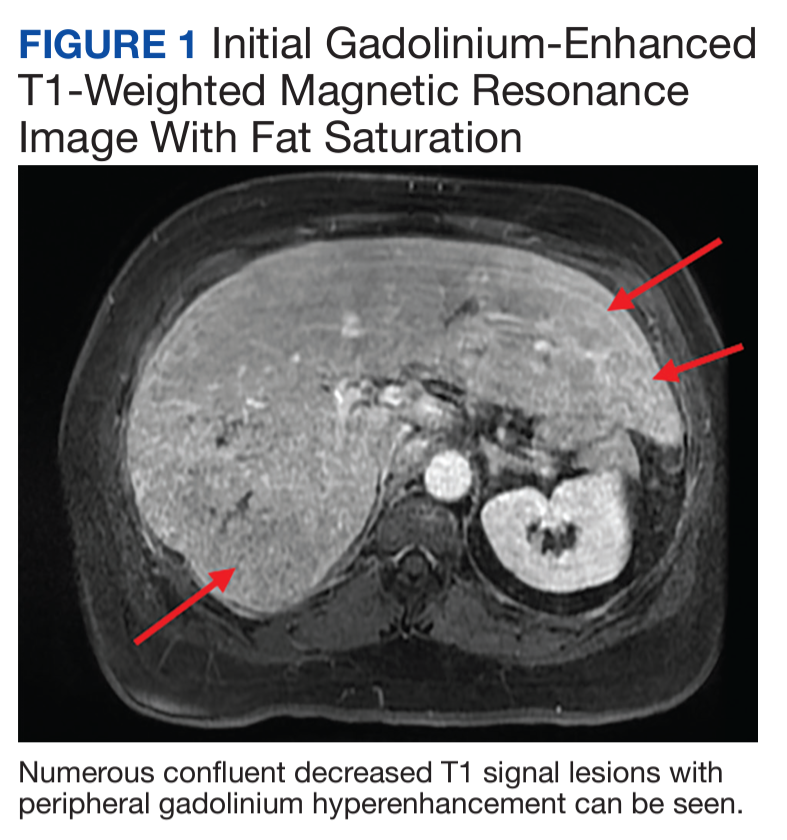
Chest X-ray did not reveal any acute cardiopulmonary process. Computed tomography with contrast of the abdomen and pelvis demonstrated numerous hypodensities within the right hepatic lobe. Right upper-quadrant ultrasound demonstrated multiple hyperechoic foci throughout the liver. confluent decreased T1 signal lesions with peripheral gadolinium hyperenhancement were evident on Gadolinium-enhanced T1-weighted magnetic resonance imaging (MRI) with fat saturation demonstrated numerous (Figure 1).
Liver biopsy and tissue cultures demonstrated normal hepatic tissue and no organism growth. Blood cultures demonstrated no growth. The patient was empirically treated with IV ceftriaxone 1 g daily and metronidazole 500 mg every 8 hours for suspected hepatic abscesses after he was admitted to the hospital.
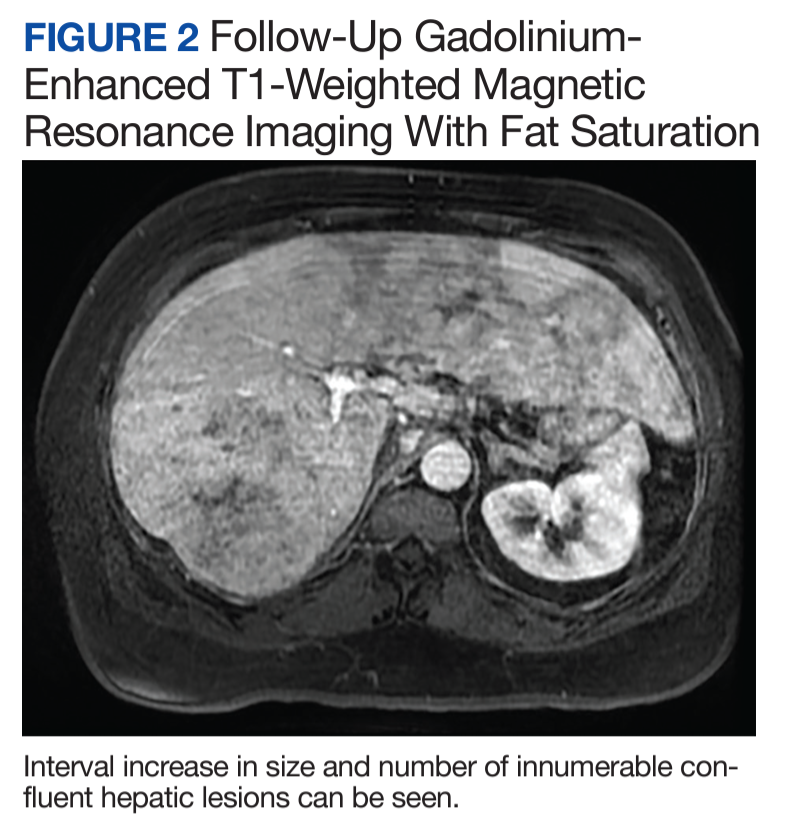
The patient’s symptoms initially improved following antibiotic treatment; however, he reported recurrence of the initial symptoms2 months later at a follow-up appointment with gastroenterology. Liver-associated enzymes also remained elevated despite 4 weeks of antibiotic treatment. Repeat gadolinium-enhanced T1 fat-saturated MRI demonstrated an interval increase in size and number of confluent hepatic lesions throughout the liver (Figure 2).
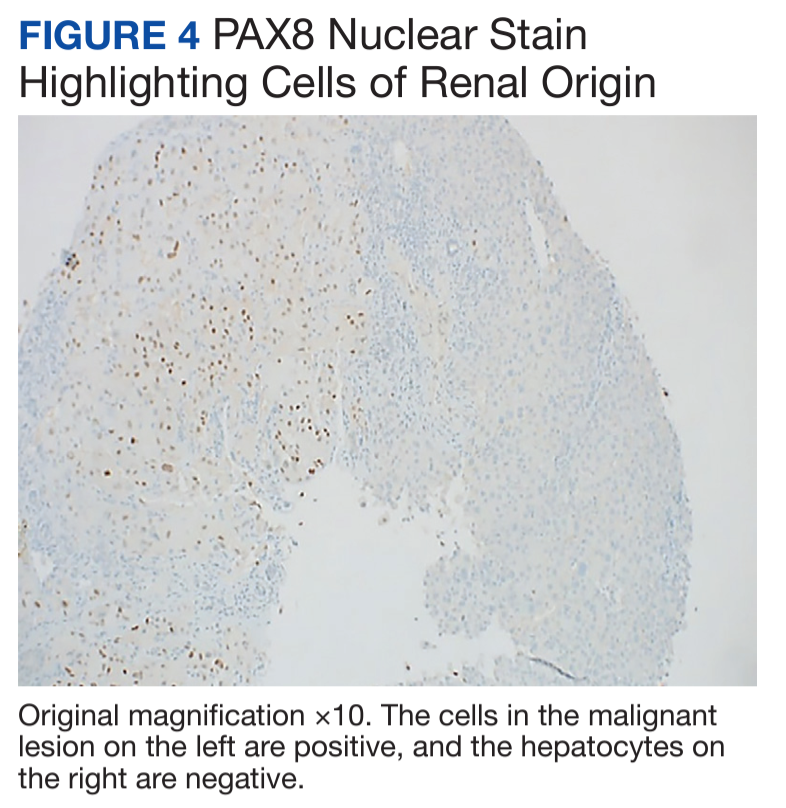
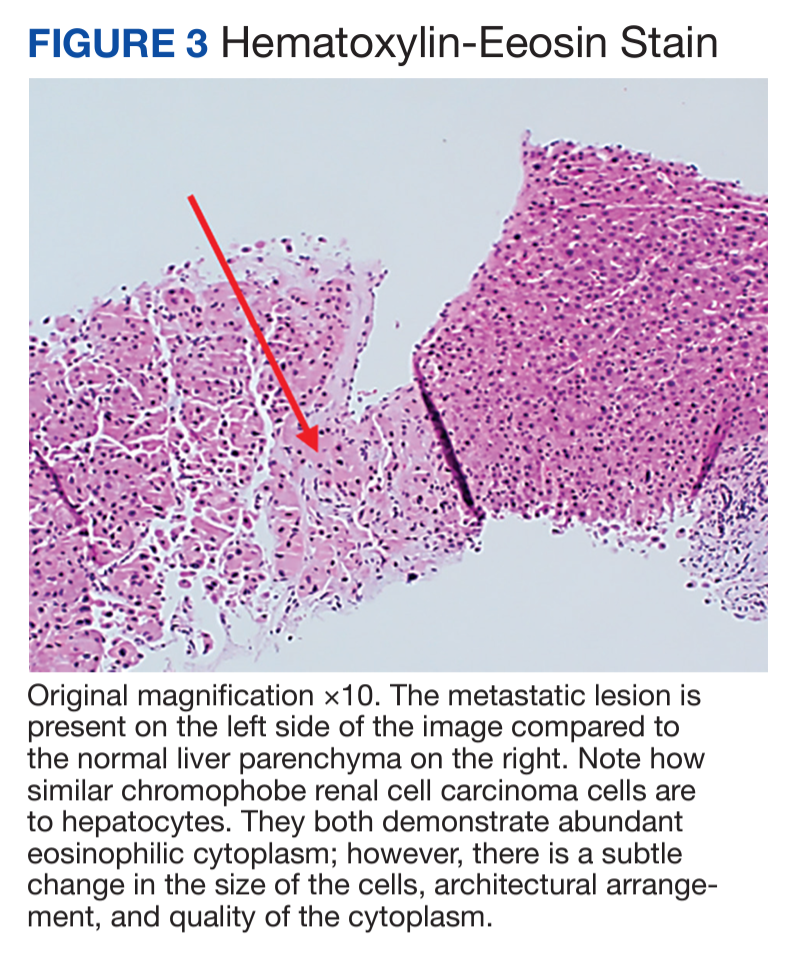
A repeat liver biopsy revealed metastatic chRCC (Figures 3 and 4) that was both morphologically and immunohistochemically similar to the first pathologic diagnosis made following nephrectomy. The first liver biopsy likely did not sample the metastatic lesions that were present but instead sampled the surrounding normal liver. The patient was initiated on lenvatinib and everolimus therapy with oncology, a recommended regimen per the National Comprehensive Cancer Network for patients with nonclear cell RCC.1
DISCUSSION
Chromophobe RCC is a rare form of RCC that has a recurrence-free survival of > 80% when treated in early stages.2 These neoplasms represent only 3000 to 6000 new cases of RCC annually, with an even lower incidence (6% to 7%) resulting in metastatic disease. The liver is the most common site of metastases (39%).2 Previously reported metastatic chRCC hepatic lesions have been incidentally noted on imaging with asymptomatic clinical presentations. In contrast to our patient, most documented cases report metastatic chRCC as a solitary hepatic lesion.3-7
A noteworthy genetic association with ChRCC is the Birt-Hogg-Dubé syndrome, which is an autosomal-dominant genetic disorder that results from germline mutations in the tumor suppressor folliculin gene located on chromosome 17.8 This syndrome is characterized by the development of various benign and malignant tumors, particularly chRCC. Our patient appeared to have a sporadic chRCC with the absence of other tumors and negative family history for malignancies. On his initial staging imaging, in accordance with National Comprehensive Cancer Network guidelines, our patient was identified only as having a 10-cm right renal mass and 1 benign regional lymph node with an otherwise unremarkable computed tomography of the chest, abdomen and pelvis, corresponding to stage 2 cancer.
Common causes of hepatic abscesses, the other potential diagnosis of concern for the patient, were biliary infections, portal vein ascension from abdominal sources, arterial translocation due to bacteremia, and local invasion due to suppuration of adjacent tissue.9 Incidence for hepatic abscesses increases with comorbidities such as diabetes, cirrhosis, malignancy, immunosuppression, and malnutrition.10 Candida is also a common culprit when there are multiple, small abscesses, often in immunocompromised patients.11 Given the high mortality rates associated with hepatic abscesses, prompt treatment is imperative.10,12 Since the clinical signs and symptoms for hepatic abscesses are nonspecific (abdominal pain, fever, and malaise) and liver function tests can vary, the diagnosis primarily relies on imaging or tissue sampling.9
It can be difficult to distinguish abscesses from metastatic lesions based on imaging alone without microbiologic and pathologic confirmation.11,13,14 There are certain radiologic characteristics that have been found to favor abscesses over metastasis, including parenchymal enhancement, arterial rim enhancement, and perilesional hyperemia.15 However, previously described hallmark characteristics of hepatic abscesses, such as the “cluster sign” demonstrating early stages of abscess coalescence, have also been seen in some hepatic metastases.16
CONCLUSIONS
This patient highlights the presentation of a rare case of metastatic chRCC with multiple hepatic lesions. While often differentiated clinically, radiographically, or histologically, malignancy and abscess can be difficult to differentiate in a patient with fevers and leukocytosis with hepatic lesions.17 Early diagnosis of hepatic abscesses and initiation of antibiotic therapy are essential. In cases when it is challenging to characterize the hepatic lesions, repeated tissue sampling and imaging can help direct therapy. Attention should be paid to a previous history of malignancy and should raise suspicion for metastatic disease, particularly with misleading imaging studies and tissue samples.
Acknowledgments
This case was presented as a poster presentation at the Tri-Service American College of Physicians Meeting, September 7-10, 2022, San Antonio, Texas.
1. National Comprehensive Cancer Network. Kidney cancer (version 2.2024). Accessed February 5, 2024. https://www.nccn.org/professionals/physician_gls/pdf/kidney.pdf
2. Vera-Badillo FE, Conde E, Duran I. Chromophobe renal cell carcinoma: a review of an uncommon entity. Int J Urol. 2012;19(10):894-900.doi:10.1111/j.1442-2042.2012.03079.x
3. Lordan JT, Fawcett WJ, Karanjia ND. Solitary liver metastasis of chromophobe renal cell carcinoma 20 years after nephrectomy treated by hepatic resection. Urology. 2008;72(1):230.e5-6. doi:10.1016/j.urology.2007.11.134
4. Talarico F, Buli P, Iusco D, Sangiorgi A, Jovine E. Synchronous nephrectomy and right hepatectomy for metastatic chromophobe renal cell carcinoma: report of a case and review of the literature. Chir Ital. 2007;59(2):257-261.
5. Aslam MI, Spencer L, Garcea G, et al. A case of liver metastasis from an oncocytoma with a focal area of chromophobe renal cell carcinoma: a wolf in sheep’s clothing. Int J Surg Pathol. 2008;17(2):158-162. doi:10.1177/1066896908318741
6. Kyoda Y, Kobayashi K, Takahashi A, et al. Liver metastasis with portal vein tumor thrombosis as a late recurrence of chromophobe renal cell carcinoma. Article in Japanese. Hinyokika Kiyo. 2009;55(1):23-25.
7. Talarico F, Capizzi D, Iusco DR. Solitary liver metastasis of chromophobe renal cell carcinoma 17 years after nephrectomy. a case report and review of the literature. Ann Ital Chir. 2013;84(ePub):S2239253X13021816.
8. Garje R, Elhag D, Yasin HA, Acharya L, Vaena D, Dahmoush L. Comprehensive review of chromophobe renal cell carcinoma. Crit Rev Oncol Hematol. 2021;160:103287. doi:10.1016/j.critrevonc.2021.103287
9. Pearl R, Pancu D, Legome E. Hepatic abscess. J Emerg Med. 2005;28:337-339.doi:10.1016/j.jemermed.2004.08.024
10. Huang CJ, Pitt HA, Lipsett PA, et al. Pyogenic hepatic abscess. Changing trends over 42 years. Ann Surg. 1996;223(5):600-607; discussion 607-609.
11. Özgül E. Multiple pyogenic liver abscesses mimicking metastatic disease on computed tomography. Cureus. 2020;12(2):e7050. doi:10.7759/cureus.7050
12. Kuo SH, Lee YT, Li CR, et al. Mortality in Emergency Department Sepsis score as a prognostic indicator in patients with pyogenic liver abscess. Am J Emerg Med. 201331(6):916-921.
13. Lardière-Deguelte S, Ragot E, Amroun K, et al. Hepatic abscess: diagnosis and management. J Visc Surg. 2015;152(4):231-243. doi:10.1016/j.jviscsurg.2015.01.013
14. Halvorsen RA, Korobkin M, Foster WL, Silverman PM, Thompson WM. The variable CT appearance of hepatic abscesses. AJR Am J Roentgenol. 1984;142(5):941-946. doi:10.2214/ajr.142.5.941
15. Oh JG, Choi SY, Lee MH, et al. Differentiation of hepatic abscess from metastasis on contrast-enhanced dynamic computed tomography in patients with a history of extrahepatic malignancy: emphasis on dynamic change of arterial rim enhancement. Abdom Radiol (NY). 2019;44(2):529-538.
16. Jeffrey RB Jr, Tolentino CS, Chang FC, Federle MP. CT of small pyogenic hepatic abscesses: the cluster sign. AJR Am J Roentgenol. 1988;151(3):487-489. doi:10.2214/ajr.151.3.487
17. Mavilia MG, Molina M, Wu GY. The evolving nature of hepatic abscess: a review. J Clin Transl Hepatol. 2016;4(2):158-168. doi:10.14218/JCTH.2016.00004
Finding new liver lesions on imaging during a febrile illness may indicate hepatic abscesses or malignancy. These can be difficult to diagnose with imaging alone. Differentiating between infectious and neoplastic etiologies may require additional images and/or tissue samples.
Hepatic abscesses are more commonly seen with other abdominal or biliary infections while metastatic disease usually presents in patients with active cancer or on surveillance imaging. While renal cell carcinoma (RCC) is the most common malignant neoplasm of the kidney, chromophobe renal cell carcinoma (chRCC) is a rare subtype that comprises only 5% of RCC cases.1 We present a case of a patient with numerous new liver lesions and fever, initially thought to be hepatic abscesses, who was found to have metastatic chRCC.
CASE PRESENTATION
A 53 year-old male with a history of stage 2 chRCC and right radical nephrectomy 2 years prior presented to the emergency department following 1 week of drenching night sweats, fatigue, and subjective fevers. In addition, the patient reported gradually progressive, dull, right upper-quadrant abdominal pain. He noted no other acute medical complaints at the time of presentation. His history was notable for hyperlipidemia. His only surgery was the nephrectomy 2 years earlier. The patient reported no alcohol, tobacco, or drug use, any recent travel, or pet or animal exposure. On admission, he was afebrile with normal heart rate and was normotensive. His physical examination was remarkable for hepatomegaly with right upper-quadrant abdominal tenderness to palpation with a negative Murphy sign. There were otherwise no abnormal cardiovascular, respiratory, or skin findings.
Laboratory tests during initial evaluation were notable for hemoglobin of 10.0 g/dL, white blood cell count of 16.7×10³ μL, alkaline phosphatase of 213 U/L, aspartate aminotransferase of 185 U/L, and alanine aminotransferase of 36 U/L. Screening tests for viral hepatitis A, B, and C were negative. Additional tests for HIV, rapid plasma reagin, Epstein-Barr virus, cytomegalovirus, and toxoplasma were negative. Tests for antimitochondrial, antismooth muscle, and serum antinuclear antibodies were negative.
Chest X-ray did not reveal any acute cardiopulmonary process. Computed tomography with contrast of the abdomen and pelvis demonstrated numerous hypodensities within the right hepatic lobe. Right upper-quadrant ultrasound demonstrated multiple hyperechoic foci throughout the liver. confluent decreased T1 signal lesions with peripheral gadolinium hyperenhancement were evident on Gadolinium-enhanced T1-weighted magnetic resonance imaging (MRI) with fat saturation demonstrated numerous (Figure 1).
Liver biopsy and tissue cultures demonstrated normal hepatic tissue and no organism growth. Blood cultures demonstrated no growth. The patient was empirically treated with IV ceftriaxone 1 g daily and metronidazole 500 mg every 8 hours for suspected hepatic abscesses after he was admitted to the hospital.
The patient’s symptoms initially improved following antibiotic treatment; however, he reported recurrence of the initial symptoms2 months later at a follow-up appointment with gastroenterology. Liver-associated enzymes also remained elevated despite 4 weeks of antibiotic treatment. Repeat gadolinium-enhanced T1 fat-saturated MRI demonstrated an interval increase in size and number of confluent hepatic lesions throughout the liver (Figure 2).
A repeat liver biopsy revealed metastatic chRCC (Figures 3 and 4) that was both morphologically and immunohistochemically similar to the first pathologic diagnosis made following nephrectomy. The first liver biopsy likely did not sample the metastatic lesions that were present but instead sampled the surrounding normal liver. The patient was initiated on lenvatinib and everolimus therapy with oncology, a recommended regimen per the National Comprehensive Cancer Network for patients with nonclear cell RCC.1
DISCUSSION
Chromophobe RCC is a rare form of RCC that has a recurrence-free survival of > 80% when treated in early stages.2 These neoplasms represent only 3000 to 6000 new cases of RCC annually, with an even lower incidence (6% to 7%) resulting in metastatic disease. The liver is the most common site of metastases (39%).2 Previously reported metastatic chRCC hepatic lesions have been incidentally noted on imaging with asymptomatic clinical presentations. In contrast to our patient, most documented cases report metastatic chRCC as a solitary hepatic lesion.3-7
A noteworthy genetic association with ChRCC is the Birt-Hogg-Dubé syndrome, which is an autosomal-dominant genetic disorder that results from germline mutations in the tumor suppressor folliculin gene located on chromosome 17.8 This syndrome is characterized by the development of various benign and malignant tumors, particularly chRCC. Our patient appeared to have a sporadic chRCC with the absence of other tumors and negative family history for malignancies. On his initial staging imaging, in accordance with National Comprehensive Cancer Network guidelines, our patient was identified only as having a 10-cm right renal mass and 1 benign regional lymph node with an otherwise unremarkable computed tomography of the chest, abdomen and pelvis, corresponding to stage 2 cancer.
Common causes of hepatic abscesses, the other potential diagnosis of concern for the patient, were biliary infections, portal vein ascension from abdominal sources, arterial translocation due to bacteremia, and local invasion due to suppuration of adjacent tissue.9 Incidence for hepatic abscesses increases with comorbidities such as diabetes, cirrhosis, malignancy, immunosuppression, and malnutrition.10 Candida is also a common culprit when there are multiple, small abscesses, often in immunocompromised patients.11 Given the high mortality rates associated with hepatic abscesses, prompt treatment is imperative.10,12 Since the clinical signs and symptoms for hepatic abscesses are nonspecific (abdominal pain, fever, and malaise) and liver function tests can vary, the diagnosis primarily relies on imaging or tissue sampling.9
It can be difficult to distinguish abscesses from metastatic lesions based on imaging alone without microbiologic and pathologic confirmation.11,13,14 There are certain radiologic characteristics that have been found to favor abscesses over metastasis, including parenchymal enhancement, arterial rim enhancement, and perilesional hyperemia.15 However, previously described hallmark characteristics of hepatic abscesses, such as the “cluster sign” demonstrating early stages of abscess coalescence, have also been seen in some hepatic metastases.16
CONCLUSIONS
This patient highlights the presentation of a rare case of metastatic chRCC with multiple hepatic lesions. While often differentiated clinically, radiographically, or histologically, malignancy and abscess can be difficult to differentiate in a patient with fevers and leukocytosis with hepatic lesions.17 Early diagnosis of hepatic abscesses and initiation of antibiotic therapy are essential. In cases when it is challenging to characterize the hepatic lesions, repeated tissue sampling and imaging can help direct therapy. Attention should be paid to a previous history of malignancy and should raise suspicion for metastatic disease, particularly with misleading imaging studies and tissue samples.
Acknowledgments
This case was presented as a poster presentation at the Tri-Service American College of Physicians Meeting, September 7-10, 2022, San Antonio, Texas.
Finding new liver lesions on imaging during a febrile illness may indicate hepatic abscesses or malignancy. These can be difficult to diagnose with imaging alone. Differentiating between infectious and neoplastic etiologies may require additional images and/or tissue samples.
Hepatic abscesses are more commonly seen with other abdominal or biliary infections while metastatic disease usually presents in patients with active cancer or on surveillance imaging. While renal cell carcinoma (RCC) is the most common malignant neoplasm of the kidney, chromophobe renal cell carcinoma (chRCC) is a rare subtype that comprises only 5% of RCC cases.1 We present a case of a patient with numerous new liver lesions and fever, initially thought to be hepatic abscesses, who was found to have metastatic chRCC.
CASE PRESENTATION
A 53 year-old male with a history of stage 2 chRCC and right radical nephrectomy 2 years prior presented to the emergency department following 1 week of drenching night sweats, fatigue, and subjective fevers. In addition, the patient reported gradually progressive, dull, right upper-quadrant abdominal pain. He noted no other acute medical complaints at the time of presentation. His history was notable for hyperlipidemia. His only surgery was the nephrectomy 2 years earlier. The patient reported no alcohol, tobacco, or drug use, any recent travel, or pet or animal exposure. On admission, he was afebrile with normal heart rate and was normotensive. His physical examination was remarkable for hepatomegaly with right upper-quadrant abdominal tenderness to palpation with a negative Murphy sign. There were otherwise no abnormal cardiovascular, respiratory, or skin findings.
Laboratory tests during initial evaluation were notable for hemoglobin of 10.0 g/dL, white blood cell count of 16.7×10³ μL, alkaline phosphatase of 213 U/L, aspartate aminotransferase of 185 U/L, and alanine aminotransferase of 36 U/L. Screening tests for viral hepatitis A, B, and C were negative. Additional tests for HIV, rapid plasma reagin, Epstein-Barr virus, cytomegalovirus, and toxoplasma were negative. Tests for antimitochondrial, antismooth muscle, and serum antinuclear antibodies were negative.
Chest X-ray did not reveal any acute cardiopulmonary process. Computed tomography with contrast of the abdomen and pelvis demonstrated numerous hypodensities within the right hepatic lobe. Right upper-quadrant ultrasound demonstrated multiple hyperechoic foci throughout the liver. confluent decreased T1 signal lesions with peripheral gadolinium hyperenhancement were evident on Gadolinium-enhanced T1-weighted magnetic resonance imaging (MRI) with fat saturation demonstrated numerous (Figure 1).
Liver biopsy and tissue cultures demonstrated normal hepatic tissue and no organism growth. Blood cultures demonstrated no growth. The patient was empirically treated with IV ceftriaxone 1 g daily and metronidazole 500 mg every 8 hours for suspected hepatic abscesses after he was admitted to the hospital.
The patient’s symptoms initially improved following antibiotic treatment; however, he reported recurrence of the initial symptoms2 months later at a follow-up appointment with gastroenterology. Liver-associated enzymes also remained elevated despite 4 weeks of antibiotic treatment. Repeat gadolinium-enhanced T1 fat-saturated MRI demonstrated an interval increase in size and number of confluent hepatic lesions throughout the liver (Figure 2).
A repeat liver biopsy revealed metastatic chRCC (Figures 3 and 4) that was both morphologically and immunohistochemically similar to the first pathologic diagnosis made following nephrectomy. The first liver biopsy likely did not sample the metastatic lesions that were present but instead sampled the surrounding normal liver. The patient was initiated on lenvatinib and everolimus therapy with oncology, a recommended regimen per the National Comprehensive Cancer Network for patients with nonclear cell RCC.1
DISCUSSION
Chromophobe RCC is a rare form of RCC that has a recurrence-free survival of > 80% when treated in early stages.2 These neoplasms represent only 3000 to 6000 new cases of RCC annually, with an even lower incidence (6% to 7%) resulting in metastatic disease. The liver is the most common site of metastases (39%).2 Previously reported metastatic chRCC hepatic lesions have been incidentally noted on imaging with asymptomatic clinical presentations. In contrast to our patient, most documented cases report metastatic chRCC as a solitary hepatic lesion.3-7
A noteworthy genetic association with ChRCC is the Birt-Hogg-Dubé syndrome, which is an autosomal-dominant genetic disorder that results from germline mutations in the tumor suppressor folliculin gene located on chromosome 17.8 This syndrome is characterized by the development of various benign and malignant tumors, particularly chRCC. Our patient appeared to have a sporadic chRCC with the absence of other tumors and negative family history for malignancies. On his initial staging imaging, in accordance with National Comprehensive Cancer Network guidelines, our patient was identified only as having a 10-cm right renal mass and 1 benign regional lymph node with an otherwise unremarkable computed tomography of the chest, abdomen and pelvis, corresponding to stage 2 cancer.
Common causes of hepatic abscesses, the other potential diagnosis of concern for the patient, were biliary infections, portal vein ascension from abdominal sources, arterial translocation due to bacteremia, and local invasion due to suppuration of adjacent tissue.9 Incidence for hepatic abscesses increases with comorbidities such as diabetes, cirrhosis, malignancy, immunosuppression, and malnutrition.10 Candida is also a common culprit when there are multiple, small abscesses, often in immunocompromised patients.11 Given the high mortality rates associated with hepatic abscesses, prompt treatment is imperative.10,12 Since the clinical signs and symptoms for hepatic abscesses are nonspecific (abdominal pain, fever, and malaise) and liver function tests can vary, the diagnosis primarily relies on imaging or tissue sampling.9
It can be difficult to distinguish abscesses from metastatic lesions based on imaging alone without microbiologic and pathologic confirmation.11,13,14 There are certain radiologic characteristics that have been found to favor abscesses over metastasis, including parenchymal enhancement, arterial rim enhancement, and perilesional hyperemia.15 However, previously described hallmark characteristics of hepatic abscesses, such as the “cluster sign” demonstrating early stages of abscess coalescence, have also been seen in some hepatic metastases.16
CONCLUSIONS
This patient highlights the presentation of a rare case of metastatic chRCC with multiple hepatic lesions. While often differentiated clinically, radiographically, or histologically, malignancy and abscess can be difficult to differentiate in a patient with fevers and leukocytosis with hepatic lesions.17 Early diagnosis of hepatic abscesses and initiation of antibiotic therapy are essential. In cases when it is challenging to characterize the hepatic lesions, repeated tissue sampling and imaging can help direct therapy. Attention should be paid to a previous history of malignancy and should raise suspicion for metastatic disease, particularly with misleading imaging studies and tissue samples.
Acknowledgments
This case was presented as a poster presentation at the Tri-Service American College of Physicians Meeting, September 7-10, 2022, San Antonio, Texas.
1. National Comprehensive Cancer Network. Kidney cancer (version 2.2024). Accessed February 5, 2024. https://www.nccn.org/professionals/physician_gls/pdf/kidney.pdf
2. Vera-Badillo FE, Conde E, Duran I. Chromophobe renal cell carcinoma: a review of an uncommon entity. Int J Urol. 2012;19(10):894-900.doi:10.1111/j.1442-2042.2012.03079.x
3. Lordan JT, Fawcett WJ, Karanjia ND. Solitary liver metastasis of chromophobe renal cell carcinoma 20 years after nephrectomy treated by hepatic resection. Urology. 2008;72(1):230.e5-6. doi:10.1016/j.urology.2007.11.134
4. Talarico F, Buli P, Iusco D, Sangiorgi A, Jovine E. Synchronous nephrectomy and right hepatectomy for metastatic chromophobe renal cell carcinoma: report of a case and review of the literature. Chir Ital. 2007;59(2):257-261.
5. Aslam MI, Spencer L, Garcea G, et al. A case of liver metastasis from an oncocytoma with a focal area of chromophobe renal cell carcinoma: a wolf in sheep’s clothing. Int J Surg Pathol. 2008;17(2):158-162. doi:10.1177/1066896908318741
6. Kyoda Y, Kobayashi K, Takahashi A, et al. Liver metastasis with portal vein tumor thrombosis as a late recurrence of chromophobe renal cell carcinoma. Article in Japanese. Hinyokika Kiyo. 2009;55(1):23-25.
7. Talarico F, Capizzi D, Iusco DR. Solitary liver metastasis of chromophobe renal cell carcinoma 17 years after nephrectomy. a case report and review of the literature. Ann Ital Chir. 2013;84(ePub):S2239253X13021816.
8. Garje R, Elhag D, Yasin HA, Acharya L, Vaena D, Dahmoush L. Comprehensive review of chromophobe renal cell carcinoma. Crit Rev Oncol Hematol. 2021;160:103287. doi:10.1016/j.critrevonc.2021.103287
9. Pearl R, Pancu D, Legome E. Hepatic abscess. J Emerg Med. 2005;28:337-339.doi:10.1016/j.jemermed.2004.08.024
10. Huang CJ, Pitt HA, Lipsett PA, et al. Pyogenic hepatic abscess. Changing trends over 42 years. Ann Surg. 1996;223(5):600-607; discussion 607-609.
11. Özgül E. Multiple pyogenic liver abscesses mimicking metastatic disease on computed tomography. Cureus. 2020;12(2):e7050. doi:10.7759/cureus.7050
12. Kuo SH, Lee YT, Li CR, et al. Mortality in Emergency Department Sepsis score as a prognostic indicator in patients with pyogenic liver abscess. Am J Emerg Med. 201331(6):916-921.
13. Lardière-Deguelte S, Ragot E, Amroun K, et al. Hepatic abscess: diagnosis and management. J Visc Surg. 2015;152(4):231-243. doi:10.1016/j.jviscsurg.2015.01.013
14. Halvorsen RA, Korobkin M, Foster WL, Silverman PM, Thompson WM. The variable CT appearance of hepatic abscesses. AJR Am J Roentgenol. 1984;142(5):941-946. doi:10.2214/ajr.142.5.941
15. Oh JG, Choi SY, Lee MH, et al. Differentiation of hepatic abscess from metastasis on contrast-enhanced dynamic computed tomography in patients with a history of extrahepatic malignancy: emphasis on dynamic change of arterial rim enhancement. Abdom Radiol (NY). 2019;44(2):529-538.
16. Jeffrey RB Jr, Tolentino CS, Chang FC, Federle MP. CT of small pyogenic hepatic abscesses: the cluster sign. AJR Am J Roentgenol. 1988;151(3):487-489. doi:10.2214/ajr.151.3.487
17. Mavilia MG, Molina M, Wu GY. The evolving nature of hepatic abscess: a review. J Clin Transl Hepatol. 2016;4(2):158-168. doi:10.14218/JCTH.2016.00004
1. National Comprehensive Cancer Network. Kidney cancer (version 2.2024). Accessed February 5, 2024. https://www.nccn.org/professionals/physician_gls/pdf/kidney.pdf
2. Vera-Badillo FE, Conde E, Duran I. Chromophobe renal cell carcinoma: a review of an uncommon entity. Int J Urol. 2012;19(10):894-900.doi:10.1111/j.1442-2042.2012.03079.x
3. Lordan JT, Fawcett WJ, Karanjia ND. Solitary liver metastasis of chromophobe renal cell carcinoma 20 years after nephrectomy treated by hepatic resection. Urology. 2008;72(1):230.e5-6. doi:10.1016/j.urology.2007.11.134
4. Talarico F, Buli P, Iusco D, Sangiorgi A, Jovine E. Synchronous nephrectomy and right hepatectomy for metastatic chromophobe renal cell carcinoma: report of a case and review of the literature. Chir Ital. 2007;59(2):257-261.
5. Aslam MI, Spencer L, Garcea G, et al. A case of liver metastasis from an oncocytoma with a focal area of chromophobe renal cell carcinoma: a wolf in sheep’s clothing. Int J Surg Pathol. 2008;17(2):158-162. doi:10.1177/1066896908318741
6. Kyoda Y, Kobayashi K, Takahashi A, et al. Liver metastasis with portal vein tumor thrombosis as a late recurrence of chromophobe renal cell carcinoma. Article in Japanese. Hinyokika Kiyo. 2009;55(1):23-25.
7. Talarico F, Capizzi D, Iusco DR. Solitary liver metastasis of chromophobe renal cell carcinoma 17 years after nephrectomy. a case report and review of the literature. Ann Ital Chir. 2013;84(ePub):S2239253X13021816.
8. Garje R, Elhag D, Yasin HA, Acharya L, Vaena D, Dahmoush L. Comprehensive review of chromophobe renal cell carcinoma. Crit Rev Oncol Hematol. 2021;160:103287. doi:10.1016/j.critrevonc.2021.103287
9. Pearl R, Pancu D, Legome E. Hepatic abscess. J Emerg Med. 2005;28:337-339.doi:10.1016/j.jemermed.2004.08.024
10. Huang CJ, Pitt HA, Lipsett PA, et al. Pyogenic hepatic abscess. Changing trends over 42 years. Ann Surg. 1996;223(5):600-607; discussion 607-609.
11. Özgül E. Multiple pyogenic liver abscesses mimicking metastatic disease on computed tomography. Cureus. 2020;12(2):e7050. doi:10.7759/cureus.7050
12. Kuo SH, Lee YT, Li CR, et al. Mortality in Emergency Department Sepsis score as a prognostic indicator in patients with pyogenic liver abscess. Am J Emerg Med. 201331(6):916-921.
13. Lardière-Deguelte S, Ragot E, Amroun K, et al. Hepatic abscess: diagnosis and management. J Visc Surg. 2015;152(4):231-243. doi:10.1016/j.jviscsurg.2015.01.013
14. Halvorsen RA, Korobkin M, Foster WL, Silverman PM, Thompson WM. The variable CT appearance of hepatic abscesses. AJR Am J Roentgenol. 1984;142(5):941-946. doi:10.2214/ajr.142.5.941
15. Oh JG, Choi SY, Lee MH, et al. Differentiation of hepatic abscess from metastasis on contrast-enhanced dynamic computed tomography in patients with a history of extrahepatic malignancy: emphasis on dynamic change of arterial rim enhancement. Abdom Radiol (NY). 2019;44(2):529-538.
16. Jeffrey RB Jr, Tolentino CS, Chang FC, Federle MP. CT of small pyogenic hepatic abscesses: the cluster sign. AJR Am J Roentgenol. 1988;151(3):487-489. doi:10.2214/ajr.151.3.487
17. Mavilia MG, Molina M, Wu GY. The evolving nature of hepatic abscess: a review. J Clin Transl Hepatol. 2016;4(2):158-168. doi:10.14218/JCTH.2016.00004
Is Primary Tumor Resection Beneficial in Stage IV CRC?
TOPLINE:
not amenable to curative therapy, new data showed.
METHODOLOGY:
- Chemotherapy is the primary treatment in patients with stage IV (CRC) and unresectable metastases. It’s unclear whether primary tumor resection before chemotherapy prolongs survival.
- Among 393 patients with stage IV colon cancer and unresectable metastases enrolled in the and trials, 187 were randomly allocated to undergo primary tumor resection and 206 to upfront chemotherapy.
- The chemotherapy regimen was left up to the treating physician. Overall survival was the primary endpoint. Median follow-up time was 36.7 months.
TAKEAWAY:
- Median overall survival was 16.7 months with primary tumor resection and 18.6 months with upfront chemotherapy (P = .191).
- Comparable overall survival between the study groups was further confirmed on multivariate analysis (hazard ratio, 0.944; P = .65) and across all subgroups.
- Serious adverse events were more common with upfront chemo than surgery (18% vs 10%; P = .027), due mainly to a significantly higher incidence of GI-related events (11% vs 5%; P = .031).
- Overall, 24% of the primary tumor resection group did not receive any chemotherapy.
IN PRACTICE:
“The results of our study provide compelling data that upfront primary tumor resection in treatment-naive stage IV CRC not amenable for curative treatment does not prolong [overall survival]. A relatively low incidence of serious adverse events in patients with an intact primary tumor together with a considerable number of patients who did not receive any chemotherapy in the primary tumor resection group provides further arguments against resection of the primary tumor in this group of patients,” the authors of the combined analysis concluded.
SOURCE:
The study, with first author Nuh N. Rahbari, MD, University of Ulm, Ulm, Germany, was published online in the Journal of Clinical Oncology.
LIMITATIONS:
Neither study completed their planned patient accrual. Although both trials are nearly identical, differences in the individual study cohorts and trial implementation could have introduced bias. Tumor molecular profiling was not performed.
DISCLOSURES:
The study had no commercial funding. Disclosures for authors are available with the original article.
A version of this article appeared on Medscape.com.
TOPLINE:
not amenable to curative therapy, new data showed.
METHODOLOGY:
- Chemotherapy is the primary treatment in patients with stage IV (CRC) and unresectable metastases. It’s unclear whether primary tumor resection before chemotherapy prolongs survival.
- Among 393 patients with stage IV colon cancer and unresectable metastases enrolled in the and trials, 187 were randomly allocated to undergo primary tumor resection and 206 to upfront chemotherapy.
- The chemotherapy regimen was left up to the treating physician. Overall survival was the primary endpoint. Median follow-up time was 36.7 months.
TAKEAWAY:
- Median overall survival was 16.7 months with primary tumor resection and 18.6 months with upfront chemotherapy (P = .191).
- Comparable overall survival between the study groups was further confirmed on multivariate analysis (hazard ratio, 0.944; P = .65) and across all subgroups.
- Serious adverse events were more common with upfront chemo than surgery (18% vs 10%; P = .027), due mainly to a significantly higher incidence of GI-related events (11% vs 5%; P = .031).
- Overall, 24% of the primary tumor resection group did not receive any chemotherapy.
IN PRACTICE:
“The results of our study provide compelling data that upfront primary tumor resection in treatment-naive stage IV CRC not amenable for curative treatment does not prolong [overall survival]. A relatively low incidence of serious adverse events in patients with an intact primary tumor together with a considerable number of patients who did not receive any chemotherapy in the primary tumor resection group provides further arguments against resection of the primary tumor in this group of patients,” the authors of the combined analysis concluded.
SOURCE:
The study, with first author Nuh N. Rahbari, MD, University of Ulm, Ulm, Germany, was published online in the Journal of Clinical Oncology.
LIMITATIONS:
Neither study completed their planned patient accrual. Although both trials are nearly identical, differences in the individual study cohorts and trial implementation could have introduced bias. Tumor molecular profiling was not performed.
DISCLOSURES:
The study had no commercial funding. Disclosures for authors are available with the original article.
A version of this article appeared on Medscape.com.
TOPLINE:
not amenable to curative therapy, new data showed.
METHODOLOGY:
- Chemotherapy is the primary treatment in patients with stage IV (CRC) and unresectable metastases. It’s unclear whether primary tumor resection before chemotherapy prolongs survival.
- Among 393 patients with stage IV colon cancer and unresectable metastases enrolled in the and trials, 187 were randomly allocated to undergo primary tumor resection and 206 to upfront chemotherapy.
- The chemotherapy regimen was left up to the treating physician. Overall survival was the primary endpoint. Median follow-up time was 36.7 months.
TAKEAWAY:
- Median overall survival was 16.7 months with primary tumor resection and 18.6 months with upfront chemotherapy (P = .191).
- Comparable overall survival between the study groups was further confirmed on multivariate analysis (hazard ratio, 0.944; P = .65) and across all subgroups.
- Serious adverse events were more common with upfront chemo than surgery (18% vs 10%; P = .027), due mainly to a significantly higher incidence of GI-related events (11% vs 5%; P = .031).
- Overall, 24% of the primary tumor resection group did not receive any chemotherapy.
IN PRACTICE:
“The results of our study provide compelling data that upfront primary tumor resection in treatment-naive stage IV CRC not amenable for curative treatment does not prolong [overall survival]. A relatively low incidence of serious adverse events in patients with an intact primary tumor together with a considerable number of patients who did not receive any chemotherapy in the primary tumor resection group provides further arguments against resection of the primary tumor in this group of patients,” the authors of the combined analysis concluded.
SOURCE:
The study, with first author Nuh N. Rahbari, MD, University of Ulm, Ulm, Germany, was published online in the Journal of Clinical Oncology.
LIMITATIONS:
Neither study completed their planned patient accrual. Although both trials are nearly identical, differences in the individual study cohorts and trial implementation could have introduced bias. Tumor molecular profiling was not performed.
DISCLOSURES:
The study had no commercial funding. Disclosures for authors are available with the original article.
A version of this article appeared on Medscape.com.
Can Changes to Chemo Regimens Improve Drug Tolerability in Older Patients?
TOPLINE:
Treatment modifications, such as dose reductions, schedule changes, or use of less toxic regimens, can improve how well older patients with advanced cancer and aging-related conditions tolerate chemotherapy regimens.
METHODOLOGY:
- Older patients are underrepresented in clinical trials, which means the reported risks associated with standard-of-care regimens typically reflect outcomes in younger, healthier patients. This underrepresentation in clinical trials has also led to uncertainties about the safety of standard chemotherapy regimens in older patients who often have other health conditions to manage, alongside cancer.
- In this secondary analysis, researchers evaluated the association between primary treatment modifications to standard-of-care chemotherapy regimens and treatment tolerability.
- The trial included 609 patients aged ≥ 70 years who had advanced cancer alongside at least one age-related condition, such as impaired cognition, and planned to start a new palliative chemotherapy regimen in the community oncology setting. The most common cancer types were gastrointestinal cancer (37.4%) and lung cancer (28.6%).
- The primary outcome was grade 3-5 adverse events within 3 months of chemotherapy initiation.
- Secondary outcomes included patient-reported functional decline and combined adverse outcomes, which incorporated clinician-rated toxic effects, patient-reported functional decline, and 6-month overall survival.
TAKEAWAY:
- Overall, 281 patients (46.1%) received a primary treatment modification, most often a dose reduction (71.9%) or a scheduling change (11.7%).
- Patients who received primary treatment modifications had a 15% lower risk for grades 3-5 adverse effects (relative risk [RR], 0.85) and a 20% lower risk for patient-reported functional decline (RR, 0.80) than those who received standard treatment.
- Patients receiving treatment modifications had 32% lower risk for a worse combined adverse outcome (odds ratio, 0.68).
- Cancer type may matter as well. When looking at outcomes by cancer type, patients with gastrointestinal cancers who received a primary treatment modification had a lower risk for toxic effects (RR, 0.82), whereas patients with lung cancer did not (RR, 1.03; 95% CI, 0.88-1.20).
IN PRACTICE:
These findings “can help oncologists to choose the optimal drug regimen, select a safe and effective initial dose, and undertake appropriate monitoring strategies to manage the clinical care of older people with advanced cancer,” the authors said.
SOURCE:
This study, led by Mostafa R. Mohamed from University of Rochester, New York, was published February 15 in JAMA Network Open.
LIMITATIONS:
Residual confounding may be present. Extremely healthy older patients may have been excluded due to study criteria, limiting generalizability. There may be variation in toxicities due to inclusion of patients with multiple heterogeneous cancer.
DISCLOSURES:
This work was supported by the National Cancer Institute and the University of Rochester, New York. The authors disclosed financial relationships outside this work.
A version of this article first appeared on Medscape.com.
TOPLINE:
Treatment modifications, such as dose reductions, schedule changes, or use of less toxic regimens, can improve how well older patients with advanced cancer and aging-related conditions tolerate chemotherapy regimens.
METHODOLOGY:
- Older patients are underrepresented in clinical trials, which means the reported risks associated with standard-of-care regimens typically reflect outcomes in younger, healthier patients. This underrepresentation in clinical trials has also led to uncertainties about the safety of standard chemotherapy regimens in older patients who often have other health conditions to manage, alongside cancer.
- In this secondary analysis, researchers evaluated the association between primary treatment modifications to standard-of-care chemotherapy regimens and treatment tolerability.
- The trial included 609 patients aged ≥ 70 years who had advanced cancer alongside at least one age-related condition, such as impaired cognition, and planned to start a new palliative chemotherapy regimen in the community oncology setting. The most common cancer types were gastrointestinal cancer (37.4%) and lung cancer (28.6%).
- The primary outcome was grade 3-5 adverse events within 3 months of chemotherapy initiation.
- Secondary outcomes included patient-reported functional decline and combined adverse outcomes, which incorporated clinician-rated toxic effects, patient-reported functional decline, and 6-month overall survival.
TAKEAWAY:
- Overall, 281 patients (46.1%) received a primary treatment modification, most often a dose reduction (71.9%) or a scheduling change (11.7%).
- Patients who received primary treatment modifications had a 15% lower risk for grades 3-5 adverse effects (relative risk [RR], 0.85) and a 20% lower risk for patient-reported functional decline (RR, 0.80) than those who received standard treatment.
- Patients receiving treatment modifications had 32% lower risk for a worse combined adverse outcome (odds ratio, 0.68).
- Cancer type may matter as well. When looking at outcomes by cancer type, patients with gastrointestinal cancers who received a primary treatment modification had a lower risk for toxic effects (RR, 0.82), whereas patients with lung cancer did not (RR, 1.03; 95% CI, 0.88-1.20).
IN PRACTICE:
These findings “can help oncologists to choose the optimal drug regimen, select a safe and effective initial dose, and undertake appropriate monitoring strategies to manage the clinical care of older people with advanced cancer,” the authors said.
SOURCE:
This study, led by Mostafa R. Mohamed from University of Rochester, New York, was published February 15 in JAMA Network Open.
LIMITATIONS:
Residual confounding may be present. Extremely healthy older patients may have been excluded due to study criteria, limiting generalizability. There may be variation in toxicities due to inclusion of patients with multiple heterogeneous cancer.
DISCLOSURES:
This work was supported by the National Cancer Institute and the University of Rochester, New York. The authors disclosed financial relationships outside this work.
A version of this article first appeared on Medscape.com.
TOPLINE:
Treatment modifications, such as dose reductions, schedule changes, or use of less toxic regimens, can improve how well older patients with advanced cancer and aging-related conditions tolerate chemotherapy regimens.
METHODOLOGY:
- Older patients are underrepresented in clinical trials, which means the reported risks associated with standard-of-care regimens typically reflect outcomes in younger, healthier patients. This underrepresentation in clinical trials has also led to uncertainties about the safety of standard chemotherapy regimens in older patients who often have other health conditions to manage, alongside cancer.
- In this secondary analysis, researchers evaluated the association between primary treatment modifications to standard-of-care chemotherapy regimens and treatment tolerability.
- The trial included 609 patients aged ≥ 70 years who had advanced cancer alongside at least one age-related condition, such as impaired cognition, and planned to start a new palliative chemotherapy regimen in the community oncology setting. The most common cancer types were gastrointestinal cancer (37.4%) and lung cancer (28.6%).
- The primary outcome was grade 3-5 adverse events within 3 months of chemotherapy initiation.
- Secondary outcomes included patient-reported functional decline and combined adverse outcomes, which incorporated clinician-rated toxic effects, patient-reported functional decline, and 6-month overall survival.
TAKEAWAY:
- Overall, 281 patients (46.1%) received a primary treatment modification, most often a dose reduction (71.9%) or a scheduling change (11.7%).
- Patients who received primary treatment modifications had a 15% lower risk for grades 3-5 adverse effects (relative risk [RR], 0.85) and a 20% lower risk for patient-reported functional decline (RR, 0.80) than those who received standard treatment.
- Patients receiving treatment modifications had 32% lower risk for a worse combined adverse outcome (odds ratio, 0.68).
- Cancer type may matter as well. When looking at outcomes by cancer type, patients with gastrointestinal cancers who received a primary treatment modification had a lower risk for toxic effects (RR, 0.82), whereas patients with lung cancer did not (RR, 1.03; 95% CI, 0.88-1.20).
IN PRACTICE:
These findings “can help oncologists to choose the optimal drug regimen, select a safe and effective initial dose, and undertake appropriate monitoring strategies to manage the clinical care of older people with advanced cancer,” the authors said.
SOURCE:
This study, led by Mostafa R. Mohamed from University of Rochester, New York, was published February 15 in JAMA Network Open.
LIMITATIONS:
Residual confounding may be present. Extremely healthy older patients may have been excluded due to study criteria, limiting generalizability. There may be variation in toxicities due to inclusion of patients with multiple heterogeneous cancer.
DISCLOSURES:
This work was supported by the National Cancer Institute and the University of Rochester, New York. The authors disclosed financial relationships outside this work.
A version of this article first appeared on Medscape.com.
Outside the Guidelines: Denosumab Overuse in Prostate Cancer
Bone-modifying agents — most notably denosumab — are often prescribed to prevent skeletal-related complications in patients with metastatic castration-sensitive prostate cancer, but the drugs are not recommended for this indication and can lead to severe toxicities.
How much does Medicare spend each year on non-recommended bone therapy?
The answer, according to a new analysis in JCO Oncology Practice, is more than $44 million, with about $43 million coming from denosumab alone.
Overall, this study found that “the Medicare program pays tens of millions of dollars each year” for bone-modifying agents in patients with metastatic castration-sensitive prostate cancer, “which is not effective and may cause side effects,” lead author Aaron Mitchell, MD, MPH, a medical oncologist at Memorial Sloan Kettering Cancer Center, New York City, and colleagues concluded.
“These findings suggest reducing bone agent overuse could be a rare healthcare ‘win-win.’ Lower costs AND improved patient outcomes,” tweeted Dr. Mitchell. “If I were a payer, I’d be paying attention!”
In Prostate Cancer, Bone-Modifying Drug Indications Vary
Bone-modifying drugs are indicated for some patients with prostate cancer.
The American Society of Clinical Oncology has endorsed guidelines that recommend the use of denosumab in men with nonmetastatic prostate cancer at high risk for fracture while taking androgen deprivation therapy.
Among men with metastatic castration-resistant prostate cancer, guidelines also recommend zoledronic acid or denosumab for preventing or delaying skeletal-related events, such as pathologic fractures and spinal cord compression.
For patients with metastatic castration-sensitive disease, however, the bone-modifying agents show no benefit in preventing skeletal-related events and are not recommended for that indication.
In this population, “treatment with bone agents results only in avoidable toxicity and financial cost,” Dr. Mitchell tweeted. In its higher-dose formulation, denosumab comes with a price tag of approximately $40,000 per year in the United States.
An earlier study from Dr. Mitchell and colleagues revealed that the use of bone-modifying drugs to prevent skeletal events in metastatic castration-sensitive prostate cancer is common.
To better understand the costs associated with this inappropriate use, the researchers reviewed Surveillance, Epidemiology, and End Results Program Medicare data from 2011 to 2015. The team identified the frequency and number of doses of zoledronic acid and denosumab prescribed against recommendations in the metastatic castration-sensitive setting, making sure to distinguish between the use of denosumab to prevent osteoporotic fractures (appropriate use) and to prevent skeletal-related events (non-recommended use).
The team found that, among 2627 patients with metastatic castration-sensitive prostate cancer, 42% received at least one dose of denosumab and 18% received at least one dose of zoledronic acid.
The authors also found that unnecessary use of these drugs increased over time — with a little over 17% of patients receiving zoledronic acid between 2007 and 2009 and just over 28% receiving either denosumab (20.3%) or zoledronic acid (8.4%) from 2012 to 2015.
The annual costs to Medicare from non-recommended prescribing came to $44,105,041 for both agents, with the costs associated with denosumab representing the lion’s share at $43,303,078.
Non-recommended use of these agents also came with adverse events, such as femur fracture and hypocalcemia, which cost an estimated $758,450 to treat annually — $682,865 for denosumab and $75,585 for zoledronic acid.
The study focused on the Medicare-age population, which means the estimates are conservative. “Denosumab overuse for younger patients with castration-sensitive prostate cancer would add substantially to this total,” the authors wrote.
“This study contributes new evidence of overuse in the metastatic castrate-sensitive prostate cancer setting, which I must admit reflects my clinical experience in seeing patients for second opinions who are treated in the community,” said Samuel U. Takvorian, MD, of the Division of Hematology and Oncology, Perelman School of Medicine, Philadelphia, who wasn’t involved in the research. “While there are some circumstances in which one would consider using a bone-modifying agent in the metastatic castrate-sensitive prostate cancer setting, most [of these] men don’t need them upfront.”
Why Is the Overuse Happening?
One reason for the inappropriate use of bone-modifying drugs could be confusion surrounding the recommendations because the drugs are recommended for some patients with prostate cancer.
Michael R. Laurent, MD, PhD, of Imelda Hospital, Bonheiden, Belgium, explained that the use of bone-modifying drugs is, paradoxically, often overlooked in settings where they are recommended — when patients have an elevated risk for osteoporosis or fracture.
“Guidelines are quite unequivocal in their recommendations to prevent osteoporosis in mostly older men who receive androgen deprivation therapy,” but “I think there is significant undertreatment” in these patients, Dr. Laurent told this news organization.
However, the recommendation for patients at risk for osteoporosis or bone fracture calls for less intense regimens, which may include lower-dose denosumab, administered once every 6 months, zoledronic acid, given yearly, or another lower potency agent, such as oral alendronate weekly, explained Philip J. Saylor, MD, an attending physician at Massachusetts General Hospital and assistant professor at Harvard Medical School, Boston.
Meanwhile, “monthly high-intensity therapy to prevent skeletal events should be reserved specifically for bone metastatic castration-resistant prostate cancer for more than just cost reasons,” Dr. Saylor said.
When it comes to the higher dose, monthly therapy in castration-sensitive prostate cancer, “we have no evidence that it is beneficial,” he said, adding that “when the prostate cancer itself is well controlled by hormonal therapy, there just aren’t very many pathologic fractures or other bone complications.”
Alongside possible confusion over the recommendations, many physicians also likely don’t know how much denosumab costs.
“In our recent physician interview study, we did find that most physicians were very much unaware of the cost of this drug, or the cost difference between denosumab and zoledronic acid, so I do think that lack of cost awareness is a factor,” Dr. Mitchell said.
Part of the reason may be how Medicare covers these agents. Typically, Medicare would not cover non-recommended indications, but “in this case, Medicare coverage is broader and includes both the guideline-recommended and non-recommended uses,” Dr. Mitchell explained.
However, the authors also identified a more cynical reason for non-recommended prescribing — promotional payments from drug makers to physicians.
In another recent paper, Dr. Mitchell said he found about “30% of doctors treating prostate cancer had received payments from Amgen for Xgeva [denosumab] promotion during the last year.”
These payments appeared to influence non-recommended prescribing: Among patients whose doctor had not received payments, 31.4% received non-recommended denosumab, which increased to nearly 50% of patients among doctors who had received payments.
Dr. Mitchell suggested a few ways to help curb inappropriate prescribing.
Medicare could, for instance, change its coverage policy to include only the recommended uses of these agents, Dr. Mitchell said.
More physician education would be another solution. “I think that physician education would be one ‘bottom-up’ approach that could work,” Dr. Mitchell added.
Dr. Mitchell, Dr. Takvorian, and Dr. Saylor had no disclosures to report. Dr. Laurent has received lecture and consultancy fees from Alexion, AM Pharma, Amgen, Galapagos, Kyowa Kirin, Menarini, Orifarm, Pharmanovia, Takeda, UCB, and Will Pharma.
A version of this article appeared on Medscape.com.
Bone-modifying agents — most notably denosumab — are often prescribed to prevent skeletal-related complications in patients with metastatic castration-sensitive prostate cancer, but the drugs are not recommended for this indication and can lead to severe toxicities.
How much does Medicare spend each year on non-recommended bone therapy?
The answer, according to a new analysis in JCO Oncology Practice, is more than $44 million, with about $43 million coming from denosumab alone.
Overall, this study found that “the Medicare program pays tens of millions of dollars each year” for bone-modifying agents in patients with metastatic castration-sensitive prostate cancer, “which is not effective and may cause side effects,” lead author Aaron Mitchell, MD, MPH, a medical oncologist at Memorial Sloan Kettering Cancer Center, New York City, and colleagues concluded.
“These findings suggest reducing bone agent overuse could be a rare healthcare ‘win-win.’ Lower costs AND improved patient outcomes,” tweeted Dr. Mitchell. “If I were a payer, I’d be paying attention!”
In Prostate Cancer, Bone-Modifying Drug Indications Vary
Bone-modifying drugs are indicated for some patients with prostate cancer.
The American Society of Clinical Oncology has endorsed guidelines that recommend the use of denosumab in men with nonmetastatic prostate cancer at high risk for fracture while taking androgen deprivation therapy.
Among men with metastatic castration-resistant prostate cancer, guidelines also recommend zoledronic acid or denosumab for preventing or delaying skeletal-related events, such as pathologic fractures and spinal cord compression.
For patients with metastatic castration-sensitive disease, however, the bone-modifying agents show no benefit in preventing skeletal-related events and are not recommended for that indication.
In this population, “treatment with bone agents results only in avoidable toxicity and financial cost,” Dr. Mitchell tweeted. In its higher-dose formulation, denosumab comes with a price tag of approximately $40,000 per year in the United States.
An earlier study from Dr. Mitchell and colleagues revealed that the use of bone-modifying drugs to prevent skeletal events in metastatic castration-sensitive prostate cancer is common.
To better understand the costs associated with this inappropriate use, the researchers reviewed Surveillance, Epidemiology, and End Results Program Medicare data from 2011 to 2015. The team identified the frequency and number of doses of zoledronic acid and denosumab prescribed against recommendations in the metastatic castration-sensitive setting, making sure to distinguish between the use of denosumab to prevent osteoporotic fractures (appropriate use) and to prevent skeletal-related events (non-recommended use).
The team found that, among 2627 patients with metastatic castration-sensitive prostate cancer, 42% received at least one dose of denosumab and 18% received at least one dose of zoledronic acid.
The authors also found that unnecessary use of these drugs increased over time — with a little over 17% of patients receiving zoledronic acid between 2007 and 2009 and just over 28% receiving either denosumab (20.3%) or zoledronic acid (8.4%) from 2012 to 2015.
The annual costs to Medicare from non-recommended prescribing came to $44,105,041 for both agents, with the costs associated with denosumab representing the lion’s share at $43,303,078.
Non-recommended use of these agents also came with adverse events, such as femur fracture and hypocalcemia, which cost an estimated $758,450 to treat annually — $682,865 for denosumab and $75,585 for zoledronic acid.
The study focused on the Medicare-age population, which means the estimates are conservative. “Denosumab overuse for younger patients with castration-sensitive prostate cancer would add substantially to this total,” the authors wrote.
“This study contributes new evidence of overuse in the metastatic castrate-sensitive prostate cancer setting, which I must admit reflects my clinical experience in seeing patients for second opinions who are treated in the community,” said Samuel U. Takvorian, MD, of the Division of Hematology and Oncology, Perelman School of Medicine, Philadelphia, who wasn’t involved in the research. “While there are some circumstances in which one would consider using a bone-modifying agent in the metastatic castrate-sensitive prostate cancer setting, most [of these] men don’t need them upfront.”
Why Is the Overuse Happening?
One reason for the inappropriate use of bone-modifying drugs could be confusion surrounding the recommendations because the drugs are recommended for some patients with prostate cancer.
Michael R. Laurent, MD, PhD, of Imelda Hospital, Bonheiden, Belgium, explained that the use of bone-modifying drugs is, paradoxically, often overlooked in settings where they are recommended — when patients have an elevated risk for osteoporosis or fracture.
“Guidelines are quite unequivocal in their recommendations to prevent osteoporosis in mostly older men who receive androgen deprivation therapy,” but “I think there is significant undertreatment” in these patients, Dr. Laurent told this news organization.
However, the recommendation for patients at risk for osteoporosis or bone fracture calls for less intense regimens, which may include lower-dose denosumab, administered once every 6 months, zoledronic acid, given yearly, or another lower potency agent, such as oral alendronate weekly, explained Philip J. Saylor, MD, an attending physician at Massachusetts General Hospital and assistant professor at Harvard Medical School, Boston.
Meanwhile, “monthly high-intensity therapy to prevent skeletal events should be reserved specifically for bone metastatic castration-resistant prostate cancer for more than just cost reasons,” Dr. Saylor said.
When it comes to the higher dose, monthly therapy in castration-sensitive prostate cancer, “we have no evidence that it is beneficial,” he said, adding that “when the prostate cancer itself is well controlled by hormonal therapy, there just aren’t very many pathologic fractures or other bone complications.”
Alongside possible confusion over the recommendations, many physicians also likely don’t know how much denosumab costs.
“In our recent physician interview study, we did find that most physicians were very much unaware of the cost of this drug, or the cost difference between denosumab and zoledronic acid, so I do think that lack of cost awareness is a factor,” Dr. Mitchell said.
Part of the reason may be how Medicare covers these agents. Typically, Medicare would not cover non-recommended indications, but “in this case, Medicare coverage is broader and includes both the guideline-recommended and non-recommended uses,” Dr. Mitchell explained.
However, the authors also identified a more cynical reason for non-recommended prescribing — promotional payments from drug makers to physicians.
In another recent paper, Dr. Mitchell said he found about “30% of doctors treating prostate cancer had received payments from Amgen for Xgeva [denosumab] promotion during the last year.”
These payments appeared to influence non-recommended prescribing: Among patients whose doctor had not received payments, 31.4% received non-recommended denosumab, which increased to nearly 50% of patients among doctors who had received payments.
Dr. Mitchell suggested a few ways to help curb inappropriate prescribing.
Medicare could, for instance, change its coverage policy to include only the recommended uses of these agents, Dr. Mitchell said.
More physician education would be another solution. “I think that physician education would be one ‘bottom-up’ approach that could work,” Dr. Mitchell added.
Dr. Mitchell, Dr. Takvorian, and Dr. Saylor had no disclosures to report. Dr. Laurent has received lecture and consultancy fees from Alexion, AM Pharma, Amgen, Galapagos, Kyowa Kirin, Menarini, Orifarm, Pharmanovia, Takeda, UCB, and Will Pharma.
A version of this article appeared on Medscape.com.
Bone-modifying agents — most notably denosumab — are often prescribed to prevent skeletal-related complications in patients with metastatic castration-sensitive prostate cancer, but the drugs are not recommended for this indication and can lead to severe toxicities.
How much does Medicare spend each year on non-recommended bone therapy?
The answer, according to a new analysis in JCO Oncology Practice, is more than $44 million, with about $43 million coming from denosumab alone.
Overall, this study found that “the Medicare program pays tens of millions of dollars each year” for bone-modifying agents in patients with metastatic castration-sensitive prostate cancer, “which is not effective and may cause side effects,” lead author Aaron Mitchell, MD, MPH, a medical oncologist at Memorial Sloan Kettering Cancer Center, New York City, and colleagues concluded.
“These findings suggest reducing bone agent overuse could be a rare healthcare ‘win-win.’ Lower costs AND improved patient outcomes,” tweeted Dr. Mitchell. “If I were a payer, I’d be paying attention!”
In Prostate Cancer, Bone-Modifying Drug Indications Vary
Bone-modifying drugs are indicated for some patients with prostate cancer.
The American Society of Clinical Oncology has endorsed guidelines that recommend the use of denosumab in men with nonmetastatic prostate cancer at high risk for fracture while taking androgen deprivation therapy.
Among men with metastatic castration-resistant prostate cancer, guidelines also recommend zoledronic acid or denosumab for preventing or delaying skeletal-related events, such as pathologic fractures and spinal cord compression.
For patients with metastatic castration-sensitive disease, however, the bone-modifying agents show no benefit in preventing skeletal-related events and are not recommended for that indication.
In this population, “treatment with bone agents results only in avoidable toxicity and financial cost,” Dr. Mitchell tweeted. In its higher-dose formulation, denosumab comes with a price tag of approximately $40,000 per year in the United States.
An earlier study from Dr. Mitchell and colleagues revealed that the use of bone-modifying drugs to prevent skeletal events in metastatic castration-sensitive prostate cancer is common.
To better understand the costs associated with this inappropriate use, the researchers reviewed Surveillance, Epidemiology, and End Results Program Medicare data from 2011 to 2015. The team identified the frequency and number of doses of zoledronic acid and denosumab prescribed against recommendations in the metastatic castration-sensitive setting, making sure to distinguish between the use of denosumab to prevent osteoporotic fractures (appropriate use) and to prevent skeletal-related events (non-recommended use).
The team found that, among 2627 patients with metastatic castration-sensitive prostate cancer, 42% received at least one dose of denosumab and 18% received at least one dose of zoledronic acid.
The authors also found that unnecessary use of these drugs increased over time — with a little over 17% of patients receiving zoledronic acid between 2007 and 2009 and just over 28% receiving either denosumab (20.3%) or zoledronic acid (8.4%) from 2012 to 2015.
The annual costs to Medicare from non-recommended prescribing came to $44,105,041 for both agents, with the costs associated with denosumab representing the lion’s share at $43,303,078.
Non-recommended use of these agents also came with adverse events, such as femur fracture and hypocalcemia, which cost an estimated $758,450 to treat annually — $682,865 for denosumab and $75,585 for zoledronic acid.
The study focused on the Medicare-age population, which means the estimates are conservative. “Denosumab overuse for younger patients with castration-sensitive prostate cancer would add substantially to this total,” the authors wrote.
“This study contributes new evidence of overuse in the metastatic castrate-sensitive prostate cancer setting, which I must admit reflects my clinical experience in seeing patients for second opinions who are treated in the community,” said Samuel U. Takvorian, MD, of the Division of Hematology and Oncology, Perelman School of Medicine, Philadelphia, who wasn’t involved in the research. “While there are some circumstances in which one would consider using a bone-modifying agent in the metastatic castrate-sensitive prostate cancer setting, most [of these] men don’t need them upfront.”
Why Is the Overuse Happening?
One reason for the inappropriate use of bone-modifying drugs could be confusion surrounding the recommendations because the drugs are recommended for some patients with prostate cancer.
Michael R. Laurent, MD, PhD, of Imelda Hospital, Bonheiden, Belgium, explained that the use of bone-modifying drugs is, paradoxically, often overlooked in settings where they are recommended — when patients have an elevated risk for osteoporosis or fracture.
“Guidelines are quite unequivocal in their recommendations to prevent osteoporosis in mostly older men who receive androgen deprivation therapy,” but “I think there is significant undertreatment” in these patients, Dr. Laurent told this news organization.
However, the recommendation for patients at risk for osteoporosis or bone fracture calls for less intense regimens, which may include lower-dose denosumab, administered once every 6 months, zoledronic acid, given yearly, or another lower potency agent, such as oral alendronate weekly, explained Philip J. Saylor, MD, an attending physician at Massachusetts General Hospital and assistant professor at Harvard Medical School, Boston.
Meanwhile, “monthly high-intensity therapy to prevent skeletal events should be reserved specifically for bone metastatic castration-resistant prostate cancer for more than just cost reasons,” Dr. Saylor said.
When it comes to the higher dose, monthly therapy in castration-sensitive prostate cancer, “we have no evidence that it is beneficial,” he said, adding that “when the prostate cancer itself is well controlled by hormonal therapy, there just aren’t very many pathologic fractures or other bone complications.”
Alongside possible confusion over the recommendations, many physicians also likely don’t know how much denosumab costs.
“In our recent physician interview study, we did find that most physicians were very much unaware of the cost of this drug, or the cost difference between denosumab and zoledronic acid, so I do think that lack of cost awareness is a factor,” Dr. Mitchell said.
Part of the reason may be how Medicare covers these agents. Typically, Medicare would not cover non-recommended indications, but “in this case, Medicare coverage is broader and includes both the guideline-recommended and non-recommended uses,” Dr. Mitchell explained.
However, the authors also identified a more cynical reason for non-recommended prescribing — promotional payments from drug makers to physicians.
In another recent paper, Dr. Mitchell said he found about “30% of doctors treating prostate cancer had received payments from Amgen for Xgeva [denosumab] promotion during the last year.”
These payments appeared to influence non-recommended prescribing: Among patients whose doctor had not received payments, 31.4% received non-recommended denosumab, which increased to nearly 50% of patients among doctors who had received payments.
Dr. Mitchell suggested a few ways to help curb inappropriate prescribing.
Medicare could, for instance, change its coverage policy to include only the recommended uses of these agents, Dr. Mitchell said.
More physician education would be another solution. “I think that physician education would be one ‘bottom-up’ approach that could work,” Dr. Mitchell added.
Dr. Mitchell, Dr. Takvorian, and Dr. Saylor had no disclosures to report. Dr. Laurent has received lecture and consultancy fees from Alexion, AM Pharma, Amgen, Galapagos, Kyowa Kirin, Menarini, Orifarm, Pharmanovia, Takeda, UCB, and Will Pharma.
A version of this article appeared on Medscape.com.
FDA Approves Amivantamab First-line Indication for NSCLC
Specifically, the FDA approved the first-line use of the agent in combination with carboplatin and pemetrexed in patients with locally advanced or metastatic NSCLC with epidermal growth factor receptor (EGFR) exon 20 insertion mutations, as detected by an FDA-approved test.
The FDA also granted traditional approval for use in these patients after their cancer has progressed on or following platinum-based chemotherapy. The original accelerated approval for this indication occurred in 2021. At that time, the FDA also approved Guardant360® CDx (Guardant Health, Inc.) as a companion diagnostic test for amivantamab-vmjw.
The first-line approval, which followed priority review, was based on the randomized, open-label PAPILLON trial, which revealed a statistically significant improvement in progression-free survival (PFS) among the 153 patients who received amivantamab-vmjw plus carboplatin and pemetrexed vs the 155 who received the chemotherapy combination alone. Median PFS was 11.4 months in the amivantamab-vmjw arm vs 6.7 months in the control arm (hazard ratio, 0.40).
Data for overall survival, a key secondary endpoint of the study, were immature at the time of the latest analysis, but “no trend toward a detriment was observed,” according to an FDA approval announcement.
Common adverse reactions, occurring in at least 20% of patients in the study, were rash, nail toxicity, stomatitis, infusion-related reaction, fatigue, edema, constipation, decreased appetite, nausea, diarrhea, and vomiting. Weight-based dosing guidance can be found in the full prescribing information.
A version of this article appeared on Medscape.com.
Specifically, the FDA approved the first-line use of the agent in combination with carboplatin and pemetrexed in patients with locally advanced or metastatic NSCLC with epidermal growth factor receptor (EGFR) exon 20 insertion mutations, as detected by an FDA-approved test.
The FDA also granted traditional approval for use in these patients after their cancer has progressed on or following platinum-based chemotherapy. The original accelerated approval for this indication occurred in 2021. At that time, the FDA also approved Guardant360® CDx (Guardant Health, Inc.) as a companion diagnostic test for amivantamab-vmjw.
The first-line approval, which followed priority review, was based on the randomized, open-label PAPILLON trial, which revealed a statistically significant improvement in progression-free survival (PFS) among the 153 patients who received amivantamab-vmjw plus carboplatin and pemetrexed vs the 155 who received the chemotherapy combination alone. Median PFS was 11.4 months in the amivantamab-vmjw arm vs 6.7 months in the control arm (hazard ratio, 0.40).
Data for overall survival, a key secondary endpoint of the study, were immature at the time of the latest analysis, but “no trend toward a detriment was observed,” according to an FDA approval announcement.
Common adverse reactions, occurring in at least 20% of patients in the study, were rash, nail toxicity, stomatitis, infusion-related reaction, fatigue, edema, constipation, decreased appetite, nausea, diarrhea, and vomiting. Weight-based dosing guidance can be found in the full prescribing information.
A version of this article appeared on Medscape.com.
Specifically, the FDA approved the first-line use of the agent in combination with carboplatin and pemetrexed in patients with locally advanced or metastatic NSCLC with epidermal growth factor receptor (EGFR) exon 20 insertion mutations, as detected by an FDA-approved test.
The FDA also granted traditional approval for use in these patients after their cancer has progressed on or following platinum-based chemotherapy. The original accelerated approval for this indication occurred in 2021. At that time, the FDA also approved Guardant360® CDx (Guardant Health, Inc.) as a companion diagnostic test for amivantamab-vmjw.
The first-line approval, which followed priority review, was based on the randomized, open-label PAPILLON trial, which revealed a statistically significant improvement in progression-free survival (PFS) among the 153 patients who received amivantamab-vmjw plus carboplatin and pemetrexed vs the 155 who received the chemotherapy combination alone. Median PFS was 11.4 months in the amivantamab-vmjw arm vs 6.7 months in the control arm (hazard ratio, 0.40).
Data for overall survival, a key secondary endpoint of the study, were immature at the time of the latest analysis, but “no trend toward a detriment was observed,” according to an FDA approval announcement.
Common adverse reactions, occurring in at least 20% of patients in the study, were rash, nail toxicity, stomatitis, infusion-related reaction, fatigue, edema, constipation, decreased appetite, nausea, diarrhea, and vomiting. Weight-based dosing guidance can be found in the full prescribing information.
A version of this article appeared on Medscape.com.
‘There’s Nothing Left to Try’: Oncologists on Managing Grief
Dr. Lewis was well acquainted with cancer grief long before he became an oncologist. Dr. Lewis’ father died of a rare, hereditary cancer syndrome when he was only 14. The condition, which causes tumors to grow in the endocrine glands, can be hard to identify and, if found late, deadly.
In some ways, Dr. Lewis’ career caring for patients with advanced cancers was born out of that first loss. He centered his practice around helping patients diagnosed at late stages, like his father.
But that comes at a cost. Many patients will die.
Dr. Lewis’ encounter with his colleague led him to inventory his practice. He found that well over half of his patients died within 2 years following their advanced cancer diagnosis.
To stave off the grief of so many losses, Dr. Lewis became an eternal optimist in the clinic, in search of the Hail Mary chemotherapy, any way to eke out a few more months only to be ambushed by grief when a patient did finally pass.
At funerals — which he made every effort to attend — Dr. Lewis couldn’t help but think, “If I had done my job better, none of us with be here.” His grief started to mingle with this sense of guilt.
It became a cycle: Denial shrouded in optimism, grief, then a toxic guilt. The pattern became untenable for his colleagues. And his partner finally called him out.
Few medical specialties draw physicians as close to their patients as oncology. The long courses of treatment-spanning years can foster an intimacy that is comforting for patients and fulfilling for physicians. But that closeness can also set doctors up for an acute grief when the end of life comes.
Experts agree that no amount of training in medical school prepares an oncologist to navigate the grief that comes with losing patients. Five oncologists spoke with this news organization about the boundaries they rely on to sustain their careers.
Don’t Go to Funerals
Don Dizon, MD, who specializes in women’s cancers, established an essential boundary 20 years ago: Never go to funerals. In his early days at Memorial Sloan Kettering Cancer Center, the death of each patient dealt him a crushing blow. He’d go to the funerals in search of closure, but that only added to the weight of his grief.
“When I started in oncology, I just remember the most tragic cases were the ones I was taking care of,” recalled Dr. Dizon, now director of the Pelvic Malignancies Program at Lifespan Cancer Institute in Lincoln, Rhode Island.
Dr. Dizon recalled one young mother who was diagnosed with ovarian cancer. She responded to treatment, but it was short-lived, and her cancer progressed, he said. Multiple treatments followed, but none were effective. Eventually, Dr. Dizon had to tell her that “there’s nothing left to try.”
At her funeral, watching her grieving husband with their daughter who had just started to walk, Dr. Dizon was overwhelmed with despair.
“When you have to do this multiple times a year,” the grief becomes untenable, he said. Sensing the difficulty I was having as a new attending, “my boss stopped sending me patients because he knew I was in trouble emotionally.”
That’s when Dr. Dizon started looking for other ways to get closure.
Today, he tries to say his goodbyes before a patient dies. After the final treatment or before hospice, Dr. Dizon has a parting conversation with his patients to express the privilege of caring for them and all he learned from them. These talks help him and his patient connect in their last moments together.
The Price of Wildly Happy Days
Molly Taylor, MD, MS, a pediatric oncologist in Seattle, sees the deeply sad days as the price an oncologist pays to be witness to the “wildly happy ones.”
Dr. Taylor has gone to patients’ funerals, has even been asked to speak at them, but she has also attended patients’ weddings.
To some degree, doctors get good at compartmentalizing, and they become accustomed to tragedy, she said. But there are some patients who stick with you, “and that is a whole other level of grief,” Dr. Taylor said.
Several years into her practice, one of Dr. Taylor’s patients, someone who reminded her of her own child, died. The death came as a surprise, and the finality of it took her breath away, she said. The sadness only deepened as days went by. “I felt that mother’s grief and still do,” she said.
The patient’s funeral was one of the most difficult moments in her career as an oncologist. Even weeks later, she caught herself picturing the family huddled together that day.
Taking long walks, commiserating with colleagues who get it, and watching the occasional cat video can help take the immediate sting away. But the pain of losing a patient can be long lasting and processing that grief can be a lonely endeavor.
“We need space to recognize grief for all providers, all the people that touch these patients’ lives — the nurses, the translators, the cleaning staff,” Dr. Taylor said. Otherwise, you start to believe you’re the only one feeling the weight of the loss.
While it doesn’t make the losses any less poignant, Dr. Taylor finds solace in the good moments: Patient graduations and weddings, survivors who now volunteer at the hospital, and a patient who had a baby of her own this past year. If facing grief daily has taught Dr. Taylor anything, it is to not let the good moments pass unnoticed.
Towing the Line
Ten years ago, Tina Rizack, MD, walked into the ICU to see a young mother holding her 6-year-old daughter. The mother had necrotizing fasciitis that had gone undiagnosed.
As Dr. Rizack stood in the doorway watching the embrace, she saw a grim future: A child without her mother. This realization hit too close to home, she said. “I still think about that case.”
In her training, Dr. Rizack, now medical director of hematology/oncology at St. Anne’s in Fall River, Massachusetts, worked with a social worker who taught her how to deal with these tough cases — most importantly, how to not take them home with her.
Over the years, Dr. Rizack learned how to build and sustain a firm barrier between work and outside work.
She doesn’t go to funerals or give out her cell phone number. If charts need to be done, she prefers to stay late at the clinic instead of bringing them home.
And she invests in the simple moments that help her detach from the day-to-day in the clinic — rooting for her kids at their games, carving out time for family meals most days, and having relaxed movie nights on the couch.
“It’s hard sometimes,” she said. But “I really do need the line.” Because without it, she can’t show up for her patients the way she wants and needs to.
Establishing the work-life boundary means that when at work, Dr. Rizack can be all in for her patients. Even after her patients’ treatment ends, she makes sure to check on them at home or in hospice. For her, sticking with patients over the long term offers some closure.
“I want to love work, and if I’m there all the time, I’m not going to love it,” she said.
Trading Funerals for the Bedside
Like many other oncologists, Charles Blanke, MD, finds that going to patients’ funerals makes the loss seem more profound. Being at the bedside when they die is not as painful, he said. In fact, being there when his patients die offers him some comfort. He rarely misses a patient’s death because now Dr. Blanke’s patients can schedule their departure.
An oncologist at the Knight Cancer Institute in Portland, Oregon, Dr. Blanke specializes in end-of-life care with an emphasis on death with dignity, also known as medical aid in dying. He admits it’s not a role every physician is comfortable with.
“If you’re paralyzed by grief, you can’t do this for a living,” he said. But he’s able to do the work because he genuinely feels he’s helping patients get “the relief they so strongly desire” in their last moments.
When cancer care can’t give them the life they wanted, he can give them control over when and how they die. And the ability to honor their last wishes offers him some closure as well.
“You know what kind of end they have. You know it was peaceful. You see them achieve the thing that was the most important to them,” he said.
Despite this process, he still encounters some circumstances utterly heart-wrenching — the very young patients who have advanced disease. Some of these patients choose to die because they can’t afford to continue treatment. Others don’t have a support system. In these instances, Dr. Blanke is often the only one in the room.
Believe it or not, he said, the paperwork — and there’s a lot of it in his line of work — helps remind Dr. Blanke that patients’ last wishes are being honored.
Making Changes
After Dr. Lewis was confronted by his partner, he began to face the shortcomings of his own coping strategies. His practice hired a social worker to help staff process difficult experiences. After the loss of every patient, the practice comes together to share and process the loss.
For him, funerals remain helpful, providing a sort of solace, so he continues to go when he can. But how to grieve is something each doctor has to figure out, he said.
Deaths still hit hard, especially the ones he doesn’t see coming. The patients who remind him of his dad can also be hard. They restart a cycle of grief from his teenage years.
The difference now is he has space to voice those concerns and someone objective to help his process.
“It’s a privilege to prepare [patients for death] and help them build their legacy,” he said. But it’s also an unrelenting challenge to navigate that grief, he said.
Still, the grief lets Dr. Lewis know he’s still engaged.
“The day I don’t feel something is probably the day I need to take a break or walk away.”
A version of this article appeared on Medscape.com.
Dr. Lewis was well acquainted with cancer grief long before he became an oncologist. Dr. Lewis’ father died of a rare, hereditary cancer syndrome when he was only 14. The condition, which causes tumors to grow in the endocrine glands, can be hard to identify and, if found late, deadly.
In some ways, Dr. Lewis’ career caring for patients with advanced cancers was born out of that first loss. He centered his practice around helping patients diagnosed at late stages, like his father.
But that comes at a cost. Many patients will die.
Dr. Lewis’ encounter with his colleague led him to inventory his practice. He found that well over half of his patients died within 2 years following their advanced cancer diagnosis.
To stave off the grief of so many losses, Dr. Lewis became an eternal optimist in the clinic, in search of the Hail Mary chemotherapy, any way to eke out a few more months only to be ambushed by grief when a patient did finally pass.
At funerals — which he made every effort to attend — Dr. Lewis couldn’t help but think, “If I had done my job better, none of us with be here.” His grief started to mingle with this sense of guilt.
It became a cycle: Denial shrouded in optimism, grief, then a toxic guilt. The pattern became untenable for his colleagues. And his partner finally called him out.
Few medical specialties draw physicians as close to their patients as oncology. The long courses of treatment-spanning years can foster an intimacy that is comforting for patients and fulfilling for physicians. But that closeness can also set doctors up for an acute grief when the end of life comes.
Experts agree that no amount of training in medical school prepares an oncologist to navigate the grief that comes with losing patients. Five oncologists spoke with this news organization about the boundaries they rely on to sustain their careers.
Don’t Go to Funerals
Don Dizon, MD, who specializes in women’s cancers, established an essential boundary 20 years ago: Never go to funerals. In his early days at Memorial Sloan Kettering Cancer Center, the death of each patient dealt him a crushing blow. He’d go to the funerals in search of closure, but that only added to the weight of his grief.
“When I started in oncology, I just remember the most tragic cases were the ones I was taking care of,” recalled Dr. Dizon, now director of the Pelvic Malignancies Program at Lifespan Cancer Institute in Lincoln, Rhode Island.
Dr. Dizon recalled one young mother who was diagnosed with ovarian cancer. She responded to treatment, but it was short-lived, and her cancer progressed, he said. Multiple treatments followed, but none were effective. Eventually, Dr. Dizon had to tell her that “there’s nothing left to try.”
At her funeral, watching her grieving husband with their daughter who had just started to walk, Dr. Dizon was overwhelmed with despair.
“When you have to do this multiple times a year,” the grief becomes untenable, he said. Sensing the difficulty I was having as a new attending, “my boss stopped sending me patients because he knew I was in trouble emotionally.”
That’s when Dr. Dizon started looking for other ways to get closure.
Today, he tries to say his goodbyes before a patient dies. After the final treatment or before hospice, Dr. Dizon has a parting conversation with his patients to express the privilege of caring for them and all he learned from them. These talks help him and his patient connect in their last moments together.
The Price of Wildly Happy Days
Molly Taylor, MD, MS, a pediatric oncologist in Seattle, sees the deeply sad days as the price an oncologist pays to be witness to the “wildly happy ones.”
Dr. Taylor has gone to patients’ funerals, has even been asked to speak at them, but she has also attended patients’ weddings.
To some degree, doctors get good at compartmentalizing, and they become accustomed to tragedy, she said. But there are some patients who stick with you, “and that is a whole other level of grief,” Dr. Taylor said.
Several years into her practice, one of Dr. Taylor’s patients, someone who reminded her of her own child, died. The death came as a surprise, and the finality of it took her breath away, she said. The sadness only deepened as days went by. “I felt that mother’s grief and still do,” she said.
The patient’s funeral was one of the most difficult moments in her career as an oncologist. Even weeks later, she caught herself picturing the family huddled together that day.
Taking long walks, commiserating with colleagues who get it, and watching the occasional cat video can help take the immediate sting away. But the pain of losing a patient can be long lasting and processing that grief can be a lonely endeavor.
“We need space to recognize grief for all providers, all the people that touch these patients’ lives — the nurses, the translators, the cleaning staff,” Dr. Taylor said. Otherwise, you start to believe you’re the only one feeling the weight of the loss.
While it doesn’t make the losses any less poignant, Dr. Taylor finds solace in the good moments: Patient graduations and weddings, survivors who now volunteer at the hospital, and a patient who had a baby of her own this past year. If facing grief daily has taught Dr. Taylor anything, it is to not let the good moments pass unnoticed.
Towing the Line
Ten years ago, Tina Rizack, MD, walked into the ICU to see a young mother holding her 6-year-old daughter. The mother had necrotizing fasciitis that had gone undiagnosed.
As Dr. Rizack stood in the doorway watching the embrace, she saw a grim future: A child without her mother. This realization hit too close to home, she said. “I still think about that case.”
In her training, Dr. Rizack, now medical director of hematology/oncology at St. Anne’s in Fall River, Massachusetts, worked with a social worker who taught her how to deal with these tough cases — most importantly, how to not take them home with her.
Over the years, Dr. Rizack learned how to build and sustain a firm barrier between work and outside work.
She doesn’t go to funerals or give out her cell phone number. If charts need to be done, she prefers to stay late at the clinic instead of bringing them home.
And she invests in the simple moments that help her detach from the day-to-day in the clinic — rooting for her kids at their games, carving out time for family meals most days, and having relaxed movie nights on the couch.
“It’s hard sometimes,” she said. But “I really do need the line.” Because without it, she can’t show up for her patients the way she wants and needs to.
Establishing the work-life boundary means that when at work, Dr. Rizack can be all in for her patients. Even after her patients’ treatment ends, she makes sure to check on them at home or in hospice. For her, sticking with patients over the long term offers some closure.
“I want to love work, and if I’m there all the time, I’m not going to love it,” she said.
Trading Funerals for the Bedside
Like many other oncologists, Charles Blanke, MD, finds that going to patients’ funerals makes the loss seem more profound. Being at the bedside when they die is not as painful, he said. In fact, being there when his patients die offers him some comfort. He rarely misses a patient’s death because now Dr. Blanke’s patients can schedule their departure.
An oncologist at the Knight Cancer Institute in Portland, Oregon, Dr. Blanke specializes in end-of-life care with an emphasis on death with dignity, also known as medical aid in dying. He admits it’s not a role every physician is comfortable with.
“If you’re paralyzed by grief, you can’t do this for a living,” he said. But he’s able to do the work because he genuinely feels he’s helping patients get “the relief they so strongly desire” in their last moments.
When cancer care can’t give them the life they wanted, he can give them control over when and how they die. And the ability to honor their last wishes offers him some closure as well.
“You know what kind of end they have. You know it was peaceful. You see them achieve the thing that was the most important to them,” he said.
Despite this process, he still encounters some circumstances utterly heart-wrenching — the very young patients who have advanced disease. Some of these patients choose to die because they can’t afford to continue treatment. Others don’t have a support system. In these instances, Dr. Blanke is often the only one in the room.
Believe it or not, he said, the paperwork — and there’s a lot of it in his line of work — helps remind Dr. Blanke that patients’ last wishes are being honored.
Making Changes
After Dr. Lewis was confronted by his partner, he began to face the shortcomings of his own coping strategies. His practice hired a social worker to help staff process difficult experiences. After the loss of every patient, the practice comes together to share and process the loss.
For him, funerals remain helpful, providing a sort of solace, so he continues to go when he can. But how to grieve is something each doctor has to figure out, he said.
Deaths still hit hard, especially the ones he doesn’t see coming. The patients who remind him of his dad can also be hard. They restart a cycle of grief from his teenage years.
The difference now is he has space to voice those concerns and someone objective to help his process.
“It’s a privilege to prepare [patients for death] and help them build their legacy,” he said. But it’s also an unrelenting challenge to navigate that grief, he said.
Still, the grief lets Dr. Lewis know he’s still engaged.
“The day I don’t feel something is probably the day I need to take a break or walk away.”
A version of this article appeared on Medscape.com.
Dr. Lewis was well acquainted with cancer grief long before he became an oncologist. Dr. Lewis’ father died of a rare, hereditary cancer syndrome when he was only 14. The condition, which causes tumors to grow in the endocrine glands, can be hard to identify and, if found late, deadly.
In some ways, Dr. Lewis’ career caring for patients with advanced cancers was born out of that first loss. He centered his practice around helping patients diagnosed at late stages, like his father.
But that comes at a cost. Many patients will die.
Dr. Lewis’ encounter with his colleague led him to inventory his practice. He found that well over half of his patients died within 2 years following their advanced cancer diagnosis.
To stave off the grief of so many losses, Dr. Lewis became an eternal optimist in the clinic, in search of the Hail Mary chemotherapy, any way to eke out a few more months only to be ambushed by grief when a patient did finally pass.
At funerals — which he made every effort to attend — Dr. Lewis couldn’t help but think, “If I had done my job better, none of us with be here.” His grief started to mingle with this sense of guilt.
It became a cycle: Denial shrouded in optimism, grief, then a toxic guilt. The pattern became untenable for his colleagues. And his partner finally called him out.
Few medical specialties draw physicians as close to their patients as oncology. The long courses of treatment-spanning years can foster an intimacy that is comforting for patients and fulfilling for physicians. But that closeness can also set doctors up for an acute grief when the end of life comes.
Experts agree that no amount of training in medical school prepares an oncologist to navigate the grief that comes with losing patients. Five oncologists spoke with this news organization about the boundaries they rely on to sustain their careers.
Don’t Go to Funerals
Don Dizon, MD, who specializes in women’s cancers, established an essential boundary 20 years ago: Never go to funerals. In his early days at Memorial Sloan Kettering Cancer Center, the death of each patient dealt him a crushing blow. He’d go to the funerals in search of closure, but that only added to the weight of his grief.
“When I started in oncology, I just remember the most tragic cases were the ones I was taking care of,” recalled Dr. Dizon, now director of the Pelvic Malignancies Program at Lifespan Cancer Institute in Lincoln, Rhode Island.
Dr. Dizon recalled one young mother who was diagnosed with ovarian cancer. She responded to treatment, but it was short-lived, and her cancer progressed, he said. Multiple treatments followed, but none were effective. Eventually, Dr. Dizon had to tell her that “there’s nothing left to try.”
At her funeral, watching her grieving husband with their daughter who had just started to walk, Dr. Dizon was overwhelmed with despair.
“When you have to do this multiple times a year,” the grief becomes untenable, he said. Sensing the difficulty I was having as a new attending, “my boss stopped sending me patients because he knew I was in trouble emotionally.”
That’s when Dr. Dizon started looking for other ways to get closure.
Today, he tries to say his goodbyes before a patient dies. After the final treatment or before hospice, Dr. Dizon has a parting conversation with his patients to express the privilege of caring for them and all he learned from them. These talks help him and his patient connect in their last moments together.
The Price of Wildly Happy Days
Molly Taylor, MD, MS, a pediatric oncologist in Seattle, sees the deeply sad days as the price an oncologist pays to be witness to the “wildly happy ones.”
Dr. Taylor has gone to patients’ funerals, has even been asked to speak at them, but she has also attended patients’ weddings.
To some degree, doctors get good at compartmentalizing, and they become accustomed to tragedy, she said. But there are some patients who stick with you, “and that is a whole other level of grief,” Dr. Taylor said.
Several years into her practice, one of Dr. Taylor’s patients, someone who reminded her of her own child, died. The death came as a surprise, and the finality of it took her breath away, she said. The sadness only deepened as days went by. “I felt that mother’s grief and still do,” she said.
The patient’s funeral was one of the most difficult moments in her career as an oncologist. Even weeks later, she caught herself picturing the family huddled together that day.
Taking long walks, commiserating with colleagues who get it, and watching the occasional cat video can help take the immediate sting away. But the pain of losing a patient can be long lasting and processing that grief can be a lonely endeavor.
“We need space to recognize grief for all providers, all the people that touch these patients’ lives — the nurses, the translators, the cleaning staff,” Dr. Taylor said. Otherwise, you start to believe you’re the only one feeling the weight of the loss.
While it doesn’t make the losses any less poignant, Dr. Taylor finds solace in the good moments: Patient graduations and weddings, survivors who now volunteer at the hospital, and a patient who had a baby of her own this past year. If facing grief daily has taught Dr. Taylor anything, it is to not let the good moments pass unnoticed.
Towing the Line
Ten years ago, Tina Rizack, MD, walked into the ICU to see a young mother holding her 6-year-old daughter. The mother had necrotizing fasciitis that had gone undiagnosed.
As Dr. Rizack stood in the doorway watching the embrace, she saw a grim future: A child without her mother. This realization hit too close to home, she said. “I still think about that case.”
In her training, Dr. Rizack, now medical director of hematology/oncology at St. Anne’s in Fall River, Massachusetts, worked with a social worker who taught her how to deal with these tough cases — most importantly, how to not take them home with her.
Over the years, Dr. Rizack learned how to build and sustain a firm barrier between work and outside work.
She doesn’t go to funerals or give out her cell phone number. If charts need to be done, she prefers to stay late at the clinic instead of bringing them home.
And she invests in the simple moments that help her detach from the day-to-day in the clinic — rooting for her kids at their games, carving out time for family meals most days, and having relaxed movie nights on the couch.
“It’s hard sometimes,” she said. But “I really do need the line.” Because without it, she can’t show up for her patients the way she wants and needs to.
Establishing the work-life boundary means that when at work, Dr. Rizack can be all in for her patients. Even after her patients’ treatment ends, she makes sure to check on them at home or in hospice. For her, sticking with patients over the long term offers some closure.
“I want to love work, and if I’m there all the time, I’m not going to love it,” she said.
Trading Funerals for the Bedside
Like many other oncologists, Charles Blanke, MD, finds that going to patients’ funerals makes the loss seem more profound. Being at the bedside when they die is not as painful, he said. In fact, being there when his patients die offers him some comfort. He rarely misses a patient’s death because now Dr. Blanke’s patients can schedule their departure.
An oncologist at the Knight Cancer Institute in Portland, Oregon, Dr. Blanke specializes in end-of-life care with an emphasis on death with dignity, also known as medical aid in dying. He admits it’s not a role every physician is comfortable with.
“If you’re paralyzed by grief, you can’t do this for a living,” he said. But he’s able to do the work because he genuinely feels he’s helping patients get “the relief they so strongly desire” in their last moments.
When cancer care can’t give them the life they wanted, he can give them control over when and how they die. And the ability to honor their last wishes offers him some closure as well.
“You know what kind of end they have. You know it was peaceful. You see them achieve the thing that was the most important to them,” he said.
Despite this process, he still encounters some circumstances utterly heart-wrenching — the very young patients who have advanced disease. Some of these patients choose to die because they can’t afford to continue treatment. Others don’t have a support system. In these instances, Dr. Blanke is often the only one in the room.
Believe it or not, he said, the paperwork — and there’s a lot of it in his line of work — helps remind Dr. Blanke that patients’ last wishes are being honored.
Making Changes
After Dr. Lewis was confronted by his partner, he began to face the shortcomings of his own coping strategies. His practice hired a social worker to help staff process difficult experiences. After the loss of every patient, the practice comes together to share and process the loss.
For him, funerals remain helpful, providing a sort of solace, so he continues to go when he can. But how to grieve is something each doctor has to figure out, he said.
Deaths still hit hard, especially the ones he doesn’t see coming. The patients who remind him of his dad can also be hard. They restart a cycle of grief from his teenage years.
The difference now is he has space to voice those concerns and someone objective to help his process.
“It’s a privilege to prepare [patients for death] and help them build their legacy,” he said. But it’s also an unrelenting challenge to navigate that grief, he said.
Still, the grief lets Dr. Lewis know he’s still engaged.
“The day I don’t feel something is probably the day I need to take a break or walk away.”
A version of this article appeared on Medscape.com.
Low-Dose Aspirin Associated With Reduced CRC Risk
TOPLINE:
Low-dose aspirin use is associated with a reduced risk for colorectal cancer (CRC), confirms a large-scale cohort study, which also suggests that the risk reduction is greatest for metastatic disease and in individuals who take the drug for at least 5 years.
METHODOLOGY:
- Researchers used several population-based registries to identify individuals aged ≥ 50 years living in Norway between 2014 and 2018, excluding those with a prior history of invasive cancer or who had lived in Norway for less than 6 months before study commencement.
- Sociodemographic information was obtained, as well as low-dose aspirin prescription data to determine the prescription date, number of dispensed packages, and defined daily dose.
- Follow-up began 6 months after entering the cohort and continued until CRC diagnosis, another cancer diagnosis, death, emigration, or the end of follow-up on December 31, 2018.
- CRC cases were categorized by site as well as by clinical stage.
TAKEAWAY:
- Of 2,186,390 individuals included, 38,577 (1.8%) were diagnosed with CRC after a median follow-up of 10.9 years. Low-dose aspirin was used at least once by 579,196 (26.5%) individuals.
- Low-dose aspirin use was more common among males, older individuals, those with a lower education or lower income, those of Norwegian origin, and individuals using other medications, including those targeting cardiovascular conditions.
- Duration of current aspirin use was also associated with the degree of CRC risk, at HRs of 0.91 for < 3 years, 0.85 for ≥ 3 and < 5 years, and 0.84 for ≥ 5 years.
- It was estimated that aspirin use averted 1073 cases of CRC over the study period.
IN PRACTICE:
“We believe that new randomized controlled trials are urgently needed to confirm the potential protective effect of aspirin against CRC and to identify subgroups in the population who might benefit the most from the use of aspirin,” the authors wrote.
SOURCE:
The research, led by Edoardo Botteri, PhD, Department of Research, Cancer Registry of Norway, National Institute of Public Health, Oslo, Norway, was published online in The American Journal of Gastroenterology.
LIMITATIONS:
This study is limited by its observational nature. Users and nonusers are also “incomparable,” as aspirin is used for the primary prevention of cardiovascular events. Moreover, information was lacking in the registries about “several known risk factors for CRC,” and so the link between aspirin and CRC risk could have been over- or underestimated. Finally, the defined daily dose may not necessarily reflect the dose actually taken by the individual or how often it was taken.
DISCLOSURES:
No relevant financial relationships were declared. The study was funded by the Norwegian Research Council.
A version of this article appeared on Medscape.com.
TOPLINE:
Low-dose aspirin use is associated with a reduced risk for colorectal cancer (CRC), confirms a large-scale cohort study, which also suggests that the risk reduction is greatest for metastatic disease and in individuals who take the drug for at least 5 years.
METHODOLOGY:
- Researchers used several population-based registries to identify individuals aged ≥ 50 years living in Norway between 2014 and 2018, excluding those with a prior history of invasive cancer or who had lived in Norway for less than 6 months before study commencement.
- Sociodemographic information was obtained, as well as low-dose aspirin prescription data to determine the prescription date, number of dispensed packages, and defined daily dose.
- Follow-up began 6 months after entering the cohort and continued until CRC diagnosis, another cancer diagnosis, death, emigration, or the end of follow-up on December 31, 2018.
- CRC cases were categorized by site as well as by clinical stage.
TAKEAWAY:
- Of 2,186,390 individuals included, 38,577 (1.8%) were diagnosed with CRC after a median follow-up of 10.9 years. Low-dose aspirin was used at least once by 579,196 (26.5%) individuals.
- Low-dose aspirin use was more common among males, older individuals, those with a lower education or lower income, those of Norwegian origin, and individuals using other medications, including those targeting cardiovascular conditions.
- Duration of current aspirin use was also associated with the degree of CRC risk, at HRs of 0.91 for < 3 years, 0.85 for ≥ 3 and < 5 years, and 0.84 for ≥ 5 years.
- It was estimated that aspirin use averted 1073 cases of CRC over the study period.
IN PRACTICE:
“We believe that new randomized controlled trials are urgently needed to confirm the potential protective effect of aspirin against CRC and to identify subgroups in the population who might benefit the most from the use of aspirin,” the authors wrote.
SOURCE:
The research, led by Edoardo Botteri, PhD, Department of Research, Cancer Registry of Norway, National Institute of Public Health, Oslo, Norway, was published online in The American Journal of Gastroenterology.
LIMITATIONS:
This study is limited by its observational nature. Users and nonusers are also “incomparable,” as aspirin is used for the primary prevention of cardiovascular events. Moreover, information was lacking in the registries about “several known risk factors for CRC,” and so the link between aspirin and CRC risk could have been over- or underestimated. Finally, the defined daily dose may not necessarily reflect the dose actually taken by the individual or how often it was taken.
DISCLOSURES:
No relevant financial relationships were declared. The study was funded by the Norwegian Research Council.
A version of this article appeared on Medscape.com.
TOPLINE:
Low-dose aspirin use is associated with a reduced risk for colorectal cancer (CRC), confirms a large-scale cohort study, which also suggests that the risk reduction is greatest for metastatic disease and in individuals who take the drug for at least 5 years.
METHODOLOGY:
- Researchers used several population-based registries to identify individuals aged ≥ 50 years living in Norway between 2014 and 2018, excluding those with a prior history of invasive cancer or who had lived in Norway for less than 6 months before study commencement.
- Sociodemographic information was obtained, as well as low-dose aspirin prescription data to determine the prescription date, number of dispensed packages, and defined daily dose.
- Follow-up began 6 months after entering the cohort and continued until CRC diagnosis, another cancer diagnosis, death, emigration, or the end of follow-up on December 31, 2018.
- CRC cases were categorized by site as well as by clinical stage.
TAKEAWAY:
- Of 2,186,390 individuals included, 38,577 (1.8%) were diagnosed with CRC after a median follow-up of 10.9 years. Low-dose aspirin was used at least once by 579,196 (26.5%) individuals.
- Low-dose aspirin use was more common among males, older individuals, those with a lower education or lower income, those of Norwegian origin, and individuals using other medications, including those targeting cardiovascular conditions.
- Duration of current aspirin use was also associated with the degree of CRC risk, at HRs of 0.91 for < 3 years, 0.85 for ≥ 3 and < 5 years, and 0.84 for ≥ 5 years.
- It was estimated that aspirin use averted 1073 cases of CRC over the study period.
IN PRACTICE:
“We believe that new randomized controlled trials are urgently needed to confirm the potential protective effect of aspirin against CRC and to identify subgroups in the population who might benefit the most from the use of aspirin,” the authors wrote.
SOURCE:
The research, led by Edoardo Botteri, PhD, Department of Research, Cancer Registry of Norway, National Institute of Public Health, Oslo, Norway, was published online in The American Journal of Gastroenterology.
LIMITATIONS:
This study is limited by its observational nature. Users and nonusers are also “incomparable,” as aspirin is used for the primary prevention of cardiovascular events. Moreover, information was lacking in the registries about “several known risk factors for CRC,” and so the link between aspirin and CRC risk could have been over- or underestimated. Finally, the defined daily dose may not necessarily reflect the dose actually taken by the individual or how often it was taken.
DISCLOSURES:
No relevant financial relationships were declared. The study was funded by the Norwegian Research Council.
A version of this article appeared on Medscape.com.
Does Bariatric Surgery Increase or Decrease Cancer Risk? It Depends.
Bariatric surgery appears to decrease the risk for some cancers, but it may increase the risk for others, particularly colorectal cancer (CRC), according to a synthesis of current evidence.
“There has been a recent burst of studies examining the association between bariatric surgery and the longitudinal risks of developing cancer,” corresponding author Zhi Ven Fong, MD, MPH, DrPH, surgical oncologist, Mayo Clinic Arizona, Phoenix, said in an interview. “However, there has not been a rigorous and critical analysis of the data published to date.”
In evaluating research showing an association between bariatric surgery and longitudinal cancer risk, the investigators found that the quality of the studies and their findings are “heterogeneous and might be susceptible to bias,” Dr. Fong said.
Bariatric surgery appears to have the strongest and most consistent association with the reduction of breast, ovarian, and endometrial cancer risk, first author Pei-Wen Lim, MD, MS, bariatric surgeon at Mayo Clinic Arizona, Phoenix, told this news organization. “However, there have been concerning signals from preclinical and epidemiological studies that bariatric surgery may be associated with a higher risk of developing colorectal cancers,” she added.
The authors cautioned against certain changes in clinical management.
“First, cancer surveillance frequency should not be altered after bariatric surgery because of any assumed reduction in longitudinal cancer risk, and surveillance strategy should mirror that of an average-risk individual,” they wrote. “Secondly, the indications for bariatric surgery should not be expanded for the purpose of cancer-risk mitigation.”
The review was published online in JAMA Surgery.
Protection Against Hormone-Related Cancers
The authors pointed to several studies that appear to support the association between bariatric surgery and decreased risk for hormone-related cancers.
Among them is an observational study of 6781 patients in Canada that showed a significant reduction in breast cancer risk at a median follow-up of 5 years in those who had bariatric surgery vs those who did not (P = .01).
The largest study to date on risk for hormone-related cancer after bariatric surgery was conducted using New York State data for 302,883 women.
It showed a lower rate of breast, endometrial, and ovarian cancers after bariatric surgery (hazard ratio [HR], 0.78; P < .001), with Roux-en-Y gastric bypass conferring the greatest benefit compared with laparoscopic sleeve gastrectomy (HR, 0.66; P = .006) and laparoscopic adjustable gastric banding (HR, 0.83; P = .006).
Beyond the shared mechanisms explaining obesity and cancer risk, a proposed explanation for the strong, consistent association between bariatric surgery and hormone-sensitive cancers is the role obesity-related changes in estrogen stimulation play in development of such cancers, the authors noted.
Association With GI Cancers
The association between bariatric surgery and development of esophageal, gastric, liver, and pancreas cancers is less clear. The data are heterogeneous, with studies showing either no association or decreased longitudinal incidence, the authors reported.
The data are also mixed when it comes to CRC. Epidemiological studies have demonstrated decreased longitudinal incidence of colon and rectal cancer after bariatric surgery; however, two studies have suggested an increased CRC risk after bariatric surgery, the authors noted.
A 15-year study from England that matched 8794 patients with obesity who underwent bariatric surgery with 8794 patients with obesity who did not have the surgery showed that gastric bypass (but not gastric banding or sleeve gastrectomy) was associated with a greater than twofold increased risk of developing colon and rectal cancer (odds ratio, 2.63).
These findings were corroborated in a Swedish cohort study with more than 10 years of follow-up data.
One potential explanation for the heterogeneous findings is that “present studies do not discriminate the sub-types of colon and rectal cancer, with bariatric surgery possibly increasing the incidence of colitis-associated cancers but not hereditary cancers,” the authors wrote.
“The mechanism by which gastric bypass may increase the risk of colorectal cancer is through changes in the gut’s microbiome. These changes in gut flora may triumph the protective effect of weight loss on the development of colorectal cancers,” Dr. Fong said.
Prospective studies are necessary to better delineate CRC risk after bariatric surgery, the authors wrote.
Benefits Outweigh Risk
“Ultimately, it has been proven that bariatric surgery saves lives by improving the metabolic profile of patients with obesity through reduction in cardiovascular risk factors such as hypertension, diabetes, and nonalcoholic fatty liver disease,” Dr. Lim said.
“If patients qualify for bariatric surgery on the basis of their BMI or comorbidities, they should pursue it for its metabolic benefits, but perhaps consider timely or closer-interval screening colonoscopies to monitor for potential colorectal cancer development,” Dr. Lim added.
When asked to comment on the review, Marina Kurian, MD, president, American Society for Metabolic and Bariatric Surgery, also pointed to the advantages of bariatric surgery in reducing major adverse cardiovascular events and improving hypertension, hyperlipidemia, and diabetes.
Bariatric surgery reduces many types of cancers, although the data specific to CRC risk with bariatric surgery are mixed, she added.
“The jury is still out,” said Dr. Kurian, clinical professor of surgery at NYU Langone Health in New York, who was not involved in the review. “There are papers and meta-analyses that show benefit even in colorectal cancer, but then there are a couple of papers out there that suggest a risk that seems to be specific to men.
“It could just be a numbers game, where we may not have enough data. We need more granular data that will help address these nuances and really determine what is the actual risk,” Dr. Kurian said. “But overall, for cancer, bariatric surgery is a win.”
This research had no specific funding. Dr. Fong and Dr. Lim had no relevant disclosures. Dr. Kurian disclosed relationships with Allergan, Allurion, CineMed, CSATS, Ezisurg Medical, Hernon, Johnson & Johnson, Medtronic, Novo, Stryker, and Vivus.
A version of this article appeared on Medscape.com.
Bariatric surgery appears to decrease the risk for some cancers, but it may increase the risk for others, particularly colorectal cancer (CRC), according to a synthesis of current evidence.
“There has been a recent burst of studies examining the association between bariatric surgery and the longitudinal risks of developing cancer,” corresponding author Zhi Ven Fong, MD, MPH, DrPH, surgical oncologist, Mayo Clinic Arizona, Phoenix, said in an interview. “However, there has not been a rigorous and critical analysis of the data published to date.”
In evaluating research showing an association between bariatric surgery and longitudinal cancer risk, the investigators found that the quality of the studies and their findings are “heterogeneous and might be susceptible to bias,” Dr. Fong said.
Bariatric surgery appears to have the strongest and most consistent association with the reduction of breast, ovarian, and endometrial cancer risk, first author Pei-Wen Lim, MD, MS, bariatric surgeon at Mayo Clinic Arizona, Phoenix, told this news organization. “However, there have been concerning signals from preclinical and epidemiological studies that bariatric surgery may be associated with a higher risk of developing colorectal cancers,” she added.
The authors cautioned against certain changes in clinical management.
“First, cancer surveillance frequency should not be altered after bariatric surgery because of any assumed reduction in longitudinal cancer risk, and surveillance strategy should mirror that of an average-risk individual,” they wrote. “Secondly, the indications for bariatric surgery should not be expanded for the purpose of cancer-risk mitigation.”
The review was published online in JAMA Surgery.
Protection Against Hormone-Related Cancers
The authors pointed to several studies that appear to support the association between bariatric surgery and decreased risk for hormone-related cancers.
Among them is an observational study of 6781 patients in Canada that showed a significant reduction in breast cancer risk at a median follow-up of 5 years in those who had bariatric surgery vs those who did not (P = .01).
The largest study to date on risk for hormone-related cancer after bariatric surgery was conducted using New York State data for 302,883 women.
It showed a lower rate of breast, endometrial, and ovarian cancers after bariatric surgery (hazard ratio [HR], 0.78; P < .001), with Roux-en-Y gastric bypass conferring the greatest benefit compared with laparoscopic sleeve gastrectomy (HR, 0.66; P = .006) and laparoscopic adjustable gastric banding (HR, 0.83; P = .006).
Beyond the shared mechanisms explaining obesity and cancer risk, a proposed explanation for the strong, consistent association between bariatric surgery and hormone-sensitive cancers is the role obesity-related changes in estrogen stimulation play in development of such cancers, the authors noted.
Association With GI Cancers
The association between bariatric surgery and development of esophageal, gastric, liver, and pancreas cancers is less clear. The data are heterogeneous, with studies showing either no association or decreased longitudinal incidence, the authors reported.
The data are also mixed when it comes to CRC. Epidemiological studies have demonstrated decreased longitudinal incidence of colon and rectal cancer after bariatric surgery; however, two studies have suggested an increased CRC risk after bariatric surgery, the authors noted.
A 15-year study from England that matched 8794 patients with obesity who underwent bariatric surgery with 8794 patients with obesity who did not have the surgery showed that gastric bypass (but not gastric banding or sleeve gastrectomy) was associated with a greater than twofold increased risk of developing colon and rectal cancer (odds ratio, 2.63).
These findings were corroborated in a Swedish cohort study with more than 10 years of follow-up data.
One potential explanation for the heterogeneous findings is that “present studies do not discriminate the sub-types of colon and rectal cancer, with bariatric surgery possibly increasing the incidence of colitis-associated cancers but not hereditary cancers,” the authors wrote.
“The mechanism by which gastric bypass may increase the risk of colorectal cancer is through changes in the gut’s microbiome. These changes in gut flora may triumph the protective effect of weight loss on the development of colorectal cancers,” Dr. Fong said.
Prospective studies are necessary to better delineate CRC risk after bariatric surgery, the authors wrote.
Benefits Outweigh Risk
“Ultimately, it has been proven that bariatric surgery saves lives by improving the metabolic profile of patients with obesity through reduction in cardiovascular risk factors such as hypertension, diabetes, and nonalcoholic fatty liver disease,” Dr. Lim said.
“If patients qualify for bariatric surgery on the basis of their BMI or comorbidities, they should pursue it for its metabolic benefits, but perhaps consider timely or closer-interval screening colonoscopies to monitor for potential colorectal cancer development,” Dr. Lim added.
When asked to comment on the review, Marina Kurian, MD, president, American Society for Metabolic and Bariatric Surgery, also pointed to the advantages of bariatric surgery in reducing major adverse cardiovascular events and improving hypertension, hyperlipidemia, and diabetes.
Bariatric surgery reduces many types of cancers, although the data specific to CRC risk with bariatric surgery are mixed, she added.
“The jury is still out,” said Dr. Kurian, clinical professor of surgery at NYU Langone Health in New York, who was not involved in the review. “There are papers and meta-analyses that show benefit even in colorectal cancer, but then there are a couple of papers out there that suggest a risk that seems to be specific to men.
“It could just be a numbers game, where we may not have enough data. We need more granular data that will help address these nuances and really determine what is the actual risk,” Dr. Kurian said. “But overall, for cancer, bariatric surgery is a win.”
This research had no specific funding. Dr. Fong and Dr. Lim had no relevant disclosures. Dr. Kurian disclosed relationships with Allergan, Allurion, CineMed, CSATS, Ezisurg Medical, Hernon, Johnson & Johnson, Medtronic, Novo, Stryker, and Vivus.
A version of this article appeared on Medscape.com.
Bariatric surgery appears to decrease the risk for some cancers, but it may increase the risk for others, particularly colorectal cancer (CRC), according to a synthesis of current evidence.
“There has been a recent burst of studies examining the association between bariatric surgery and the longitudinal risks of developing cancer,” corresponding author Zhi Ven Fong, MD, MPH, DrPH, surgical oncologist, Mayo Clinic Arizona, Phoenix, said in an interview. “However, there has not been a rigorous and critical analysis of the data published to date.”
In evaluating research showing an association between bariatric surgery and longitudinal cancer risk, the investigators found that the quality of the studies and their findings are “heterogeneous and might be susceptible to bias,” Dr. Fong said.
Bariatric surgery appears to have the strongest and most consistent association with the reduction of breast, ovarian, and endometrial cancer risk, first author Pei-Wen Lim, MD, MS, bariatric surgeon at Mayo Clinic Arizona, Phoenix, told this news organization. “However, there have been concerning signals from preclinical and epidemiological studies that bariatric surgery may be associated with a higher risk of developing colorectal cancers,” she added.
The authors cautioned against certain changes in clinical management.
“First, cancer surveillance frequency should not be altered after bariatric surgery because of any assumed reduction in longitudinal cancer risk, and surveillance strategy should mirror that of an average-risk individual,” they wrote. “Secondly, the indications for bariatric surgery should not be expanded for the purpose of cancer-risk mitigation.”
The review was published online in JAMA Surgery.
Protection Against Hormone-Related Cancers
The authors pointed to several studies that appear to support the association between bariatric surgery and decreased risk for hormone-related cancers.
Among them is an observational study of 6781 patients in Canada that showed a significant reduction in breast cancer risk at a median follow-up of 5 years in those who had bariatric surgery vs those who did not (P = .01).
The largest study to date on risk for hormone-related cancer after bariatric surgery was conducted using New York State data for 302,883 women.
It showed a lower rate of breast, endometrial, and ovarian cancers after bariatric surgery (hazard ratio [HR], 0.78; P < .001), with Roux-en-Y gastric bypass conferring the greatest benefit compared with laparoscopic sleeve gastrectomy (HR, 0.66; P = .006) and laparoscopic adjustable gastric banding (HR, 0.83; P = .006).
Beyond the shared mechanisms explaining obesity and cancer risk, a proposed explanation for the strong, consistent association between bariatric surgery and hormone-sensitive cancers is the role obesity-related changes in estrogen stimulation play in development of such cancers, the authors noted.
Association With GI Cancers
The association between bariatric surgery and development of esophageal, gastric, liver, and pancreas cancers is less clear. The data are heterogeneous, with studies showing either no association or decreased longitudinal incidence, the authors reported.
The data are also mixed when it comes to CRC. Epidemiological studies have demonstrated decreased longitudinal incidence of colon and rectal cancer after bariatric surgery; however, two studies have suggested an increased CRC risk after bariatric surgery, the authors noted.
A 15-year study from England that matched 8794 patients with obesity who underwent bariatric surgery with 8794 patients with obesity who did not have the surgery showed that gastric bypass (but not gastric banding or sleeve gastrectomy) was associated with a greater than twofold increased risk of developing colon and rectal cancer (odds ratio, 2.63).
These findings were corroborated in a Swedish cohort study with more than 10 years of follow-up data.
One potential explanation for the heterogeneous findings is that “present studies do not discriminate the sub-types of colon and rectal cancer, with bariatric surgery possibly increasing the incidence of colitis-associated cancers but not hereditary cancers,” the authors wrote.
“The mechanism by which gastric bypass may increase the risk of colorectal cancer is through changes in the gut’s microbiome. These changes in gut flora may triumph the protective effect of weight loss on the development of colorectal cancers,” Dr. Fong said.
Prospective studies are necessary to better delineate CRC risk after bariatric surgery, the authors wrote.
Benefits Outweigh Risk
“Ultimately, it has been proven that bariatric surgery saves lives by improving the metabolic profile of patients with obesity through reduction in cardiovascular risk factors such as hypertension, diabetes, and nonalcoholic fatty liver disease,” Dr. Lim said.
“If patients qualify for bariatric surgery on the basis of their BMI or comorbidities, they should pursue it for its metabolic benefits, but perhaps consider timely or closer-interval screening colonoscopies to monitor for potential colorectal cancer development,” Dr. Lim added.
When asked to comment on the review, Marina Kurian, MD, president, American Society for Metabolic and Bariatric Surgery, also pointed to the advantages of bariatric surgery in reducing major adverse cardiovascular events and improving hypertension, hyperlipidemia, and diabetes.
Bariatric surgery reduces many types of cancers, although the data specific to CRC risk with bariatric surgery are mixed, she added.
“The jury is still out,” said Dr. Kurian, clinical professor of surgery at NYU Langone Health in New York, who was not involved in the review. “There are papers and meta-analyses that show benefit even in colorectal cancer, but then there are a couple of papers out there that suggest a risk that seems to be specific to men.
“It could just be a numbers game, where we may not have enough data. We need more granular data that will help address these nuances and really determine what is the actual risk,” Dr. Kurian said. “But overall, for cancer, bariatric surgery is a win.”
This research had no specific funding. Dr. Fong and Dr. Lim had no relevant disclosures. Dr. Kurian disclosed relationships with Allergan, Allurion, CineMed, CSATS, Ezisurg Medical, Hernon, Johnson & Johnson, Medtronic, Novo, Stryker, and Vivus.
A version of this article appeared on Medscape.com.