User login
Acute diverticulitis: Call in the surgical specialist, or maybe not?
CHICAGO – Surgical outcomes of acute, complicated diverticulitis are equivalent regardless of whether a colorectal or general surgeon wields the scalpel, a multicenter study showed.
There was no difference between the colorectal surgery (CRS) and general surgery groups for the primary outcomes of 90-day morbidity (26% vs 28%; P = .76), readmission (32% vs. 25%; P = .48), and length of stay (both median 9 days; P = .82).

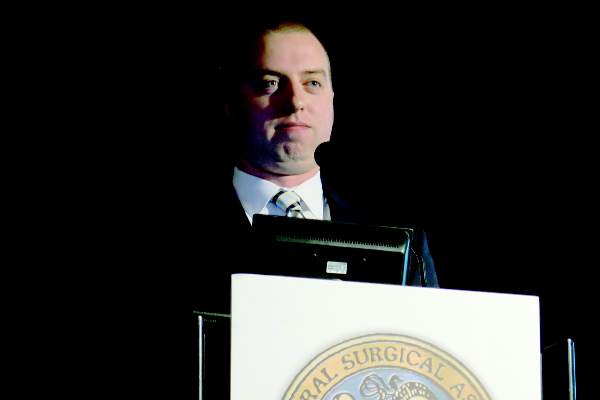
Surgeon specialization was not associated with any of the outcomes in multivariate regression that accounted for patient demographics, surgeon type, and disease characteristics, study author Capt. G. Paul Wright, U.S. Army Reserve Medical Corps, reported at the annual meeting of the Central Surgical Association.
The authors tackled the controversial issue in light of recent data suggesting improved acute, complicated diverticulitis surgery outcomes in the hands of specialized surgeons. A 2014 study reported that colorectal surgeons were less likely than general surgeons to use a Hartmann’s procedure and had reduced LOS and time to stoma reversal (J. Am. Coll. Surg. 2014;218:1156-61).
The current analysis involved 115 consecutive patients with acute, complicated diverticulitis who underwent emergent surgery with either a colorectal surgeon (n = 62) or general surgeon (n = 53) at two university-affiliated hospitals from 2006 to 2013. Age, Charlson Comorbidity Index, and American Society of Anesthesiologists class were similar between groups.
The colorectal surgeon group (CRS), however, was significantly more likely to have had previous episodes of diverticulitis (58% vs. 25%; P < .001), likely representing a referral bias or preexisting relationship with their surgeon, Dr. Wright said.
The general surgeon (GS) group had a significantly higher number of Systemic Inflammatory Response Syndrome criteria (P = .009 for all groups), higher rates of Hinchey class 3 disease (59% vs. 32%: P = .02), and ICU admissions (25% vs. 7%; P = .006).
The most common procedure among general surgeons was a Hartmann’s procedure (64% vs. 34%; P < .001), whereas colorectal surgeons favored primary anastomosis with diverting ileostomy (45% vs. 0%; P < .001), Dr. Wright, from Grand Rapids Medical Education Partners and Michigan State University, both in Grand Rapids, reported.
General surgeons were more likely to close the skin (85% vs. 50%), while in the CRS group the skin was left partially or completely open in 50% of patients. Operative time at the index admission was an average of 36 minutes longer in the CRS group (mean 164 minutes vs. 128 minutes; P = .005).
The CRS group had a higher rate of stoma reversal (78% vs 65%) and shorter time to stoma reversal (4 months vs. 4.7 months), but the difference was not statistically significant. The CRS group had a significantly shorter stoma reversal OR duration (mean 106 minutes vs. 182 minutes; P = .0010) and stoma reversal length of stay (mean 4 days vs. 7 days; P < .001).
“As general surgeons will no doubt continue to care for acute diverticulitis, increased use of primary anastomosis with proximal diversion when appropriate may be warranted due to the secondary benefits seen in stoma reversal,” Dr. Wright said.
Mortality was low and similar, at just one death in the CRS and two in the GS group.
Invited discussant William Cirocco, from Ohio State University in Columbus, said the type of surgical intervention is just one aspect in the management of patients with diverticulitis.
“An additional nonoperative approach may lead to conversion of an emergent to a nonemergent single-stage dissection. These critical decisions require experience and training,” Dr. Cirocco said. “For patients who require emergent operation for diffuse peritonitis, I believe that background and experience of the individual surgeon trumps the presence or absence of specialty training.”
Dr. Wright and his coauthors reported having no financial conflicts.
CHICAGO – Surgical outcomes of acute, complicated diverticulitis are equivalent regardless of whether a colorectal or general surgeon wields the scalpel, a multicenter study showed.
There was no difference between the colorectal surgery (CRS) and general surgery groups for the primary outcomes of 90-day morbidity (26% vs 28%; P = .76), readmission (32% vs. 25%; P = .48), and length of stay (both median 9 days; P = .82).
Surgeon specialization was not associated with any of the outcomes in multivariate regression that accounted for patient demographics, surgeon type, and disease characteristics, study author Capt. G. Paul Wright, U.S. Army Reserve Medical Corps, reported at the annual meeting of the Central Surgical Association.
The authors tackled the controversial issue in light of recent data suggesting improved acute, complicated diverticulitis surgery outcomes in the hands of specialized surgeons. A 2014 study reported that colorectal surgeons were less likely than general surgeons to use a Hartmann’s procedure and had reduced LOS and time to stoma reversal (J. Am. Coll. Surg. 2014;218:1156-61).
The current analysis involved 115 consecutive patients with acute, complicated diverticulitis who underwent emergent surgery with either a colorectal surgeon (n = 62) or general surgeon (n = 53) at two university-affiliated hospitals from 2006 to 2013. Age, Charlson Comorbidity Index, and American Society of Anesthesiologists class were similar between groups.
The colorectal surgeon group (CRS), however, was significantly more likely to have had previous episodes of diverticulitis (58% vs. 25%; P < .001), likely representing a referral bias or preexisting relationship with their surgeon, Dr. Wright said.
The general surgeon (GS) group had a significantly higher number of Systemic Inflammatory Response Syndrome criteria (P = .009 for all groups), higher rates of Hinchey class 3 disease (59% vs. 32%: P = .02), and ICU admissions (25% vs. 7%; P = .006).
The most common procedure among general surgeons was a Hartmann’s procedure (64% vs. 34%; P < .001), whereas colorectal surgeons favored primary anastomosis with diverting ileostomy (45% vs. 0%; P < .001), Dr. Wright, from Grand Rapids Medical Education Partners and Michigan State University, both in Grand Rapids, reported.
General surgeons were more likely to close the skin (85% vs. 50%), while in the CRS group the skin was left partially or completely open in 50% of patients. Operative time at the index admission was an average of 36 minutes longer in the CRS group (mean 164 minutes vs. 128 minutes; P = .005).
The CRS group had a higher rate of stoma reversal (78% vs 65%) and shorter time to stoma reversal (4 months vs. 4.7 months), but the difference was not statistically significant. The CRS group had a significantly shorter stoma reversal OR duration (mean 106 minutes vs. 182 minutes; P = .0010) and stoma reversal length of stay (mean 4 days vs. 7 days; P < .001).
“As general surgeons will no doubt continue to care for acute diverticulitis, increased use of primary anastomosis with proximal diversion when appropriate may be warranted due to the secondary benefits seen in stoma reversal,” Dr. Wright said.
Mortality was low and similar, at just one death in the CRS and two in the GS group.
Invited discussant William Cirocco, from Ohio State University in Columbus, said the type of surgical intervention is just one aspect in the management of patients with diverticulitis.
“An additional nonoperative approach may lead to conversion of an emergent to a nonemergent single-stage dissection. These critical decisions require experience and training,” Dr. Cirocco said. “For patients who require emergent operation for diffuse peritonitis, I believe that background and experience of the individual surgeon trumps the presence or absence of specialty training.”
Dr. Wright and his coauthors reported having no financial conflicts.
CHICAGO – Surgical outcomes of acute, complicated diverticulitis are equivalent regardless of whether a colorectal or general surgeon wields the scalpel, a multicenter study showed.
There was no difference between the colorectal surgery (CRS) and general surgery groups for the primary outcomes of 90-day morbidity (26% vs 28%; P = .76), readmission (32% vs. 25%; P = .48), and length of stay (both median 9 days; P = .82).
Surgeon specialization was not associated with any of the outcomes in multivariate regression that accounted for patient demographics, surgeon type, and disease characteristics, study author Capt. G. Paul Wright, U.S. Army Reserve Medical Corps, reported at the annual meeting of the Central Surgical Association.
The authors tackled the controversial issue in light of recent data suggesting improved acute, complicated diverticulitis surgery outcomes in the hands of specialized surgeons. A 2014 study reported that colorectal surgeons were less likely than general surgeons to use a Hartmann’s procedure and had reduced LOS and time to stoma reversal (J. Am. Coll. Surg. 2014;218:1156-61).
The current analysis involved 115 consecutive patients with acute, complicated diverticulitis who underwent emergent surgery with either a colorectal surgeon (n = 62) or general surgeon (n = 53) at two university-affiliated hospitals from 2006 to 2013. Age, Charlson Comorbidity Index, and American Society of Anesthesiologists class were similar between groups.
The colorectal surgeon group (CRS), however, was significantly more likely to have had previous episodes of diverticulitis (58% vs. 25%; P < .001), likely representing a referral bias or preexisting relationship with their surgeon, Dr. Wright said.
The general surgeon (GS) group had a significantly higher number of Systemic Inflammatory Response Syndrome criteria (P = .009 for all groups), higher rates of Hinchey class 3 disease (59% vs. 32%: P = .02), and ICU admissions (25% vs. 7%; P = .006).
The most common procedure among general surgeons was a Hartmann’s procedure (64% vs. 34%; P < .001), whereas colorectal surgeons favored primary anastomosis with diverting ileostomy (45% vs. 0%; P < .001), Dr. Wright, from Grand Rapids Medical Education Partners and Michigan State University, both in Grand Rapids, reported.
General surgeons were more likely to close the skin (85% vs. 50%), while in the CRS group the skin was left partially or completely open in 50% of patients. Operative time at the index admission was an average of 36 minutes longer in the CRS group (mean 164 minutes vs. 128 minutes; P = .005).
The CRS group had a higher rate of stoma reversal (78% vs 65%) and shorter time to stoma reversal (4 months vs. 4.7 months), but the difference was not statistically significant. The CRS group had a significantly shorter stoma reversal OR duration (mean 106 minutes vs. 182 minutes; P = .0010) and stoma reversal length of stay (mean 4 days vs. 7 days; P < .001).
“As general surgeons will no doubt continue to care for acute diverticulitis, increased use of primary anastomosis with proximal diversion when appropriate may be warranted due to the secondary benefits seen in stoma reversal,” Dr. Wright said.
Mortality was low and similar, at just one death in the CRS and two in the GS group.
Invited discussant William Cirocco, from Ohio State University in Columbus, said the type of surgical intervention is just one aspect in the management of patients with diverticulitis.
“An additional nonoperative approach may lead to conversion of an emergent to a nonemergent single-stage dissection. These critical decisions require experience and training,” Dr. Cirocco said. “For patients who require emergent operation for diffuse peritonitis, I believe that background and experience of the individual surgeon trumps the presence or absence of specialty training.”
Dr. Wright and his coauthors reported having no financial conflicts.
AT THE ANNUAL MEETING OF THE CENTRAL SURGICAL ASSOCIATION
Key clinical point: Major outcomes of acute, complicated diverticulitis were comparable regardless of surgeon specialization.
Major finding: Patients with diverticulitis treated by colorectal and general surgeons had similar 90-day morbidity (26% vs 28%; P = .76), readmissions (32% vs. 25%; P = .48), and LOS (both median 9 days;P = .82).
Data source: Retrospective study in 115 patients with acute complicated diverticulitis.
Disclosures: Dr. Wright and his coauthors reported having no financial conflicts.
ACS NSQIP data: Laparoscopic sleeve gastrectomy is at least as safe as gastric bypass
Laparoscopic sleeve gastrectomy is associated with lower rates of morbidity and similar mortality when compared with laparoscopic Roux-en-Y gastric bypass, according to an analysis of 2010-2011 data from the American College of Surgeons National Surgical Quality Improvement Program database.
Of 24,117 patients included in the analysis, 79.5% underwent laparoscopic Roux-en-Y gastric bypass (LGB), and 20.5% had laparoscopic sleeve gastrectomy (LSG). Of note, the proportion of LSG cases increased from 14.6% in 2010 to 24.8% in 2011, Dr. Monica T. Young of the University of California Irvine Medical Center, Orange, Calif., and her colleagues reported.

Those who underwent LGB had a significantly higher rate of 30-day risk-adjusted morbidity (odds ratio, 1.32). The 30-day mortality rate was 0.15% with bypass and 0.10% for sleeve gastrectomy, the investigators said (J. Am. Coll. Surg. 2015 [doi:
10.1016/j.jamcollsurg.2015.01.059]).
Further, sleeve gastrectomy was associated with shorter operative time (101 vs. 133 minutes) and with lower rates of blood loss requiring transfusion (0.65% vs. 1.5%), deep wound infections (0.06% vs. 0.20%), sepsis (0.34% vs. 0.58%), overall serious morbidity (3.8% vs. 5.8%), and reoperations within 30 days (1.6% vs. 2.5%).
The rate of deep venous thrombosis, however, was significantly higher with sleeve gastrectomy (0.47% vs. 0.21%). Deep vein thrombosis was the only complication found to be higher after LSG, they noted.
Older patients, those with a higher body mass index, and those who smoked or had hypertension were at significantly greater risk of serious morbidity.
Given the increasing popularity and use of sleeve gastrectomy as seen both in this study and nationally – with a reported increase in utilization from 0.9% in 2008 to 36.3% in 2012, it is important to compare outcomes with LSG with those for the preferred Roux-en-Y bypass surgery, the investigators said, noting that few large-scale studies have compared outcomes with the two procedures.
“Over the past decade, laparoscopic sleeve gastrectomy has emerged as a common utilized bariatric procedure. LSG has several advantages over LGB including preservation of endoscopic access to the upper gastrointestinal tract, avoidance of intestinal anastomosis, and prevention of dumping syndrome by pylorus preservation,” they wrote, adding that studies increasingly demonstrate its efficacy for weight loss.
The current findings support those of other recent studies, and a comparison of the data with those from 2007 to 2010 from the ACS NSQIP database showed that while reoperation rates after gastric bypass and sleeve gastrectomy have declined dramatically over time, readmission rates remain elevated.
“Therefore, it appears that further quality improvement initiatives are necessary to reduce the rate of readmissions after bariatric surgery,” the investigators wrote, noting that a national collaborative to reduce 30-day readmissions by 20% (the Metabolic and Bariatric Surgery Accreditation and Quality Improvement Program, or MBSAQIP) is currently enrolling.
Additional randomized controlled trials are also needed to evaluate differences in long-term outcomes between the two procedures, they concluded.
The authors reported having no relevant financial disclosures.
Laparoscopic sleeve gastrectomy is associated with lower rates of morbidity and similar mortality when compared with laparoscopic Roux-en-Y gastric bypass, according to an analysis of 2010-2011 data from the American College of Surgeons National Surgical Quality Improvement Program database.
Of 24,117 patients included in the analysis, 79.5% underwent laparoscopic Roux-en-Y gastric bypass (LGB), and 20.5% had laparoscopic sleeve gastrectomy (LSG). Of note, the proportion of LSG cases increased from 14.6% in 2010 to 24.8% in 2011, Dr. Monica T. Young of the University of California Irvine Medical Center, Orange, Calif., and her colleagues reported.
Those who underwent LGB had a significantly higher rate of 30-day risk-adjusted morbidity (odds ratio, 1.32). The 30-day mortality rate was 0.15% with bypass and 0.10% for sleeve gastrectomy, the investigators said (J. Am. Coll. Surg. 2015 [doi:
10.1016/j.jamcollsurg.2015.01.059]).
Further, sleeve gastrectomy was associated with shorter operative time (101 vs. 133 minutes) and with lower rates of blood loss requiring transfusion (0.65% vs. 1.5%), deep wound infections (0.06% vs. 0.20%), sepsis (0.34% vs. 0.58%), overall serious morbidity (3.8% vs. 5.8%), and reoperations within 30 days (1.6% vs. 2.5%).
The rate of deep venous thrombosis, however, was significantly higher with sleeve gastrectomy (0.47% vs. 0.21%). Deep vein thrombosis was the only complication found to be higher after LSG, they noted.
Older patients, those with a higher body mass index, and those who smoked or had hypertension were at significantly greater risk of serious morbidity.
Given the increasing popularity and use of sleeve gastrectomy as seen both in this study and nationally – with a reported increase in utilization from 0.9% in 2008 to 36.3% in 2012, it is important to compare outcomes with LSG with those for the preferred Roux-en-Y bypass surgery, the investigators said, noting that few large-scale studies have compared outcomes with the two procedures.
“Over the past decade, laparoscopic sleeve gastrectomy has emerged as a common utilized bariatric procedure. LSG has several advantages over LGB including preservation of endoscopic access to the upper gastrointestinal tract, avoidance of intestinal anastomosis, and prevention of dumping syndrome by pylorus preservation,” they wrote, adding that studies increasingly demonstrate its efficacy for weight loss.
The current findings support those of other recent studies, and a comparison of the data with those from 2007 to 2010 from the ACS NSQIP database showed that while reoperation rates after gastric bypass and sleeve gastrectomy have declined dramatically over time, readmission rates remain elevated.
“Therefore, it appears that further quality improvement initiatives are necessary to reduce the rate of readmissions after bariatric surgery,” the investigators wrote, noting that a national collaborative to reduce 30-day readmissions by 20% (the Metabolic and Bariatric Surgery Accreditation and Quality Improvement Program, or MBSAQIP) is currently enrolling.
Additional randomized controlled trials are also needed to evaluate differences in long-term outcomes between the two procedures, they concluded.
The authors reported having no relevant financial disclosures.
Laparoscopic sleeve gastrectomy is associated with lower rates of morbidity and similar mortality when compared with laparoscopic Roux-en-Y gastric bypass, according to an analysis of 2010-2011 data from the American College of Surgeons National Surgical Quality Improvement Program database.
Of 24,117 patients included in the analysis, 79.5% underwent laparoscopic Roux-en-Y gastric bypass (LGB), and 20.5% had laparoscopic sleeve gastrectomy (LSG). Of note, the proportion of LSG cases increased from 14.6% in 2010 to 24.8% in 2011, Dr. Monica T. Young of the University of California Irvine Medical Center, Orange, Calif., and her colleagues reported.
Those who underwent LGB had a significantly higher rate of 30-day risk-adjusted morbidity (odds ratio, 1.32). The 30-day mortality rate was 0.15% with bypass and 0.10% for sleeve gastrectomy, the investigators said (J. Am. Coll. Surg. 2015 [doi:
10.1016/j.jamcollsurg.2015.01.059]).
Further, sleeve gastrectomy was associated with shorter operative time (101 vs. 133 minutes) and with lower rates of blood loss requiring transfusion (0.65% vs. 1.5%), deep wound infections (0.06% vs. 0.20%), sepsis (0.34% vs. 0.58%), overall serious morbidity (3.8% vs. 5.8%), and reoperations within 30 days (1.6% vs. 2.5%).
The rate of deep venous thrombosis, however, was significantly higher with sleeve gastrectomy (0.47% vs. 0.21%). Deep vein thrombosis was the only complication found to be higher after LSG, they noted.
Older patients, those with a higher body mass index, and those who smoked or had hypertension were at significantly greater risk of serious morbidity.
Given the increasing popularity and use of sleeve gastrectomy as seen both in this study and nationally – with a reported increase in utilization from 0.9% in 2008 to 36.3% in 2012, it is important to compare outcomes with LSG with those for the preferred Roux-en-Y bypass surgery, the investigators said, noting that few large-scale studies have compared outcomes with the two procedures.
“Over the past decade, laparoscopic sleeve gastrectomy has emerged as a common utilized bariatric procedure. LSG has several advantages over LGB including preservation of endoscopic access to the upper gastrointestinal tract, avoidance of intestinal anastomosis, and prevention of dumping syndrome by pylorus preservation,” they wrote, adding that studies increasingly demonstrate its efficacy for weight loss.
The current findings support those of other recent studies, and a comparison of the data with those from 2007 to 2010 from the ACS NSQIP database showed that while reoperation rates after gastric bypass and sleeve gastrectomy have declined dramatically over time, readmission rates remain elevated.
“Therefore, it appears that further quality improvement initiatives are necessary to reduce the rate of readmissions after bariatric surgery,” the investigators wrote, noting that a national collaborative to reduce 30-day readmissions by 20% (the Metabolic and Bariatric Surgery Accreditation and Quality Improvement Program, or MBSAQIP) is currently enrolling.
Additional randomized controlled trials are also needed to evaluate differences in long-term outcomes between the two procedures, they concluded.
The authors reported having no relevant financial disclosures.
FROM THE JOURNAL OF THE AMERICAN COLLEGE OF SURGEONS
Key clinical point: Laparoscopic sleeve gastrectomy appears to have numerous advantages over laparoscopic Roux-en-Y gastric bypass.
Major finding: Patients who underwent LGB had a significantly higher rate of 30-day risk-adjusted morbidity (odds ratio, 1.32).
Data source: An analysis of data from the ACS NSQIP database.
Disclosures: The authors reported having no relevant financial disclosures.

Modified Sugarbaker enhances parastomal hernia repair
CHICAGO – Patients who underwent modified laparoscopic Sugarbaker parastomal hernia repair were a third less likely to experience recurrence as those repaired with other surgical techniques in a multicenter, retrospective study in 62 patients.
The recurrence rate was 16.6% for the modified Sugarbaker technique, compared with 61% for keyhole repair, 69.2% for ostomy relocation, and 33.3% for open repair (P value < .001). Median follow-up was 16.6 months, 19.6 months, 16.4 months, and 27.2 months (P = .748).
In an adjusted Cox proportional hazards regression model, the Sugarbaker technique (hazard ratio, 0.28; P = .021) and body mass index (HR, 1.09; P = .013) were the only significant predictors of time to hernia recurrence.
Using the Kaplan-Meier method, 80% of Sugarbaker patients would be recurrence free at 2 years vs. about 60% of those in the other groups (log-rank P = .021), Mr. Francis DeAsis, a research assistant from NorthShore University Health in Evanston, Ill., reported at the annual meeting of the Central Surgical Association.
The findings are in keeping with prior Sugarbaker studies involving 177 repairs between 2005 and 2013, reporting recurrence rates between 4% and 20% and morbidity of 12%-43%, he said.
Morbidity was 40% among the 25 Sugarbaker repairs in the current analysis, significantly lower than that in the Keyhole, relocation, and open repair groups (40% vs. 83.3%, 61.5%, 83.3%; P = .005).
“Based on our results and others, we’d like to suggest that the Sugarbaker approach should be the primary option for treating parastomal hernia,” Mr. DeAsis said.
The study provides “further proof that no other technique available results in a durable repair compared to the Sugarbaker technique for these challenging hernias,” senior study author Dr. Michael Ujiki, director of minimally invasive surgery at NorthShore, said in an interview.
The Sugarbaker technique typically involves a laparoscopic mesh sublay over the fascial defect and lateralization of the stoma limb. Modifications at NorthShore included use of polytetrafluoroethylene mesh with a 5-cm overlap of the defect and, if possible, primary closure of the defect. A catheter is occasionally used to identify the correct ostomy limb, but most importantly, a laparoscopic approach is utilized in order to decrease wound infections and quicken the return to daily activities, Dr. Ujiki said. “We also avoid cautery and diligently look for other incidental hernias at the prevision incisions.”
Ileus (> 3 days) was the most common complication in all groups: Sugarbaker (4/25), keyhole (9/18), relocation (3/13), and open (1/6). Only one death occurred; in the open group.
Discussant Dr. Matthew Goldblatt, with the Medical College of Wisconsin in Milwaukee, questioned how many patients also had ventral hernias and whether this was a complicating factor in ileus or length of stay and whether the fascia was closed primarily during keyhole repair or the mesh simply placed as a bridge, as this can impact failure rates.
Dr. Ujiki responded that some patients had concomitant ventral hernias and that they simply used a larger piece of mesh to cover both hernias. Primary closure was not part of the keyhole repair early in the 10-year series, spanning 2004 to 2014, but ultimately was performed in about half of patients in the keyhole group.
“I don’t think that there’s going to be a difference between the two in terms of recurrence, but I can’t say for sure,” he added.
At this point, the group does not use prophylactic mesh placement at the time the ostomy is created, to avoid infections.
Finally, the audience asked whether the investigators are willing to accept a 16% recurrence rate, a fourfold increase over the best reported result with a modified Sugarbaker technique.
“With these hernia repairs, to me a 16% recurrence rate is outstanding and I think it will only get better,” Dr. Ujiki said.
The series includes every patient on which they’ve performed a Sugarbaker and thus, represents their learning curve, which may not be the case with other series, he noted.
Dr. Ujiki left the audience with two bits of advice to hasten the learning curve: leave at least 5 cm of overlap because the mesh will shrink down and keep the stitches close to the mesh without cutting off the bowel.
CHICAGO – Patients who underwent modified laparoscopic Sugarbaker parastomal hernia repair were a third less likely to experience recurrence as those repaired with other surgical techniques in a multicenter, retrospective study in 62 patients.
The recurrence rate was 16.6% for the modified Sugarbaker technique, compared with 61% for keyhole repair, 69.2% for ostomy relocation, and 33.3% for open repair (P value < .001). Median follow-up was 16.6 months, 19.6 months, 16.4 months, and 27.2 months (P = .748).
In an adjusted Cox proportional hazards regression model, the Sugarbaker technique (hazard ratio, 0.28; P = .021) and body mass index (HR, 1.09; P = .013) were the only significant predictors of time to hernia recurrence.
Using the Kaplan-Meier method, 80% of Sugarbaker patients would be recurrence free at 2 years vs. about 60% of those in the other groups (log-rank P = .021), Mr. Francis DeAsis, a research assistant from NorthShore University Health in Evanston, Ill., reported at the annual meeting of the Central Surgical Association.
The findings are in keeping with prior Sugarbaker studies involving 177 repairs between 2005 and 2013, reporting recurrence rates between 4% and 20% and morbidity of 12%-43%, he said.
Morbidity was 40% among the 25 Sugarbaker repairs in the current analysis, significantly lower than that in the Keyhole, relocation, and open repair groups (40% vs. 83.3%, 61.5%, 83.3%; P = .005).
“Based on our results and others, we’d like to suggest that the Sugarbaker approach should be the primary option for treating parastomal hernia,” Mr. DeAsis said.
The study provides “further proof that no other technique available results in a durable repair compared to the Sugarbaker technique for these challenging hernias,” senior study author Dr. Michael Ujiki, director of minimally invasive surgery at NorthShore, said in an interview.
The Sugarbaker technique typically involves a laparoscopic mesh sublay over the fascial defect and lateralization of the stoma limb. Modifications at NorthShore included use of polytetrafluoroethylene mesh with a 5-cm overlap of the defect and, if possible, primary closure of the defect. A catheter is occasionally used to identify the correct ostomy limb, but most importantly, a laparoscopic approach is utilized in order to decrease wound infections and quicken the return to daily activities, Dr. Ujiki said. “We also avoid cautery and diligently look for other incidental hernias at the prevision incisions.”
Ileus (> 3 days) was the most common complication in all groups: Sugarbaker (4/25), keyhole (9/18), relocation (3/13), and open (1/6). Only one death occurred; in the open group.
Discussant Dr. Matthew Goldblatt, with the Medical College of Wisconsin in Milwaukee, questioned how many patients also had ventral hernias and whether this was a complicating factor in ileus or length of stay and whether the fascia was closed primarily during keyhole repair or the mesh simply placed as a bridge, as this can impact failure rates.
Dr. Ujiki responded that some patients had concomitant ventral hernias and that they simply used a larger piece of mesh to cover both hernias. Primary closure was not part of the keyhole repair early in the 10-year series, spanning 2004 to 2014, but ultimately was performed in about half of patients in the keyhole group.
“I don’t think that there’s going to be a difference between the two in terms of recurrence, but I can’t say for sure,” he added.
At this point, the group does not use prophylactic mesh placement at the time the ostomy is created, to avoid infections.
Finally, the audience asked whether the investigators are willing to accept a 16% recurrence rate, a fourfold increase over the best reported result with a modified Sugarbaker technique.
“With these hernia repairs, to me a 16% recurrence rate is outstanding and I think it will only get better,” Dr. Ujiki said.
The series includes every patient on which they’ve performed a Sugarbaker and thus, represents their learning curve, which may not be the case with other series, he noted.
Dr. Ujiki left the audience with two bits of advice to hasten the learning curve: leave at least 5 cm of overlap because the mesh will shrink down and keep the stitches close to the mesh without cutting off the bowel.
CHICAGO – Patients who underwent modified laparoscopic Sugarbaker parastomal hernia repair were a third less likely to experience recurrence as those repaired with other surgical techniques in a multicenter, retrospective study in 62 patients.
The recurrence rate was 16.6% for the modified Sugarbaker technique, compared with 61% for keyhole repair, 69.2% for ostomy relocation, and 33.3% for open repair (P value < .001). Median follow-up was 16.6 months, 19.6 months, 16.4 months, and 27.2 months (P = .748).
In an adjusted Cox proportional hazards regression model, the Sugarbaker technique (hazard ratio, 0.28; P = .021) and body mass index (HR, 1.09; P = .013) were the only significant predictors of time to hernia recurrence.
Using the Kaplan-Meier method, 80% of Sugarbaker patients would be recurrence free at 2 years vs. about 60% of those in the other groups (log-rank P = .021), Mr. Francis DeAsis, a research assistant from NorthShore University Health in Evanston, Ill., reported at the annual meeting of the Central Surgical Association.
The findings are in keeping with prior Sugarbaker studies involving 177 repairs between 2005 and 2013, reporting recurrence rates between 4% and 20% and morbidity of 12%-43%, he said.
Morbidity was 40% among the 25 Sugarbaker repairs in the current analysis, significantly lower than that in the Keyhole, relocation, and open repair groups (40% vs. 83.3%, 61.5%, 83.3%; P = .005).
“Based on our results and others, we’d like to suggest that the Sugarbaker approach should be the primary option for treating parastomal hernia,” Mr. DeAsis said.
The study provides “further proof that no other technique available results in a durable repair compared to the Sugarbaker technique for these challenging hernias,” senior study author Dr. Michael Ujiki, director of minimally invasive surgery at NorthShore, said in an interview.
The Sugarbaker technique typically involves a laparoscopic mesh sublay over the fascial defect and lateralization of the stoma limb. Modifications at NorthShore included use of polytetrafluoroethylene mesh with a 5-cm overlap of the defect and, if possible, primary closure of the defect. A catheter is occasionally used to identify the correct ostomy limb, but most importantly, a laparoscopic approach is utilized in order to decrease wound infections and quicken the return to daily activities, Dr. Ujiki said. “We also avoid cautery and diligently look for other incidental hernias at the prevision incisions.”
Ileus (> 3 days) was the most common complication in all groups: Sugarbaker (4/25), keyhole (9/18), relocation (3/13), and open (1/6). Only one death occurred; in the open group.
Discussant Dr. Matthew Goldblatt, with the Medical College of Wisconsin in Milwaukee, questioned how many patients also had ventral hernias and whether this was a complicating factor in ileus or length of stay and whether the fascia was closed primarily during keyhole repair or the mesh simply placed as a bridge, as this can impact failure rates.
Dr. Ujiki responded that some patients had concomitant ventral hernias and that they simply used a larger piece of mesh to cover both hernias. Primary closure was not part of the keyhole repair early in the 10-year series, spanning 2004 to 2014, but ultimately was performed in about half of patients in the keyhole group.
“I don’t think that there’s going to be a difference between the two in terms of recurrence, but I can’t say for sure,” he added.
At this point, the group does not use prophylactic mesh placement at the time the ostomy is created, to avoid infections.
Finally, the audience asked whether the investigators are willing to accept a 16% recurrence rate, a fourfold increase over the best reported result with a modified Sugarbaker technique.
“With these hernia repairs, to me a 16% recurrence rate is outstanding and I think it will only get better,” Dr. Ujiki said.
The series includes every patient on which they’ve performed a Sugarbaker and thus, represents their learning curve, which may not be the case with other series, he noted.
Dr. Ujiki left the audience with two bits of advice to hasten the learning curve: leave at least 5 cm of overlap because the mesh will shrink down and keep the stitches close to the mesh without cutting off the bowel.
AT THE ANNUAL MEETING OF THE CENTRAL SURGICAL ASSOCIATION
Key clinical point: A modified laparoscopic Sugarbaker parastomal hernia repair had lower rates of recurrence and complications than other surgical repair techniques.
Major finding: The recurrence rate was 16.6% for the modified Sugarbaker technique, 61% for keyhole repair, 69.2% for ostomy relocation, and 33.3% for open repair (P < .001).
Data source: Retrospective study of 62 parastomal hernia repairs.
Disclosures: Mr. DeAsis reported having no financial disclosures. Co-authors Dr. John Linn and Dr. Michael Ujiki reported serving as consultants for Covidien and speakers for Gore.
Most thyroid nodules have favorable prognosis
During 5 years of follow-up, cancer arose in only 0.3% of thyroid nodules that were cytologically and sonographically benign at baseline, according to a large prospective study published online March 3 in JAMA.
Furthermore, only two of the five nodules that became cancerous had grown beforehand, reported Dr. Cosimo Durante of the Sapienza University of Rome and his associates. “These data suggest that the American Thyroid Association’s recommendation for indication for repeat cytology should be revised. Clinical and sonographic findings should probably play larger roles in the decision-making process,” the researchers said (JAMA 2015;313:926-35).

Advances in diagnostic imaging have increased the detection of thyroid nodules, the great majority of which are found to be benign. For such nodules, the ATA recommends repeating thyroid ultrasonography at 6-18 months and then every 3-5 years thereafter, as long as nodules do not significantly grow (defined as at least a 20% increase in two nodule diameters, with a minimum increase of at least 2 mm [Thyroid 2009;19:1167-214]). But little is known about rate, extent, or predictors of nodule growth, the researchers noted. Therefore, they performed annual thyroid ultrasound examinations on 992 patients who had one to four asymptomatic subcentimeter thyroid modules that were cytologically or sonographically benign at baseline.
After 5 years of follow-up, just 15.4% of patients had experienced significant nodule growth according to the ATA definition, the researchers reported. Average growth was 4.9 mm, and 9.3% of patients developed new nodules, of which one was found to be cancerous. Growth was least likely when a patient’s largest nodule measured 7.5 mm or less and was significantly more likely when patients had multiple nodules instead of one; had baseline nodule volume greater than 0.2 mL; were up to 45 years old, compared with at least 60 years of age; and were male, the investigators said.
Among older patients, having a body mass index of 28.6 kg/m2 more than doubled the odds of nodule growth, in keeping with recent reports linking obesity and insulin resistance with nodular thyroid disease, they added.
The findings suggest that repeat thyroid ultrasonography could be safely extended to 12 months for initial follow-up and to every 5 years thereafter for most patients, as long as nodule size remained stable, Dr. Durante and his associates said. “This approach should be suitable for about 85% of patients, whose risk of disease progression is low. Closer surveillance may be appropriate for nodules occurring in younger patients or older overweight individuals with multiple nodules, large nodules (greater than 7.5 mm), or both,” they added.
The Umberto Di Mario Foundation, Banca d’Italia, and the Italian Thyroid Cancer Observatory Foundation funded the study. The authors reported having no conflicts of interest.
Thyroid nodules are pervasive, whereas thyroid cancer is not. The findings from Durante et al represent an important step in improving the efficiency and mitigating the expense of follow-up for the vast majority of thyroid nodules that are either cytologically or sonographically benign.
These prospective data provide reassurance about the validity of a benign cytology result obtained by ultrasound-guided fine-needle aspiration and confirm a very low false-negative rate, at 1.1%. The practice of routine sonographic surveillance with repeat fine-needle aspiration for growth, as recommended by published guidelines, is not the most efficient strategy to detect the very small number of missed cancers among previously sampled cytologically benign nodules. The one-size-fits-all approach simply does not work. Instead, surveillance strategies should be individualized based on a nodule’s sonographic appearance.
Many nodules detected on ultrasound are small (less than 1 cm) and not sonographically suspicious. In the study by Durante et al, only one cancer was diagnosed during follow-up among the 852 sonographically benign nodules that were smaller than 1 cm. Of note, the trigger for fine-needle aspiration for this nodule was development of hypoechogenicity and irregular margins, not growth.
Although 69% of nodules [in the study] remained stable in size, size increase was not a harbinger of malignancy, especially if the nodule had no sonographically suspicious features.
Anne R. Cappola, M.D., Sc.M., and Susan J. Mandel, M.D., M.P.H., are with the University of Pennsylvania, Philadelphia. Dr. Cappola is also an associate editor of JAMA. These comments are based on their accompanying editorial (JAMA 2015 March 3 [doi:10.1001/jama.2015.0836]).
Thyroid nodules are pervasive, whereas thyroid cancer is not. The findings from Durante et al represent an important step in improving the efficiency and mitigating the expense of follow-up for the vast majority of thyroid nodules that are either cytologically or sonographically benign.
These prospective data provide reassurance about the validity of a benign cytology result obtained by ultrasound-guided fine-needle aspiration and confirm a very low false-negative rate, at 1.1%. The practice of routine sonographic surveillance with repeat fine-needle aspiration for growth, as recommended by published guidelines, is not the most efficient strategy to detect the very small number of missed cancers among previously sampled cytologically benign nodules. The one-size-fits-all approach simply does not work. Instead, surveillance strategies should be individualized based on a nodule’s sonographic appearance.
Many nodules detected on ultrasound are small (less than 1 cm) and not sonographically suspicious. In the study by Durante et al, only one cancer was diagnosed during follow-up among the 852 sonographically benign nodules that were smaller than 1 cm. Of note, the trigger for fine-needle aspiration for this nodule was development of hypoechogenicity and irregular margins, not growth.
Although 69% of nodules [in the study] remained stable in size, size increase was not a harbinger of malignancy, especially if the nodule had no sonographically suspicious features.
Anne R. Cappola, M.D., Sc.M., and Susan J. Mandel, M.D., M.P.H., are with the University of Pennsylvania, Philadelphia. Dr. Cappola is also an associate editor of JAMA. These comments are based on their accompanying editorial (JAMA 2015 March 3 [doi:10.1001/jama.2015.0836]).
Thyroid nodules are pervasive, whereas thyroid cancer is not. The findings from Durante et al represent an important step in improving the efficiency and mitigating the expense of follow-up for the vast majority of thyroid nodules that are either cytologically or sonographically benign.
These prospective data provide reassurance about the validity of a benign cytology result obtained by ultrasound-guided fine-needle aspiration and confirm a very low false-negative rate, at 1.1%. The practice of routine sonographic surveillance with repeat fine-needle aspiration for growth, as recommended by published guidelines, is not the most efficient strategy to detect the very small number of missed cancers among previously sampled cytologically benign nodules. The one-size-fits-all approach simply does not work. Instead, surveillance strategies should be individualized based on a nodule’s sonographic appearance.
Many nodules detected on ultrasound are small (less than 1 cm) and not sonographically suspicious. In the study by Durante et al, only one cancer was diagnosed during follow-up among the 852 sonographically benign nodules that were smaller than 1 cm. Of note, the trigger for fine-needle aspiration for this nodule was development of hypoechogenicity and irregular margins, not growth.
Although 69% of nodules [in the study] remained stable in size, size increase was not a harbinger of malignancy, especially if the nodule had no sonographically suspicious features.
Anne R. Cappola, M.D., Sc.M., and Susan J. Mandel, M.D., M.P.H., are with the University of Pennsylvania, Philadelphia. Dr. Cappola is also an associate editor of JAMA. These comments are based on their accompanying editorial (JAMA 2015 March 3 [doi:10.1001/jama.2015.0836]).
During 5 years of follow-up, cancer arose in only 0.3% of thyroid nodules that were cytologically and sonographically benign at baseline, according to a large prospective study published online March 3 in JAMA.
Furthermore, only two of the five nodules that became cancerous had grown beforehand, reported Dr. Cosimo Durante of the Sapienza University of Rome and his associates. “These data suggest that the American Thyroid Association’s recommendation for indication for repeat cytology should be revised. Clinical and sonographic findings should probably play larger roles in the decision-making process,” the researchers said (JAMA 2015;313:926-35).
Advances in diagnostic imaging have increased the detection of thyroid nodules, the great majority of which are found to be benign. For such nodules, the ATA recommends repeating thyroid ultrasonography at 6-18 months and then every 3-5 years thereafter, as long as nodules do not significantly grow (defined as at least a 20% increase in two nodule diameters, with a minimum increase of at least 2 mm [Thyroid 2009;19:1167-214]). But little is known about rate, extent, or predictors of nodule growth, the researchers noted. Therefore, they performed annual thyroid ultrasound examinations on 992 patients who had one to four asymptomatic subcentimeter thyroid modules that were cytologically or sonographically benign at baseline.
After 5 years of follow-up, just 15.4% of patients had experienced significant nodule growth according to the ATA definition, the researchers reported. Average growth was 4.9 mm, and 9.3% of patients developed new nodules, of which one was found to be cancerous. Growth was least likely when a patient’s largest nodule measured 7.5 mm or less and was significantly more likely when patients had multiple nodules instead of one; had baseline nodule volume greater than 0.2 mL; were up to 45 years old, compared with at least 60 years of age; and were male, the investigators said.
Among older patients, having a body mass index of 28.6 kg/m2 more than doubled the odds of nodule growth, in keeping with recent reports linking obesity and insulin resistance with nodular thyroid disease, they added.
The findings suggest that repeat thyroid ultrasonography could be safely extended to 12 months for initial follow-up and to every 5 years thereafter for most patients, as long as nodule size remained stable, Dr. Durante and his associates said. “This approach should be suitable for about 85% of patients, whose risk of disease progression is low. Closer surveillance may be appropriate for nodules occurring in younger patients or older overweight individuals with multiple nodules, large nodules (greater than 7.5 mm), or both,” they added.
The Umberto Di Mario Foundation, Banca d’Italia, and the Italian Thyroid Cancer Observatory Foundation funded the study. The authors reported having no conflicts of interest.
During 5 years of follow-up, cancer arose in only 0.3% of thyroid nodules that were cytologically and sonographically benign at baseline, according to a large prospective study published online March 3 in JAMA.
Furthermore, only two of the five nodules that became cancerous had grown beforehand, reported Dr. Cosimo Durante of the Sapienza University of Rome and his associates. “These data suggest that the American Thyroid Association’s recommendation for indication for repeat cytology should be revised. Clinical and sonographic findings should probably play larger roles in the decision-making process,” the researchers said (JAMA 2015;313:926-35).
Advances in diagnostic imaging have increased the detection of thyroid nodules, the great majority of which are found to be benign. For such nodules, the ATA recommends repeating thyroid ultrasonography at 6-18 months and then every 3-5 years thereafter, as long as nodules do not significantly grow (defined as at least a 20% increase in two nodule diameters, with a minimum increase of at least 2 mm [Thyroid 2009;19:1167-214]). But little is known about rate, extent, or predictors of nodule growth, the researchers noted. Therefore, they performed annual thyroid ultrasound examinations on 992 patients who had one to four asymptomatic subcentimeter thyroid modules that were cytologically or sonographically benign at baseline.
After 5 years of follow-up, just 15.4% of patients had experienced significant nodule growth according to the ATA definition, the researchers reported. Average growth was 4.9 mm, and 9.3% of patients developed new nodules, of which one was found to be cancerous. Growth was least likely when a patient’s largest nodule measured 7.5 mm or less and was significantly more likely when patients had multiple nodules instead of one; had baseline nodule volume greater than 0.2 mL; were up to 45 years old, compared with at least 60 years of age; and were male, the investigators said.
Among older patients, having a body mass index of 28.6 kg/m2 more than doubled the odds of nodule growth, in keeping with recent reports linking obesity and insulin resistance with nodular thyroid disease, they added.
The findings suggest that repeat thyroid ultrasonography could be safely extended to 12 months for initial follow-up and to every 5 years thereafter for most patients, as long as nodule size remained stable, Dr. Durante and his associates said. “This approach should be suitable for about 85% of patients, whose risk of disease progression is low. Closer surveillance may be appropriate for nodules occurring in younger patients or older overweight individuals with multiple nodules, large nodules (greater than 7.5 mm), or both,” they added.
The Umberto Di Mario Foundation, Banca d’Italia, and the Italian Thyroid Cancer Observatory Foundation funded the study. The authors reported having no conflicts of interest.
FROM JAMA
Key clinical point: The vast majority of thyroid nodules found to be benign at baseline remained so 5 years later.
Major finding: Cancer arose in only 0.3% of nodules in 5 years of follow-up.
Data source: Prospective, multicenter, observational study of 992 patients with 1,567 asymptomatic thyroid nodules.
Disclosures: The Umberto Di Mario Foundation, Banca d’Italia, and the Italian Thyroid Cancer Observatory Foundation funded the study. The authors reported having no conflicts of interest.

ACP guidelines for preventing, treating pressure ulcers
Alternating-air and low-air-loss mattresses and overlays have little data to support their use for preventing or treating pressure ulcers, the Clinical Guidelines Committee of the American College of Physicians has concluded.
Many U.S. acute-care hospitals, home caregivers, and long-term nursing facilities use alternating-air and low-air-loss mattresses and overlays, even though the evidence in favor of using these surfaces is sparse and of poor quality, the guideline writers said.
The devices have not been show to actually reduce pressure ulcers. The harms have been poorly reported but could be significant. “Using these support systems is expensive and adds unnecessary burden on the health care system. Based on a review of the current evidence, lower-cost support surfaces should be the preferred approach to care,” Dr. Amir Qaseem, of the ACP, Philadelphia, and his associates wrote.
The committee performed an extensive review of the literature on pressure ulcers and compiled two Clinical Practice Guidelines – one concerning prevention (Ann. Intern. Med. 2015;162 [doi:10.7326/M14-1567]) and the other concerning treatment (Ann. Intern. Med. 2015;162 [doi:10.7326/M14-1568]) – in part because “a growing industry” has developed in recent years and aggressively pitches a wide array of products for this patient population. The guidelines present the available evidence on the comparative effectiveness of tools and strategies but state repeatedly that evidence regarding pressure ulcers is sparse and of poor quality.
The prevention guideline strongly recommends that clinicians choose advanced static mattresses or advanced static overlays rather than standard hospital mattresses for at-risk patients. Static mattresses and advanced static overlays provide a constant level of inflation or support and evenly distribute body weight. These products are among the few actually shown to reduce the incidence of pressure ulcers. They are also preferable to alternating-air mattresses and overlays, which change the distribution of pressure by inflating or deflating cells within the devices, and to low-air-loss mattresses and overlays, which use flowing air to regulate heat and humidity and adjust pressure.
Evidence is similarly poor or lacking concerning the use of other support surfaces such as heel supports or boots and a variety of wheelchair cushions. Also lacking evidence are other preventive interventions that extend beyond “usual care,” such as different types of repositioning schemes, a variety of leg elevations, various nutritional supplements, and a wide variety of skin care strategies and topical treatments.
The prevention guideline advises patient assessments to identify those at risk of developing pressure ulcers. However, there is not enough evidence to demonstrate that any one of the many risk assessment tools for this purpose is superior to the others, nor that any of these tools is superior to simple clinical judgment. Risk factors for pressure ulcers include older age; black race or Hispanic ethnicity; low body weight; cognitive impairment; physical impairments; and comorbid conditions that may affect soft-tissue integrity and healing, such as urinary or fecal incontinence, diabetes, edema, impaired microcirculation, hypoalbuminemia, and malnutrition, Dr. Qaseem and his associates wrote (Ann. Intern. Med. 2015 March 2 [doi:10.7326/M14-1567]).
The treatment guideline for patients who already have pressure ulcers similarly notes that the lack of evidence for advanced support surfaces such as alternating-air and low-air-loss mattresses and overlays. It similarly recommends advanced static mattresses or overlays for these patients.
The treatment guideline recommends protein or amino acid supplements as well as hydrocolloid or foam dressings to reduce wound size, and electrical stimulation to accelerate wound healing. The evidence for these recommendations is “weak” and of low- to moderate-quality, Dr. Qaseem and his associates said (Ann. Intern. Med. 2015 March 2 [doi:10.7326/M14-1568]).
The evidence for the safety and efficacy of hyperbaric oxygen therapy, even though it is often used to treat pressure ulcers in hospitals, is similarly inconclusive. Also lacking good-quality evidence are the use of alternating-air chair cushions, three-dimensional polyester overlays, zinc supplements, L-carnosine supplements, wound dressings other than the ones already discussed, debriding enzymes, topical phenytoin, maggot therapy, biological agents other than platelet-derived growth factor, or hydrotherapy in which wounds are cleaned using a whirlpool or pulsed lavage.
These guidelines emphasize the dire need for good science to guide both prevention and treatment of pressure ulcers. Despite the ubiquity of pressure ulcers and their potential to threaten life and limb, clinical management varies greatly. Most of the research in this field to date has been underpowered and focused on early signs of healing rather than on more definitive outcomes.
Joyce Black, Ph.D., R.N., is at the University of Nebraska Medical Center, Omaha. Her financial disclosures are available at www.acponline.org. Dr. Black made these remarks in an editorial accompanying the ACP Clinical Practice Guidelines on prevention and treatment of pressure ulcers (Ann. Intern. Med. 2015 March 2 [doi:10.1326/M15-0190]).
These guidelines emphasize the dire need for good science to guide both prevention and treatment of pressure ulcers. Despite the ubiquity of pressure ulcers and their potential to threaten life and limb, clinical management varies greatly. Most of the research in this field to date has been underpowered and focused on early signs of healing rather than on more definitive outcomes.
Joyce Black, Ph.D., R.N., is at the University of Nebraska Medical Center, Omaha. Her financial disclosures are available at www.acponline.org. Dr. Black made these remarks in an editorial accompanying the ACP Clinical Practice Guidelines on prevention and treatment of pressure ulcers (Ann. Intern. Med. 2015 March 2 [doi:10.1326/M15-0190]).
These guidelines emphasize the dire need for good science to guide both prevention and treatment of pressure ulcers. Despite the ubiquity of pressure ulcers and their potential to threaten life and limb, clinical management varies greatly. Most of the research in this field to date has been underpowered and focused on early signs of healing rather than on more definitive outcomes.
Joyce Black, Ph.D., R.N., is at the University of Nebraska Medical Center, Omaha. Her financial disclosures are available at www.acponline.org. Dr. Black made these remarks in an editorial accompanying the ACP Clinical Practice Guidelines on prevention and treatment of pressure ulcers (Ann. Intern. Med. 2015 March 2 [doi:10.1326/M15-0190]).
Alternating-air and low-air-loss mattresses and overlays have little data to support their use for preventing or treating pressure ulcers, the Clinical Guidelines Committee of the American College of Physicians has concluded.
Many U.S. acute-care hospitals, home caregivers, and long-term nursing facilities use alternating-air and low-air-loss mattresses and overlays, even though the evidence in favor of using these surfaces is sparse and of poor quality, the guideline writers said.
The devices have not been show to actually reduce pressure ulcers. The harms have been poorly reported but could be significant. “Using these support systems is expensive and adds unnecessary burden on the health care system. Based on a review of the current evidence, lower-cost support surfaces should be the preferred approach to care,” Dr. Amir Qaseem, of the ACP, Philadelphia, and his associates wrote.
The committee performed an extensive review of the literature on pressure ulcers and compiled two Clinical Practice Guidelines – one concerning prevention (Ann. Intern. Med. 2015;162 [doi:10.7326/M14-1567]) and the other concerning treatment (Ann. Intern. Med. 2015;162 [doi:10.7326/M14-1568]) – in part because “a growing industry” has developed in recent years and aggressively pitches a wide array of products for this patient population. The guidelines present the available evidence on the comparative effectiveness of tools and strategies but state repeatedly that evidence regarding pressure ulcers is sparse and of poor quality.
The prevention guideline strongly recommends that clinicians choose advanced static mattresses or advanced static overlays rather than standard hospital mattresses for at-risk patients. Static mattresses and advanced static overlays provide a constant level of inflation or support and evenly distribute body weight. These products are among the few actually shown to reduce the incidence of pressure ulcers. They are also preferable to alternating-air mattresses and overlays, which change the distribution of pressure by inflating or deflating cells within the devices, and to low-air-loss mattresses and overlays, which use flowing air to regulate heat and humidity and adjust pressure.
Evidence is similarly poor or lacking concerning the use of other support surfaces such as heel supports or boots and a variety of wheelchair cushions. Also lacking evidence are other preventive interventions that extend beyond “usual care,” such as different types of repositioning schemes, a variety of leg elevations, various nutritional supplements, and a wide variety of skin care strategies and topical treatments.
The prevention guideline advises patient assessments to identify those at risk of developing pressure ulcers. However, there is not enough evidence to demonstrate that any one of the many risk assessment tools for this purpose is superior to the others, nor that any of these tools is superior to simple clinical judgment. Risk factors for pressure ulcers include older age; black race or Hispanic ethnicity; low body weight; cognitive impairment; physical impairments; and comorbid conditions that may affect soft-tissue integrity and healing, such as urinary or fecal incontinence, diabetes, edema, impaired microcirculation, hypoalbuminemia, and malnutrition, Dr. Qaseem and his associates wrote (Ann. Intern. Med. 2015 March 2 [doi:10.7326/M14-1567]).
The treatment guideline for patients who already have pressure ulcers similarly notes that the lack of evidence for advanced support surfaces such as alternating-air and low-air-loss mattresses and overlays. It similarly recommends advanced static mattresses or overlays for these patients.
The treatment guideline recommends protein or amino acid supplements as well as hydrocolloid or foam dressings to reduce wound size, and electrical stimulation to accelerate wound healing. The evidence for these recommendations is “weak” and of low- to moderate-quality, Dr. Qaseem and his associates said (Ann. Intern. Med. 2015 March 2 [doi:10.7326/M14-1568]).
The evidence for the safety and efficacy of hyperbaric oxygen therapy, even though it is often used to treat pressure ulcers in hospitals, is similarly inconclusive. Also lacking good-quality evidence are the use of alternating-air chair cushions, three-dimensional polyester overlays, zinc supplements, L-carnosine supplements, wound dressings other than the ones already discussed, debriding enzymes, topical phenytoin, maggot therapy, biological agents other than platelet-derived growth factor, or hydrotherapy in which wounds are cleaned using a whirlpool or pulsed lavage.
Alternating-air and low-air-loss mattresses and overlays have little data to support their use for preventing or treating pressure ulcers, the Clinical Guidelines Committee of the American College of Physicians has concluded.
Many U.S. acute-care hospitals, home caregivers, and long-term nursing facilities use alternating-air and low-air-loss mattresses and overlays, even though the evidence in favor of using these surfaces is sparse and of poor quality, the guideline writers said.
The devices have not been show to actually reduce pressure ulcers. The harms have been poorly reported but could be significant. “Using these support systems is expensive and adds unnecessary burden on the health care system. Based on a review of the current evidence, lower-cost support surfaces should be the preferred approach to care,” Dr. Amir Qaseem, of the ACP, Philadelphia, and his associates wrote.
The committee performed an extensive review of the literature on pressure ulcers and compiled two Clinical Practice Guidelines – one concerning prevention (Ann. Intern. Med. 2015;162 [doi:10.7326/M14-1567]) and the other concerning treatment (Ann. Intern. Med. 2015;162 [doi:10.7326/M14-1568]) – in part because “a growing industry” has developed in recent years and aggressively pitches a wide array of products for this patient population. The guidelines present the available evidence on the comparative effectiveness of tools and strategies but state repeatedly that evidence regarding pressure ulcers is sparse and of poor quality.
The prevention guideline strongly recommends that clinicians choose advanced static mattresses or advanced static overlays rather than standard hospital mattresses for at-risk patients. Static mattresses and advanced static overlays provide a constant level of inflation or support and evenly distribute body weight. These products are among the few actually shown to reduce the incidence of pressure ulcers. They are also preferable to alternating-air mattresses and overlays, which change the distribution of pressure by inflating or deflating cells within the devices, and to low-air-loss mattresses and overlays, which use flowing air to regulate heat and humidity and adjust pressure.
Evidence is similarly poor or lacking concerning the use of other support surfaces such as heel supports or boots and a variety of wheelchair cushions. Also lacking evidence are other preventive interventions that extend beyond “usual care,” such as different types of repositioning schemes, a variety of leg elevations, various nutritional supplements, and a wide variety of skin care strategies and topical treatments.
The prevention guideline advises patient assessments to identify those at risk of developing pressure ulcers. However, there is not enough evidence to demonstrate that any one of the many risk assessment tools for this purpose is superior to the others, nor that any of these tools is superior to simple clinical judgment. Risk factors for pressure ulcers include older age; black race or Hispanic ethnicity; low body weight; cognitive impairment; physical impairments; and comorbid conditions that may affect soft-tissue integrity and healing, such as urinary or fecal incontinence, diabetes, edema, impaired microcirculation, hypoalbuminemia, and malnutrition, Dr. Qaseem and his associates wrote (Ann. Intern. Med. 2015 March 2 [doi:10.7326/M14-1567]).
The treatment guideline for patients who already have pressure ulcers similarly notes that the lack of evidence for advanced support surfaces such as alternating-air and low-air-loss mattresses and overlays. It similarly recommends advanced static mattresses or overlays for these patients.
The treatment guideline recommends protein or amino acid supplements as well as hydrocolloid or foam dressings to reduce wound size, and electrical stimulation to accelerate wound healing. The evidence for these recommendations is “weak” and of low- to moderate-quality, Dr. Qaseem and his associates said (Ann. Intern. Med. 2015 March 2 [doi:10.7326/M14-1568]).
The evidence for the safety and efficacy of hyperbaric oxygen therapy, even though it is often used to treat pressure ulcers in hospitals, is similarly inconclusive. Also lacking good-quality evidence are the use of alternating-air chair cushions, three-dimensional polyester overlays, zinc supplements, L-carnosine supplements, wound dressings other than the ones already discussed, debriding enzymes, topical phenytoin, maggot therapy, biological agents other than platelet-derived growth factor, or hydrotherapy in which wounds are cleaned using a whirlpool or pulsed lavage.
Case studies highlight HCV health care transmission risk
Hospitals should carefully monitor equipment for hepatitis C virus contamination and the possibility of health care transmission, according to a Feb. 27 report from the Centers for Disease Control and Prevention.

The CDC report focuses on two specific cases of health care–transmitted HCV. In 2010, a patient without HCV in a New Jersey hospital was treated by an anesthesiologist who had immediately beforehand treated someone with HCV. Despite the single commonality between the two patients, patient A contracted HCV.
In 2011, a patient in Wisconsin with a history of diabetes and chronic renal disease was diagnosed with HCV-4, a subtype of the disease that is rare in that part of the world. The infection occurred in 2009, when this patient had a kidney transplant at the same time as a patient with HCV-4 also was having a kidney transplant. The two transplants shared a surgeon, but the source of infection was likely a perfusion machine where an HCV-positive kidney and an HCV-negative kidney were both stored without cleaning the machine.
“These cases illustrate the importance of partnerships and communication between public health and health care professionals to ensure that basic infection control and injection safety practices are optimized wherever health care is delivered,” the CDC investigators concluded.
Read the full report in the MMWR (2015;64:165-70).
Hospitals should carefully monitor equipment for hepatitis C virus contamination and the possibility of health care transmission, according to a Feb. 27 report from the Centers for Disease Control and Prevention.
The CDC report focuses on two specific cases of health care–transmitted HCV. In 2010, a patient without HCV in a New Jersey hospital was treated by an anesthesiologist who had immediately beforehand treated someone with HCV. Despite the single commonality between the two patients, patient A contracted HCV.
In 2011, a patient in Wisconsin with a history of diabetes and chronic renal disease was diagnosed with HCV-4, a subtype of the disease that is rare in that part of the world. The infection occurred in 2009, when this patient had a kidney transplant at the same time as a patient with HCV-4 also was having a kidney transplant. The two transplants shared a surgeon, but the source of infection was likely a perfusion machine where an HCV-positive kidney and an HCV-negative kidney were both stored without cleaning the machine.
“These cases illustrate the importance of partnerships and communication between public health and health care professionals to ensure that basic infection control and injection safety practices are optimized wherever health care is delivered,” the CDC investigators concluded.
Read the full report in the MMWR (2015;64:165-70).
Hospitals should carefully monitor equipment for hepatitis C virus contamination and the possibility of health care transmission, according to a Feb. 27 report from the Centers for Disease Control and Prevention.
The CDC report focuses on two specific cases of health care–transmitted HCV. In 2010, a patient without HCV in a New Jersey hospital was treated by an anesthesiologist who had immediately beforehand treated someone with HCV. Despite the single commonality between the two patients, patient A contracted HCV.
In 2011, a patient in Wisconsin with a history of diabetes and chronic renal disease was diagnosed with HCV-4, a subtype of the disease that is rare in that part of the world. The infection occurred in 2009, when this patient had a kidney transplant at the same time as a patient with HCV-4 also was having a kidney transplant. The two transplants shared a surgeon, but the source of infection was likely a perfusion machine where an HCV-positive kidney and an HCV-negative kidney were both stored without cleaning the machine.
“These cases illustrate the importance of partnerships and communication between public health and health care professionals to ensure that basic infection control and injection safety practices are optimized wherever health care is delivered,” the CDC investigators concluded.
Read the full report in the MMWR (2015;64:165-70).

FDA approves antibacterial combo drug Avycaz
The Food and Drug Administration has approved the antibacterial drug ceftazidime-avibactam (Avycaz) on Feb. 25 for complicated intra-abdominal infections in combination with metronidazole, and for complicated urinary tract infections including pyelonephritis in adults.
“It is important that the use of Avycaz be reserved for situations where there are limited or no alternative antibacterial drugs for treating a patient’s infection,” Dr. Edward Cox, director of the FDA’s Office of Antimicrobial Products in the Center for Drug Evaluation and Research, said in a statement.

Avycaz is a fixed-combination drug containing ceftazidime, a previously approved cephalosporin with in vitro activity against certain gram-negative and gram-positive bacteria, and avibactam, a beta-lactamase inhibitor.
The addition of avibactam to ceftazidime protects ceftazidime from breakdown by extended spectrum beta-lactamases, Klebsiella pneumoniae carbapenemase (KPC), and AmpC-producing pathogens, according to David Nicholson, Ph.D., executive vice president of branded research and development at Actavis, which is jointly developing the drug with AstraZeneca.
“The FDA approval of Avycaz is an important step forward in enhancing our ability to respond to serious pathogens caused by difficult-to-treat gram-negative pathogens,” he said in a statement.
The recent rise in the incidence of multidrug-resistant gram-negative pathogens poses a significant threat to patients and places a tremendous strain on the U.S. health care system, Dr. Jose Vazquez, chief of infectious disease at Georgia Regents University in Augusta, Ga., commented in the same statement.
“The increasing prevalence of KPC-producing Enterobacteriaceae in particular, has become a major therapeutic challenge for physicians managing these infections. Unfortunately, there are currently a limited number of safe and effective antimicrobials to treat these serious infections,” he said.
Avycaz was granted priority review and named a Qualified Infectious Disease Product (QIDP), a designation given to antibacterial products to treat serious or life-threatening infections.
Its efficacy was supported in part by findings of the efficacy and safety of ceftazidime for the treatment of complicated intra-abdominal infections (cIAI) and complicated urinary tract infections (cUTI). The contribution of avibactam to Avycaz was based on data from in vitro studies and animal models of infection. Avycaz was also studied in two phase II trials, one each in cIAI and cUTI.
The most common side effects are vomiting, nausea, constipation, and anxiety. The FDA advises health care professionals to inform patients of these risks and that decreased efficacy, seizures, and other neurologic events were seen in patients with renal impairment. Serious skin reactions and anaphylaxis may occur in patients with penicillin allergies.
The recommended dosage for patients with normal renal function is 2.5 g administered every 8 hours by intravenous infusion over 2 hours in adults aged 18 years and older. For patients with changing or impaired renal function (creatinine clearance < 50 mL/min), CrCL should be monitored at least daily and the dosage adjusted accordingly.
In a phase III trial of intra-abdominal infections, clinical cure rates were lower in the subgroup of patients with CrCL of 30-50 mL/min, compared with those with CrCL greater than 50 mL/min, according to the company. The reduction in cure rates was more marked in patients treated with Avycaz plus metronidazole vs. meropenem-treated patients.
Avycaz will be available in the second quarter of 2015, according to the company. Phase III studies evaluating Avycaz for the treatment of cIAI and cUTI are ongoing and targeted for completion in late 2015.
The Food and Drug Administration has approved the antibacterial drug ceftazidime-avibactam (Avycaz) on Feb. 25 for complicated intra-abdominal infections in combination with metronidazole, and for complicated urinary tract infections including pyelonephritis in adults.
“It is important that the use of Avycaz be reserved for situations where there are limited or no alternative antibacterial drugs for treating a patient’s infection,” Dr. Edward Cox, director of the FDA’s Office of Antimicrobial Products in the Center for Drug Evaluation and Research, said in a statement.
Avycaz is a fixed-combination drug containing ceftazidime, a previously approved cephalosporin with in vitro activity against certain gram-negative and gram-positive bacteria, and avibactam, a beta-lactamase inhibitor.
The addition of avibactam to ceftazidime protects ceftazidime from breakdown by extended spectrum beta-lactamases, Klebsiella pneumoniae carbapenemase (KPC), and AmpC-producing pathogens, according to David Nicholson, Ph.D., executive vice president of branded research and development at Actavis, which is jointly developing the drug with AstraZeneca.
“The FDA approval of Avycaz is an important step forward in enhancing our ability to respond to serious pathogens caused by difficult-to-treat gram-negative pathogens,” he said in a statement.
The recent rise in the incidence of multidrug-resistant gram-negative pathogens poses a significant threat to patients and places a tremendous strain on the U.S. health care system, Dr. Jose Vazquez, chief of infectious disease at Georgia Regents University in Augusta, Ga., commented in the same statement.
“The increasing prevalence of KPC-producing Enterobacteriaceae in particular, has become a major therapeutic challenge for physicians managing these infections. Unfortunately, there are currently a limited number of safe and effective antimicrobials to treat these serious infections,” he said.
Avycaz was granted priority review and named a Qualified Infectious Disease Product (QIDP), a designation given to antibacterial products to treat serious or life-threatening infections.
Its efficacy was supported in part by findings of the efficacy and safety of ceftazidime for the treatment of complicated intra-abdominal infections (cIAI) and complicated urinary tract infections (cUTI). The contribution of avibactam to Avycaz was based on data from in vitro studies and animal models of infection. Avycaz was also studied in two phase II trials, one each in cIAI and cUTI.
The most common side effects are vomiting, nausea, constipation, and anxiety. The FDA advises health care professionals to inform patients of these risks and that decreased efficacy, seizures, and other neurologic events were seen in patients with renal impairment. Serious skin reactions and anaphylaxis may occur in patients with penicillin allergies.
The recommended dosage for patients with normal renal function is 2.5 g administered every 8 hours by intravenous infusion over 2 hours in adults aged 18 years and older. For patients with changing or impaired renal function (creatinine clearance < 50 mL/min), CrCL should be monitored at least daily and the dosage adjusted accordingly.
In a phase III trial of intra-abdominal infections, clinical cure rates were lower in the subgroup of patients with CrCL of 30-50 mL/min, compared with those with CrCL greater than 50 mL/min, according to the company. The reduction in cure rates was more marked in patients treated with Avycaz plus metronidazole vs. meropenem-treated patients.
Avycaz will be available in the second quarter of 2015, according to the company. Phase III studies evaluating Avycaz for the treatment of cIAI and cUTI are ongoing and targeted for completion in late 2015.
The Food and Drug Administration has approved the antibacterial drug ceftazidime-avibactam (Avycaz) on Feb. 25 for complicated intra-abdominal infections in combination with metronidazole, and for complicated urinary tract infections including pyelonephritis in adults.
“It is important that the use of Avycaz be reserved for situations where there are limited or no alternative antibacterial drugs for treating a patient’s infection,” Dr. Edward Cox, director of the FDA’s Office of Antimicrobial Products in the Center for Drug Evaluation and Research, said in a statement.
Avycaz is a fixed-combination drug containing ceftazidime, a previously approved cephalosporin with in vitro activity against certain gram-negative and gram-positive bacteria, and avibactam, a beta-lactamase inhibitor.
The addition of avibactam to ceftazidime protects ceftazidime from breakdown by extended spectrum beta-lactamases, Klebsiella pneumoniae carbapenemase (KPC), and AmpC-producing pathogens, according to David Nicholson, Ph.D., executive vice president of branded research and development at Actavis, which is jointly developing the drug with AstraZeneca.
“The FDA approval of Avycaz is an important step forward in enhancing our ability to respond to serious pathogens caused by difficult-to-treat gram-negative pathogens,” he said in a statement.
The recent rise in the incidence of multidrug-resistant gram-negative pathogens poses a significant threat to patients and places a tremendous strain on the U.S. health care system, Dr. Jose Vazquez, chief of infectious disease at Georgia Regents University in Augusta, Ga., commented in the same statement.
“The increasing prevalence of KPC-producing Enterobacteriaceae in particular, has become a major therapeutic challenge for physicians managing these infections. Unfortunately, there are currently a limited number of safe and effective antimicrobials to treat these serious infections,” he said.
Avycaz was granted priority review and named a Qualified Infectious Disease Product (QIDP), a designation given to antibacterial products to treat serious or life-threatening infections.
Its efficacy was supported in part by findings of the efficacy and safety of ceftazidime for the treatment of complicated intra-abdominal infections (cIAI) and complicated urinary tract infections (cUTI). The contribution of avibactam to Avycaz was based on data from in vitro studies and animal models of infection. Avycaz was also studied in two phase II trials, one each in cIAI and cUTI.
The most common side effects are vomiting, nausea, constipation, and anxiety. The FDA advises health care professionals to inform patients of these risks and that decreased efficacy, seizures, and other neurologic events were seen in patients with renal impairment. Serious skin reactions and anaphylaxis may occur in patients with penicillin allergies.
The recommended dosage for patients with normal renal function is 2.5 g administered every 8 hours by intravenous infusion over 2 hours in adults aged 18 years and older. For patients with changing or impaired renal function (creatinine clearance < 50 mL/min), CrCL should be monitored at least daily and the dosage adjusted accordingly.
In a phase III trial of intra-abdominal infections, clinical cure rates were lower in the subgroup of patients with CrCL of 30-50 mL/min, compared with those with CrCL greater than 50 mL/min, according to the company. The reduction in cure rates was more marked in patients treated with Avycaz plus metronidazole vs. meropenem-treated patients.
Avycaz will be available in the second quarter of 2015, according to the company. Phase III studies evaluating Avycaz for the treatment of cIAI and cUTI are ongoing and targeted for completion in late 2015.

Do complications muddle NSQIP risk calculator validity?
The American College of Surgeons’ NSQIP surgical risk calculator was effective for evaluating patients at average surgical risk undergoing laparoscopic colectomy at a single institution, but did not accurately predict outcomes in a small percentage of patients when one or more serious complications occurred, a new study has found.
Specifically, the actual length of stay (LOS) was significantly longer than predicted by the calculator (4.22 days vs. 4.11 days; P = .0001), with four outliers with multiple complications having an LOS more than 3 standard deviations from the mean. After removing the outliers, the actual LOS was significantly shorter than that predicted (3.31 days vs. 4.05 days; P = .002). Occurrence of any complication was also significantly lower than predicted (17.3% vs. 19.4%; P = .05).
“Addition of surgeon- and patient-specific data via the American College of Surgeons case-logging system could better adjust for these areas,” study author Dr. Kyle Cologne and his colleagues recommend.
Read the full article at J. Am. Coll. Surg. 2015;220:281-6.
The American College of Surgeons’ NSQIP surgical risk calculator was effective for evaluating patients at average surgical risk undergoing laparoscopic colectomy at a single institution, but did not accurately predict outcomes in a small percentage of patients when one or more serious complications occurred, a new study has found.
Specifically, the actual length of stay (LOS) was significantly longer than predicted by the calculator (4.22 days vs. 4.11 days; P = .0001), with four outliers with multiple complications having an LOS more than 3 standard deviations from the mean. After removing the outliers, the actual LOS was significantly shorter than that predicted (3.31 days vs. 4.05 days; P = .002). Occurrence of any complication was also significantly lower than predicted (17.3% vs. 19.4%; P = .05).
“Addition of surgeon- and patient-specific data via the American College of Surgeons case-logging system could better adjust for these areas,” study author Dr. Kyle Cologne and his colleagues recommend.
Read the full article at J. Am. Coll. Surg. 2015;220:281-6.
The American College of Surgeons’ NSQIP surgical risk calculator was effective for evaluating patients at average surgical risk undergoing laparoscopic colectomy at a single institution, but did not accurately predict outcomes in a small percentage of patients when one or more serious complications occurred, a new study has found.
Specifically, the actual length of stay (LOS) was significantly longer than predicted by the calculator (4.22 days vs. 4.11 days; P = .0001), with four outliers with multiple complications having an LOS more than 3 standard deviations from the mean. After removing the outliers, the actual LOS was significantly shorter than that predicted (3.31 days vs. 4.05 days; P = .002). Occurrence of any complication was also significantly lower than predicted (17.3% vs. 19.4%; P = .05).
“Addition of surgeon- and patient-specific data via the American College of Surgeons case-logging system could better adjust for these areas,” study author Dr. Kyle Cologne and his colleagues recommend.
Read the full article at J. Am. Coll. Surg. 2015;220:281-6.
Guidelines updated for postoperative delirium in geriatric patients
The American Geriatrics Society has released its new Clinical Practice Guideline for Postoperative Delirium in Older Adults, which the society hopes will enable health care professionals to improve delirium prevention and treatment through evidence-based measures.

Among the recommendations for treating delirium in geriatric postsurgical patients are nonpharmacologic interventions such as mobility and walking, avoiding physical restraints, and assuring adequate oxygen, fluids, and nutrition; pain management, preferably with nonopioid medications; and avoidance of certain medications such as antipsychotics, benzodiazepines, and cholinesterase inhibitors.
The guidelines are part of a larger package that includes patient resources, evidence tables and journal articles, and other companion public education materials, available on the AGS website.
The American Geriatrics Society has released its new Clinical Practice Guideline for Postoperative Delirium in Older Adults, which the society hopes will enable health care professionals to improve delirium prevention and treatment through evidence-based measures.
Among the recommendations for treating delirium in geriatric postsurgical patients are nonpharmacologic interventions such as mobility and walking, avoiding physical restraints, and assuring adequate oxygen, fluids, and nutrition; pain management, preferably with nonopioid medications; and avoidance of certain medications such as antipsychotics, benzodiazepines, and cholinesterase inhibitors.
The guidelines are part of a larger package that includes patient resources, evidence tables and journal articles, and other companion public education materials, available on the AGS website.
The American Geriatrics Society has released its new Clinical Practice Guideline for Postoperative Delirium in Older Adults, which the society hopes will enable health care professionals to improve delirium prevention and treatment through evidence-based measures.
Among the recommendations for treating delirium in geriatric postsurgical patients are nonpharmacologic interventions such as mobility and walking, avoiding physical restraints, and assuring adequate oxygen, fluids, and nutrition; pain management, preferably with nonopioid medications; and avoidance of certain medications such as antipsychotics, benzodiazepines, and cholinesterase inhibitors.
The guidelines are part of a larger package that includes patient resources, evidence tables and journal articles, and other companion public education materials, available on the AGS website.

AGA guideline addresses asymptomatic neoplastic pancreatic cysts
For asymptomatic neoplastic pancreatic cysts discovered incidentally on abdominal imaging, surgery is warranted only if both a solid component and a dilated pancreatic duct are shown and/or if endoscopic* ultrasound with or without fine-needle aspiration has detected “concerning features,” according to a clinical practice guideline published in the April issue of Gastroenterology (doi:10.1053/j.gastro.2015.01.015).
Even then, patients should be referred for the procedure only to centers that perform high volumes of pancreatic surgery, so as to minimize the relatively high rates of morbidity and mortality associated with these invasive, expensive, and potentially harmful surgeries.
These are 2 of the 10 recommendations and “suggestions” in the American Gastroenterological Association guideline, which is the first such guideline to be based on a systematic evaluation of the available evidence, said Dr. Santhi Swaroop Vege of the division of gastroenterology and hepatology, Mayo Clinic, Rochester, Minn., and his associates.
Incidental discovery of asymptomatic pancreatic cysts is common with the increasing use of sophisticated abdominal imaging techniques. For example, approximately 15% of patients undergoing abdominal MRI for other indications are found to have them. Clinical management is very difficult because only a small fraction of these lesions prove to be malignant, and the data to guide diagnostic and treatment decisions are sparse and of very low quality, based almost entirely on retrospective case series. Nevertheless, Dr. Vege and his associates developed the guideline from the limited evidence that is available, because of the seriousness of the outcomes for that minority of cancers and the complexity of management strategies.
“These recommendations may result in significant controversy, as they advocate less frequent follow-up and a higher threshold before offering endoscopic ultrasound and/or surgery. However, consistent utilization should decrease inadvertent harm to patients and reduce the costs of health care delivery,” they noted.
After reviewing the literature, the investigators estimated that an asymptomatic cyst found incidentally on MRI has only a 10 in 100,000 chance of being a mucinous invasive malignancy and a 17 in 100,000 chance of being a ductal cancer. The guideline therefore suggests that surveillance is sufficient for asymptomatic pancreatic cysts smaller than 3 cm that don’t have a solid component or a dilated pancreatic duct. The preferred imaging modality is MRI, and the preferred surveillance interval is at 1 year after discovery. If no change is noted, surveillance every 2 years for a total of 5 years should be sufficient.
The risk of malignant transformation is estimated to be only 0.24% per year, and is even lower among cysts that show no changes over time. “The small risk of malignant progression in stable cysts is likely outweighed by the costs of surveillance and the risks of surgery,” so the guideline suggests that surveillance can be discontinued if no change has occurred after 5 years or if the patient is no longer a candidate for surgery. However, some patients, such as those with a family history of pancreatic cancer, may opt to continue surveillance.
In contrast, asymptomatic pancreatic cysts that have at least two high-risk features should be assessed using endoscopic ultrasound, with or without fine-needle aspiration. If these procedures reveal “concerning features,” the benefits of surgery probably outweigh the risks, and surgical excision/resection is conditionally recommended. However, even in these “suspect” lesions only an estimated 17% are found to harbor high-grade dysplasia. Any benefit ascribed to surgery must be balanced against “an overall postoperative mortality of 2% and major morbidity of 30% from our review of the literature,” Dr. Vege and his associates said.
In contrast to its suggestions and conditional recommendations, the AGA guideline strongly recommends that if surgery is being considered, patients be referred to “a center with demonstrated expertise in pancreatic surgery.” Their investigation showed that in the U.S. overall, all pancreatic surgeries carry a postoperative mortality of 6.6%, while in centers of excellence, the postoperative mortality is only 2%.
The guideline conditionally suggests that patients found to have invasive cancer or dysplasia in a resected cyst can undergo MRI surveillance of any remaining pancreas every 2 years, for as long as the patient remains a good candidate for further surgery.
Another recommendation is that patients be given a clear understanding of the benefits and risks of any surveillance program, because surveillance may not be appropriate for some. Certain patients have a high tolerance for risk and may decide against surveillance once the small risk of malignancy is explained to them. Others have a limited life expectancy and are unlikely to benefit from surveillance or surgery, and still others who are poor surgical candidates because of age or comorbidities shouldn’t be subjected to surveillance.
Finally, this AGA guideline pertains only to asymptomatic neoplastic pancreatic cysts. It doesn’t address lesions such as solid papillary neoplasms, cystic degeneration of adenocarcinomas, neuroendocrine tumors, or main duct intraductal papillary mucinous neoplasms without side-branch involvement, because identification of these lesions is more straightforward and the accepted management approach is surgical resection, Dr. Vege and his associates added.
*A correction was made on April 29, 2015.
For asymptomatic neoplastic pancreatic cysts discovered incidentally on abdominal imaging, surgery is warranted only if both a solid component and a dilated pancreatic duct are shown and/or if endoscopic* ultrasound with or without fine-needle aspiration has detected “concerning features,” according to a clinical practice guideline published in the April issue of Gastroenterology (doi:10.1053/j.gastro.2015.01.015).
Even then, patients should be referred for the procedure only to centers that perform high volumes of pancreatic surgery, so as to minimize the relatively high rates of morbidity and mortality associated with these invasive, expensive, and potentially harmful surgeries.
These are 2 of the 10 recommendations and “suggestions” in the American Gastroenterological Association guideline, which is the first such guideline to be based on a systematic evaluation of the available evidence, said Dr. Santhi Swaroop Vege of the division of gastroenterology and hepatology, Mayo Clinic, Rochester, Minn., and his associates.
Incidental discovery of asymptomatic pancreatic cysts is common with the increasing use of sophisticated abdominal imaging techniques. For example, approximately 15% of patients undergoing abdominal MRI for other indications are found to have them. Clinical management is very difficult because only a small fraction of these lesions prove to be malignant, and the data to guide diagnostic and treatment decisions are sparse and of very low quality, based almost entirely on retrospective case series. Nevertheless, Dr. Vege and his associates developed the guideline from the limited evidence that is available, because of the seriousness of the outcomes for that minority of cancers and the complexity of management strategies.
“These recommendations may result in significant controversy, as they advocate less frequent follow-up and a higher threshold before offering endoscopic ultrasound and/or surgery. However, consistent utilization should decrease inadvertent harm to patients and reduce the costs of health care delivery,” they noted.
After reviewing the literature, the investigators estimated that an asymptomatic cyst found incidentally on MRI has only a 10 in 100,000 chance of being a mucinous invasive malignancy and a 17 in 100,000 chance of being a ductal cancer. The guideline therefore suggests that surveillance is sufficient for asymptomatic pancreatic cysts smaller than 3 cm that don’t have a solid component or a dilated pancreatic duct. The preferred imaging modality is MRI, and the preferred surveillance interval is at 1 year after discovery. If no change is noted, surveillance every 2 years for a total of 5 years should be sufficient.
The risk of malignant transformation is estimated to be only 0.24% per year, and is even lower among cysts that show no changes over time. “The small risk of malignant progression in stable cysts is likely outweighed by the costs of surveillance and the risks of surgery,” so the guideline suggests that surveillance can be discontinued if no change has occurred after 5 years or if the patient is no longer a candidate for surgery. However, some patients, such as those with a family history of pancreatic cancer, may opt to continue surveillance.
In contrast, asymptomatic pancreatic cysts that have at least two high-risk features should be assessed using endoscopic ultrasound, with or without fine-needle aspiration. If these procedures reveal “concerning features,” the benefits of surgery probably outweigh the risks, and surgical excision/resection is conditionally recommended. However, even in these “suspect” lesions only an estimated 17% are found to harbor high-grade dysplasia. Any benefit ascribed to surgery must be balanced against “an overall postoperative mortality of 2% and major morbidity of 30% from our review of the literature,” Dr. Vege and his associates said.
In contrast to its suggestions and conditional recommendations, the AGA guideline strongly recommends that if surgery is being considered, patients be referred to “a center with demonstrated expertise in pancreatic surgery.” Their investigation showed that in the U.S. overall, all pancreatic surgeries carry a postoperative mortality of 6.6%, while in centers of excellence, the postoperative mortality is only 2%.
The guideline conditionally suggests that patients found to have invasive cancer or dysplasia in a resected cyst can undergo MRI surveillance of any remaining pancreas every 2 years, for as long as the patient remains a good candidate for further surgery.
Another recommendation is that patients be given a clear understanding of the benefits and risks of any surveillance program, because surveillance may not be appropriate for some. Certain patients have a high tolerance for risk and may decide against surveillance once the small risk of malignancy is explained to them. Others have a limited life expectancy and are unlikely to benefit from surveillance or surgery, and still others who are poor surgical candidates because of age or comorbidities shouldn’t be subjected to surveillance.
Finally, this AGA guideline pertains only to asymptomatic neoplastic pancreatic cysts. It doesn’t address lesions such as solid papillary neoplasms, cystic degeneration of adenocarcinomas, neuroendocrine tumors, or main duct intraductal papillary mucinous neoplasms without side-branch involvement, because identification of these lesions is more straightforward and the accepted management approach is surgical resection, Dr. Vege and his associates added.
*A correction was made on April 29, 2015.
For asymptomatic neoplastic pancreatic cysts discovered incidentally on abdominal imaging, surgery is warranted only if both a solid component and a dilated pancreatic duct are shown and/or if endoscopic* ultrasound with or without fine-needle aspiration has detected “concerning features,” according to a clinical practice guideline published in the April issue of Gastroenterology (doi:10.1053/j.gastro.2015.01.015).
Even then, patients should be referred for the procedure only to centers that perform high volumes of pancreatic surgery, so as to minimize the relatively high rates of morbidity and mortality associated with these invasive, expensive, and potentially harmful surgeries.
These are 2 of the 10 recommendations and “suggestions” in the American Gastroenterological Association guideline, which is the first such guideline to be based on a systematic evaluation of the available evidence, said Dr. Santhi Swaroop Vege of the division of gastroenterology and hepatology, Mayo Clinic, Rochester, Minn., and his associates.
Incidental discovery of asymptomatic pancreatic cysts is common with the increasing use of sophisticated abdominal imaging techniques. For example, approximately 15% of patients undergoing abdominal MRI for other indications are found to have them. Clinical management is very difficult because only a small fraction of these lesions prove to be malignant, and the data to guide diagnostic and treatment decisions are sparse and of very low quality, based almost entirely on retrospective case series. Nevertheless, Dr. Vege and his associates developed the guideline from the limited evidence that is available, because of the seriousness of the outcomes for that minority of cancers and the complexity of management strategies.
“These recommendations may result in significant controversy, as they advocate less frequent follow-up and a higher threshold before offering endoscopic ultrasound and/or surgery. However, consistent utilization should decrease inadvertent harm to patients and reduce the costs of health care delivery,” they noted.
After reviewing the literature, the investigators estimated that an asymptomatic cyst found incidentally on MRI has only a 10 in 100,000 chance of being a mucinous invasive malignancy and a 17 in 100,000 chance of being a ductal cancer. The guideline therefore suggests that surveillance is sufficient for asymptomatic pancreatic cysts smaller than 3 cm that don’t have a solid component or a dilated pancreatic duct. The preferred imaging modality is MRI, and the preferred surveillance interval is at 1 year after discovery. If no change is noted, surveillance every 2 years for a total of 5 years should be sufficient.
The risk of malignant transformation is estimated to be only 0.24% per year, and is even lower among cysts that show no changes over time. “The small risk of malignant progression in stable cysts is likely outweighed by the costs of surveillance and the risks of surgery,” so the guideline suggests that surveillance can be discontinued if no change has occurred after 5 years or if the patient is no longer a candidate for surgery. However, some patients, such as those with a family history of pancreatic cancer, may opt to continue surveillance.
In contrast, asymptomatic pancreatic cysts that have at least two high-risk features should be assessed using endoscopic ultrasound, with or without fine-needle aspiration. If these procedures reveal “concerning features,” the benefits of surgery probably outweigh the risks, and surgical excision/resection is conditionally recommended. However, even in these “suspect” lesions only an estimated 17% are found to harbor high-grade dysplasia. Any benefit ascribed to surgery must be balanced against “an overall postoperative mortality of 2% and major morbidity of 30% from our review of the literature,” Dr. Vege and his associates said.
In contrast to its suggestions and conditional recommendations, the AGA guideline strongly recommends that if surgery is being considered, patients be referred to “a center with demonstrated expertise in pancreatic surgery.” Their investigation showed that in the U.S. overall, all pancreatic surgeries carry a postoperative mortality of 6.6%, while in centers of excellence, the postoperative mortality is only 2%.
The guideline conditionally suggests that patients found to have invasive cancer or dysplasia in a resected cyst can undergo MRI surveillance of any remaining pancreas every 2 years, for as long as the patient remains a good candidate for further surgery.
Another recommendation is that patients be given a clear understanding of the benefits and risks of any surveillance program, because surveillance may not be appropriate for some. Certain patients have a high tolerance for risk and may decide against surveillance once the small risk of malignancy is explained to them. Others have a limited life expectancy and are unlikely to benefit from surveillance or surgery, and still others who are poor surgical candidates because of age or comorbidities shouldn’t be subjected to surveillance.
Finally, this AGA guideline pertains only to asymptomatic neoplastic pancreatic cysts. It doesn’t address lesions such as solid papillary neoplasms, cystic degeneration of adenocarcinomas, neuroendocrine tumors, or main duct intraductal papillary mucinous neoplasms without side-branch involvement, because identification of these lesions is more straightforward and the accepted management approach is surgical resection, Dr. Vege and his associates added.
*A correction was made on April 29, 2015.
Key clinical point: A new AGA clinical practice guideline suggests surgery is warranted only if asymptomatic neoplastic pancreatic cysts have both a solid component and a dilated pancreatic duct and/or concerning features on endoscopic ultrasound with or without fine-needle aspiration.
Major finding: An asymptomatic pancreatic cyst found incidentally on MRI is estimated to have only a 10 in 100,000 chance of being a mucinous invasive malignancy and a 17 in 100,000 chance of being a ductal cancer.
Data source: A review and summary of the available evidence regarding management of asymptomatic neoplastic pancreatic cysts, and a compilation of recommendations for clinicians.
Disclosures: Dr. Vege and his associates’ disclosures are available at the American Gastroenterological Association, Bethesda, Md.