User login
Lupin recalls quinapril tablets because of potential carcinogen
Lupin Pharmaceuticals is recalling four lots of quinapril tablets because of unacceptable levels of the nitrosamine impurity, N-nitroso-quinapril, a potential carcinogen.
Nitrosamines “may increase the risk of cancer if people are exposed to them above acceptable levels over long periods of time,” the company says in a recall notice posted on the Food and Drug Administration website.
Lupin says it “has received no reports of illness that appear to relate to this issue.”
Quinapril is an ACE inhibitor used to treat hypertension. Lupin stopped marketing quinapril tablets in September 2022.
The recalled product – quinapril tablets USP 20 mg and 40 mg – are packaged in 90-count bottles and were distributed nationwide to U.S. wholesalers, drug chains, mail order pharmacies, and supermarkets between March 15, 2021, and Sept. 1, 2022.
Lupin is notifying customers to immediately stop distribution of the recalled product and is arranging for the affected product lots to be returned to the company.
Questions regarding this recall should be directed to Inmar Rx Solutions at (877) 538-8445 Monday to Friday between 9:00 a.m. to 5:00 p.m. EST.
Patients and physicians are also advised to report any adverse events or side effects related to the affected products to MedWatch, the FDA’s Safety Information and Adverse Event Reporting program.
Pfizer recalled several lots of quinapril owing to the presence of the same impurity in March 2022and again in April.
A version of this article first appeared on Medscape.com.
Lupin Pharmaceuticals is recalling four lots of quinapril tablets because of unacceptable levels of the nitrosamine impurity, N-nitroso-quinapril, a potential carcinogen.
Nitrosamines “may increase the risk of cancer if people are exposed to them above acceptable levels over long periods of time,” the company says in a recall notice posted on the Food and Drug Administration website.
Lupin says it “has received no reports of illness that appear to relate to this issue.”
Quinapril is an ACE inhibitor used to treat hypertension. Lupin stopped marketing quinapril tablets in September 2022.
The recalled product – quinapril tablets USP 20 mg and 40 mg – are packaged in 90-count bottles and were distributed nationwide to U.S. wholesalers, drug chains, mail order pharmacies, and supermarkets between March 15, 2021, and Sept. 1, 2022.
Lupin is notifying customers to immediately stop distribution of the recalled product and is arranging for the affected product lots to be returned to the company.
Questions regarding this recall should be directed to Inmar Rx Solutions at (877) 538-8445 Monday to Friday between 9:00 a.m. to 5:00 p.m. EST.
Patients and physicians are also advised to report any adverse events or side effects related to the affected products to MedWatch, the FDA’s Safety Information and Adverse Event Reporting program.
Pfizer recalled several lots of quinapril owing to the presence of the same impurity in March 2022and again in April.
A version of this article first appeared on Medscape.com.
Lupin Pharmaceuticals is recalling four lots of quinapril tablets because of unacceptable levels of the nitrosamine impurity, N-nitroso-quinapril, a potential carcinogen.
Nitrosamines “may increase the risk of cancer if people are exposed to them above acceptable levels over long periods of time,” the company says in a recall notice posted on the Food and Drug Administration website.
Lupin says it “has received no reports of illness that appear to relate to this issue.”
Quinapril is an ACE inhibitor used to treat hypertension. Lupin stopped marketing quinapril tablets in September 2022.
The recalled product – quinapril tablets USP 20 mg and 40 mg – are packaged in 90-count bottles and were distributed nationwide to U.S. wholesalers, drug chains, mail order pharmacies, and supermarkets between March 15, 2021, and Sept. 1, 2022.
Lupin is notifying customers to immediately stop distribution of the recalled product and is arranging for the affected product lots to be returned to the company.
Questions regarding this recall should be directed to Inmar Rx Solutions at (877) 538-8445 Monday to Friday between 9:00 a.m. to 5:00 p.m. EST.
Patients and physicians are also advised to report any adverse events or side effects related to the affected products to MedWatch, the FDA’s Safety Information and Adverse Event Reporting program.
Pfizer recalled several lots of quinapril owing to the presence of the same impurity in March 2022and again in April.
A version of this article first appeared on Medscape.com.
Cosmetic medicine expert shares male facial aesthetics pearls
SAN DIEGO – .
“Men generally have larger facial muscle mass,” Dr. Green, a dermatologist in Coral Gables, Fla., said at the annual Masters of Aesthetics Symposium. “We need a higher dose to treat them, or they will not be happy. In general, I try to increase the dose by about 50% for my male patients.”

Two early trials of dose adjustments support this practice, he said. In one, 80 men were randomized to receive a total dose of either 20, 40, 60, or 80 U of botulinum toxin type A (Botox) in the glabellar area. The researchers found that the 40, 60, and 80 U doses of botulinum toxin type A were consistently more effective in reducing glabellar lines than the 20 U dose.
In a subsequent study, researchers administered botulinum toxin type A (Dysport) 0.5 to 0.7 mL for men (60, 70, or 80 units), based on procerus/corrugator muscle mass. Efficacy was assessed by a blinded evaluator and patient self-evaluation at several time points up to 150 days post treatment. The median duration of effect was 109 days vs. 0 days for placebo in the blinded evaluator evaluation and 107 days vs. 0 for placebo in the patient self-evaluation.
Most injection algorithms for treating the glabella rely on a 5- or 7-point injection technique, but in 2021, researchers led by Sebastian Cotofana, MD, PhD, of the department of clinical anatomy at Mayo Clinic, Rochester, Minn., reported results from a study of the efficacy and safety of a refined 3-point injection technique targeting horizontal and vertical lines to prevent brow ptosis.
“Prior to this study Sebastian asked me, ‘Why do you guys always inject the body of the muscle?’ ” Dr. Green said. “‘If you inject the origin of the muscle on bone, you could more effectively wipe out the entire muscle’s movement. You’re going to get a better result at a lower dose, so let’s study this.’”
The injection technique involves targeting the midline level of the connecting line between left and right medial canthal ligaments with a 90-degree injection angle with bone contact, as well as the medial and inferior margin of eyebrows with a 45-degree injection angle in relation to midline with frontal bone contact. These three points are located inferior to the traditional (on-label) glabellar frown line injections used to treat the frontalis and the brow depressors.
The researchers used the 5-point glabellar line severity scale to evaluate the time of effect onset and the injection-related outcome 120 days after the treatment in 27 men and 78 women. They found that the onset of the neuromodulator effect occurred in an average of 3.5 days, and no adverse events such as eyebrow ptosis, upper eyelid ptosis, medial eyebrow ptosis, and lateral frontalis hyperactivity occurred during the study period.
“If you inject the origin of these muscles, you can get a brow lift with this technique by avoiding frontalis altogether,” Dr. Green said. “The caveat is, it’s so great at lifting the brows that if you treat the forehead, you may create a midline horizontal ‘shelf’ like I’ve never seen before, where the eyebrows elevate into an immobile superior frontalis.”
To avoid this when treating the forehead as well, he’s learned to split the dose of neuromodulator. “If I was injecting 5 units in the procerus before, I’ll do 2.5 units on nasal bone at the insertion of the muscle and then 2.5 units higher up in the traditional midline procerus injection site,” Dr. Green said.
“Same with the corrugators,” he continued. “Then, remember to inject more superficially in the lateral part, the tail of the corrugators, because the tail of the corrugators is inserting into the undersurface of the dermis. That’s why you see that skin puckering in the lateral brows when people frown. You’re pretty safe to chase that laterally if the brow’s already flat as in men, but I caution you [not] to do that in women, because you may flatten the brow.”
Dr. Green said that he is aware of two cases of lid ptosis from the 3-point technique, one of which happened to him.
“When you’re on the bone with your thumb you can feel that liquid traveling along the bone,” he said. “It can travel all the way to the midline pupil where the levator palpebrae superioris muscle is. I now don’t come in contact with bone with my corrugator origin injections, but rather float the needle a couple of millimeters off bone (in muscle) to hopefully prevent that from happening. Alternatively, some people will compress the brow along frontal bone lateral to that corrugator injection site while they’re injecting to prevent backflow of the neuromodulator.”
Dr. Green reported having received research funding and/or consulting fees from many device and pharmaceutical companies.
SAN DIEGO – .
“Men generally have larger facial muscle mass,” Dr. Green, a dermatologist in Coral Gables, Fla., said at the annual Masters of Aesthetics Symposium. “We need a higher dose to treat them, or they will not be happy. In general, I try to increase the dose by about 50% for my male patients.”
Two early trials of dose adjustments support this practice, he said. In one, 80 men were randomized to receive a total dose of either 20, 40, 60, or 80 U of botulinum toxin type A (Botox) in the glabellar area. The researchers found that the 40, 60, and 80 U doses of botulinum toxin type A were consistently more effective in reducing glabellar lines than the 20 U dose.
In a subsequent study, researchers administered botulinum toxin type A (Dysport) 0.5 to 0.7 mL for men (60, 70, or 80 units), based on procerus/corrugator muscle mass. Efficacy was assessed by a blinded evaluator and patient self-evaluation at several time points up to 150 days post treatment. The median duration of effect was 109 days vs. 0 days for placebo in the blinded evaluator evaluation and 107 days vs. 0 for placebo in the patient self-evaluation.
Most injection algorithms for treating the glabella rely on a 5- or 7-point injection technique, but in 2021, researchers led by Sebastian Cotofana, MD, PhD, of the department of clinical anatomy at Mayo Clinic, Rochester, Minn., reported results from a study of the efficacy and safety of a refined 3-point injection technique targeting horizontal and vertical lines to prevent brow ptosis.
“Prior to this study Sebastian asked me, ‘Why do you guys always inject the body of the muscle?’ ” Dr. Green said. “‘If you inject the origin of the muscle on bone, you could more effectively wipe out the entire muscle’s movement. You’re going to get a better result at a lower dose, so let’s study this.’”
The injection technique involves targeting the midline level of the connecting line between left and right medial canthal ligaments with a 90-degree injection angle with bone contact, as well as the medial and inferior margin of eyebrows with a 45-degree injection angle in relation to midline with frontal bone contact. These three points are located inferior to the traditional (on-label) glabellar frown line injections used to treat the frontalis and the brow depressors.
The researchers used the 5-point glabellar line severity scale to evaluate the time of effect onset and the injection-related outcome 120 days after the treatment in 27 men and 78 women. They found that the onset of the neuromodulator effect occurred in an average of 3.5 days, and no adverse events such as eyebrow ptosis, upper eyelid ptosis, medial eyebrow ptosis, and lateral frontalis hyperactivity occurred during the study period.
“If you inject the origin of these muscles, you can get a brow lift with this technique by avoiding frontalis altogether,” Dr. Green said. “The caveat is, it’s so great at lifting the brows that if you treat the forehead, you may create a midline horizontal ‘shelf’ like I’ve never seen before, where the eyebrows elevate into an immobile superior frontalis.”
To avoid this when treating the forehead as well, he’s learned to split the dose of neuromodulator. “If I was injecting 5 units in the procerus before, I’ll do 2.5 units on nasal bone at the insertion of the muscle and then 2.5 units higher up in the traditional midline procerus injection site,” Dr. Green said.
“Same with the corrugators,” he continued. “Then, remember to inject more superficially in the lateral part, the tail of the corrugators, because the tail of the corrugators is inserting into the undersurface of the dermis. That’s why you see that skin puckering in the lateral brows when people frown. You’re pretty safe to chase that laterally if the brow’s already flat as in men, but I caution you [not] to do that in women, because you may flatten the brow.”
Dr. Green said that he is aware of two cases of lid ptosis from the 3-point technique, one of which happened to him.
“When you’re on the bone with your thumb you can feel that liquid traveling along the bone,” he said. “It can travel all the way to the midline pupil where the levator palpebrae superioris muscle is. I now don’t come in contact with bone with my corrugator origin injections, but rather float the needle a couple of millimeters off bone (in muscle) to hopefully prevent that from happening. Alternatively, some people will compress the brow along frontal bone lateral to that corrugator injection site while they’re injecting to prevent backflow of the neuromodulator.”
Dr. Green reported having received research funding and/or consulting fees from many device and pharmaceutical companies.
SAN DIEGO – .
“Men generally have larger facial muscle mass,” Dr. Green, a dermatologist in Coral Gables, Fla., said at the annual Masters of Aesthetics Symposium. “We need a higher dose to treat them, or they will not be happy. In general, I try to increase the dose by about 50% for my male patients.”
Two early trials of dose adjustments support this practice, he said. In one, 80 men were randomized to receive a total dose of either 20, 40, 60, or 80 U of botulinum toxin type A (Botox) in the glabellar area. The researchers found that the 40, 60, and 80 U doses of botulinum toxin type A were consistently more effective in reducing glabellar lines than the 20 U dose.
In a subsequent study, researchers administered botulinum toxin type A (Dysport) 0.5 to 0.7 mL for men (60, 70, or 80 units), based on procerus/corrugator muscle mass. Efficacy was assessed by a blinded evaluator and patient self-evaluation at several time points up to 150 days post treatment. The median duration of effect was 109 days vs. 0 days for placebo in the blinded evaluator evaluation and 107 days vs. 0 for placebo in the patient self-evaluation.
Most injection algorithms for treating the glabella rely on a 5- or 7-point injection technique, but in 2021, researchers led by Sebastian Cotofana, MD, PhD, of the department of clinical anatomy at Mayo Clinic, Rochester, Minn., reported results from a study of the efficacy and safety of a refined 3-point injection technique targeting horizontal and vertical lines to prevent brow ptosis.
“Prior to this study Sebastian asked me, ‘Why do you guys always inject the body of the muscle?’ ” Dr. Green said. “‘If you inject the origin of the muscle on bone, you could more effectively wipe out the entire muscle’s movement. You’re going to get a better result at a lower dose, so let’s study this.’”
The injection technique involves targeting the midline level of the connecting line between left and right medial canthal ligaments with a 90-degree injection angle with bone contact, as well as the medial and inferior margin of eyebrows with a 45-degree injection angle in relation to midline with frontal bone contact. These three points are located inferior to the traditional (on-label) glabellar frown line injections used to treat the frontalis and the brow depressors.
The researchers used the 5-point glabellar line severity scale to evaluate the time of effect onset and the injection-related outcome 120 days after the treatment in 27 men and 78 women. They found that the onset of the neuromodulator effect occurred in an average of 3.5 days, and no adverse events such as eyebrow ptosis, upper eyelid ptosis, medial eyebrow ptosis, and lateral frontalis hyperactivity occurred during the study period.
“If you inject the origin of these muscles, you can get a brow lift with this technique by avoiding frontalis altogether,” Dr. Green said. “The caveat is, it’s so great at lifting the brows that if you treat the forehead, you may create a midline horizontal ‘shelf’ like I’ve never seen before, where the eyebrows elevate into an immobile superior frontalis.”
To avoid this when treating the forehead as well, he’s learned to split the dose of neuromodulator. “If I was injecting 5 units in the procerus before, I’ll do 2.5 units on nasal bone at the insertion of the muscle and then 2.5 units higher up in the traditional midline procerus injection site,” Dr. Green said.
“Same with the corrugators,” he continued. “Then, remember to inject more superficially in the lateral part, the tail of the corrugators, because the tail of the corrugators is inserting into the undersurface of the dermis. That’s why you see that skin puckering in the lateral brows when people frown. You’re pretty safe to chase that laterally if the brow’s already flat as in men, but I caution you [not] to do that in women, because you may flatten the brow.”
Dr. Green said that he is aware of two cases of lid ptosis from the 3-point technique, one of which happened to him.
“When you’re on the bone with your thumb you can feel that liquid traveling along the bone,” he said. “It can travel all the way to the midline pupil where the levator palpebrae superioris muscle is. I now don’t come in contact with bone with my corrugator origin injections, but rather float the needle a couple of millimeters off bone (in muscle) to hopefully prevent that from happening. Alternatively, some people will compress the brow along frontal bone lateral to that corrugator injection site while they’re injecting to prevent backflow of the neuromodulator.”
Dr. Green reported having received research funding and/or consulting fees from many device and pharmaceutical companies.
AT MOAS 2022

Sexual assault allegations lead to arrest of Ohio gastroenterologist
According to Cleveland Municipal Court records, Omar Massoud, MD, PhD, of Westlake, Ohio, has been charged with three counts of kidnapping, all first-degree felonies, and three counts of gross sexual imposition, all third-degree felonies.
The assaults are alleged to have happened during liver examinations on March 25, Nov. 11, and Nov. 28, 2022 at Cleveland Clinic’s main campus located at 9500 Euclid Avenue.
No further details were provided.
Dr. Massoud is the former chief of hepatology at the Cleveland Clinic.
In a statement, the Cleveland Clinic said it “immediately reported the accusations to the appropriate law enforcement agencies and are fully cooperating with the investigations.”
“Following a thorough internal investigation,” Dr. Massoud was fired, the Cleveland Clinic said.
“Cleveland Clinic is strongly committed to protecting the rights and safety of our patients, visitors, and caregivers from any type of inappropriate behavior. We care deeply about patient safety and any form of misconduct is not tolerated,” the statement said.
A version of this article first appeared on Medscape.com.
According to Cleveland Municipal Court records, Omar Massoud, MD, PhD, of Westlake, Ohio, has been charged with three counts of kidnapping, all first-degree felonies, and three counts of gross sexual imposition, all third-degree felonies.
The assaults are alleged to have happened during liver examinations on March 25, Nov. 11, and Nov. 28, 2022 at Cleveland Clinic’s main campus located at 9500 Euclid Avenue.
No further details were provided.
Dr. Massoud is the former chief of hepatology at the Cleveland Clinic.
In a statement, the Cleveland Clinic said it “immediately reported the accusations to the appropriate law enforcement agencies and are fully cooperating with the investigations.”
“Following a thorough internal investigation,” Dr. Massoud was fired, the Cleveland Clinic said.
“Cleveland Clinic is strongly committed to protecting the rights and safety of our patients, visitors, and caregivers from any type of inappropriate behavior. We care deeply about patient safety and any form of misconduct is not tolerated,” the statement said.
A version of this article first appeared on Medscape.com.
According to Cleveland Municipal Court records, Omar Massoud, MD, PhD, of Westlake, Ohio, has been charged with three counts of kidnapping, all first-degree felonies, and three counts of gross sexual imposition, all third-degree felonies.
The assaults are alleged to have happened during liver examinations on March 25, Nov. 11, and Nov. 28, 2022 at Cleveland Clinic’s main campus located at 9500 Euclid Avenue.
No further details were provided.
Dr. Massoud is the former chief of hepatology at the Cleveland Clinic.
In a statement, the Cleveland Clinic said it “immediately reported the accusations to the appropriate law enforcement agencies and are fully cooperating with the investigations.”
“Following a thorough internal investigation,” Dr. Massoud was fired, the Cleveland Clinic said.
“Cleveland Clinic is strongly committed to protecting the rights and safety of our patients, visitors, and caregivers from any type of inappropriate behavior. We care deeply about patient safety and any form of misconduct is not tolerated,” the statement said.
A version of this article first appeared on Medscape.com.
Kiwifruit found effective for constipation
Kiwifruit can increase the frequency of bowel movements for people with constipation, according to researchers in New Zealand.
“In addition to improved measures of constipation status, there was a significant improvement in stool consistency, reduction in constipation, indigestion/reflux, and abdominal pain resulting in an improved overall level of GI comfort,” write Richard Gearry, MD, PhD, of the University of Otago, New Zealand, and colleagues.
Dr. Gearry and colleagues describe their international multicenter controlled trial of kiwifruit as a constipation treatment in the American Journal of Gastroenterology.
Although constipation is common, previous researchers have reported a high rate of dissatisfaction with pharmaceutical treatments.
Other components of kiwifruit, such as raphides, may alter mucin production, leading to improved laxation.
Several previous studies have suggested that regular consumption of fresh, green kiwifruit may be effective as a treatment for constipation. However, these studies have typically been small with nonstandardized endpoints, Dr. Gearry and colleagues note. In their article, they did not comment on studies of other fresh fruits or vegetables as constipation treatments.
The researchers set out to test the benefits of the fruit in a more rigorous trial. They recruited adults in New Zealand, Italy, and Japan who had either functional constipation or constipation-predominant irritable bowel syndrome (IBS-C), as well as healthy people as controls. The primary difference between functional constipation and IBS-C is that people with IBS-C experience abdominal pain along with constipation, they write.
Between June 12, 2014, and June 17, 2017, 184 participants were enrolled. Participants included 136 women and 48 men, a proportion consistent with the gender prevalence of constipation. The mean age was 30.5 years in Japan, 36.9 years in Italy, and 44.8 years in New Zealand, and the mean body mass index was 20.6 in Japan, 23.0 in Italy, and 25.4 in New Zealand.
For 2 weeks following recruitment, the participants became accustomed to recording their bowel movements with respect to frequency, completeness, spontaneity, stool form, laxative use, and degree of straining.
Participants were then randomly assigned to consume either two ripe green kiwifruit (Actinidia chinensis var. deliciosa “Hayward”) without the skins, or 7.5 g of psyllium per day for 4 weeks. Psyllium is considered a first-line treatment for both the constipation conditions with which participants were diagnosed. The fiber content of psyllium is similar to that of kiwifruit.
After 4 weeks, treatments were stopped for 4 weeks as a washout period, after which patients were switched to the other treatment for another 4 weeks.
The researchers provided them with two bisacodyl (5-g suppositories) as a pharmacologic rescue therapy.
Overall, 169 participants completed the study, and compliance with diary completion was more than 80%.
At the end of the 4-week treatment periods, the people with functional constipation who ate kiwifruit demonstrated an average increase of 1.53 bowel movements per week, a statistically significant increase (P < .0001). Those with IBS-C demonstrated an increase of 1.73 (P = .0001). Both groups reported significantly improved gastrointestinal comfort on the gastrointestinal symptom rating scale.
The frequency of bowel movements in the healthy participants did not increase.
Among those participants who took psyllium, only those with IBS-C experienced a statistically significant increase in the frequency of their bowel movements or a decrease in their gastrointestinal symptoms. Their bowel movements increased by an average of 1.87 per week (P = .0051).
The participants who ate kiwifruit reported softening of stool consistency, reduction in straining, and improvement in quality of life compared with baseline, and these improvements in straining and stool consistency were better than was reported by those who took psyllium.
“Taken in conjunction with previous clinical trials of green kiwifruit and the emerging physiological data from functional studies, consumption of two green kiwifruit can be safely recommended as an effective treatment for constipation in those with functional gastrointestinal disorders that will also provide improvements in symptoms of GI comfort,” the researchers conclude.
Two of the researchers were employed by Zespri International, a cooperative of kiwifruit growers, which partially funded the study and approved its design. The New Zealand study center trial was jointly funded by a grant from the New Zealand government.
A version of this article first appeared on Medscape.com.
Kiwifruit can increase the frequency of bowel movements for people with constipation, according to researchers in New Zealand.
“In addition to improved measures of constipation status, there was a significant improvement in stool consistency, reduction in constipation, indigestion/reflux, and abdominal pain resulting in an improved overall level of GI comfort,” write Richard Gearry, MD, PhD, of the University of Otago, New Zealand, and colleagues.
Dr. Gearry and colleagues describe their international multicenter controlled trial of kiwifruit as a constipation treatment in the American Journal of Gastroenterology.
Although constipation is common, previous researchers have reported a high rate of dissatisfaction with pharmaceutical treatments.
Other components of kiwifruit, such as raphides, may alter mucin production, leading to improved laxation.
Several previous studies have suggested that regular consumption of fresh, green kiwifruit may be effective as a treatment for constipation. However, these studies have typically been small with nonstandardized endpoints, Dr. Gearry and colleagues note. In their article, they did not comment on studies of other fresh fruits or vegetables as constipation treatments.
The researchers set out to test the benefits of the fruit in a more rigorous trial. They recruited adults in New Zealand, Italy, and Japan who had either functional constipation or constipation-predominant irritable bowel syndrome (IBS-C), as well as healthy people as controls. The primary difference between functional constipation and IBS-C is that people with IBS-C experience abdominal pain along with constipation, they write.
Between June 12, 2014, and June 17, 2017, 184 participants were enrolled. Participants included 136 women and 48 men, a proportion consistent with the gender prevalence of constipation. The mean age was 30.5 years in Japan, 36.9 years in Italy, and 44.8 years in New Zealand, and the mean body mass index was 20.6 in Japan, 23.0 in Italy, and 25.4 in New Zealand.
For 2 weeks following recruitment, the participants became accustomed to recording their bowel movements with respect to frequency, completeness, spontaneity, stool form, laxative use, and degree of straining.
Participants were then randomly assigned to consume either two ripe green kiwifruit (Actinidia chinensis var. deliciosa “Hayward”) without the skins, or 7.5 g of psyllium per day for 4 weeks. Psyllium is considered a first-line treatment for both the constipation conditions with which participants were diagnosed. The fiber content of psyllium is similar to that of kiwifruit.
After 4 weeks, treatments were stopped for 4 weeks as a washout period, after which patients were switched to the other treatment for another 4 weeks.
The researchers provided them with two bisacodyl (5-g suppositories) as a pharmacologic rescue therapy.
Overall, 169 participants completed the study, and compliance with diary completion was more than 80%.
At the end of the 4-week treatment periods, the people with functional constipation who ate kiwifruit demonstrated an average increase of 1.53 bowel movements per week, a statistically significant increase (P < .0001). Those with IBS-C demonstrated an increase of 1.73 (P = .0001). Both groups reported significantly improved gastrointestinal comfort on the gastrointestinal symptom rating scale.
The frequency of bowel movements in the healthy participants did not increase.
Among those participants who took psyllium, only those with IBS-C experienced a statistically significant increase in the frequency of their bowel movements or a decrease in their gastrointestinal symptoms. Their bowel movements increased by an average of 1.87 per week (P = .0051).
The participants who ate kiwifruit reported softening of stool consistency, reduction in straining, and improvement in quality of life compared with baseline, and these improvements in straining and stool consistency were better than was reported by those who took psyllium.
“Taken in conjunction with previous clinical trials of green kiwifruit and the emerging physiological data from functional studies, consumption of two green kiwifruit can be safely recommended as an effective treatment for constipation in those with functional gastrointestinal disorders that will also provide improvements in symptoms of GI comfort,” the researchers conclude.
Two of the researchers were employed by Zespri International, a cooperative of kiwifruit growers, which partially funded the study and approved its design. The New Zealand study center trial was jointly funded by a grant from the New Zealand government.
A version of this article first appeared on Medscape.com.
Kiwifruit can increase the frequency of bowel movements for people with constipation, according to researchers in New Zealand.
“In addition to improved measures of constipation status, there was a significant improvement in stool consistency, reduction in constipation, indigestion/reflux, and abdominal pain resulting in an improved overall level of GI comfort,” write Richard Gearry, MD, PhD, of the University of Otago, New Zealand, and colleagues.
Dr. Gearry and colleagues describe their international multicenter controlled trial of kiwifruit as a constipation treatment in the American Journal of Gastroenterology.
Although constipation is common, previous researchers have reported a high rate of dissatisfaction with pharmaceutical treatments.
Other components of kiwifruit, such as raphides, may alter mucin production, leading to improved laxation.
Several previous studies have suggested that regular consumption of fresh, green kiwifruit may be effective as a treatment for constipation. However, these studies have typically been small with nonstandardized endpoints, Dr. Gearry and colleagues note. In their article, they did not comment on studies of other fresh fruits or vegetables as constipation treatments.
The researchers set out to test the benefits of the fruit in a more rigorous trial. They recruited adults in New Zealand, Italy, and Japan who had either functional constipation or constipation-predominant irritable bowel syndrome (IBS-C), as well as healthy people as controls. The primary difference between functional constipation and IBS-C is that people with IBS-C experience abdominal pain along with constipation, they write.
Between June 12, 2014, and June 17, 2017, 184 participants were enrolled. Participants included 136 women and 48 men, a proportion consistent with the gender prevalence of constipation. The mean age was 30.5 years in Japan, 36.9 years in Italy, and 44.8 years in New Zealand, and the mean body mass index was 20.6 in Japan, 23.0 in Italy, and 25.4 in New Zealand.
For 2 weeks following recruitment, the participants became accustomed to recording their bowel movements with respect to frequency, completeness, spontaneity, stool form, laxative use, and degree of straining.
Participants were then randomly assigned to consume either two ripe green kiwifruit (Actinidia chinensis var. deliciosa “Hayward”) without the skins, or 7.5 g of psyllium per day for 4 weeks. Psyllium is considered a first-line treatment for both the constipation conditions with which participants were diagnosed. The fiber content of psyllium is similar to that of kiwifruit.
After 4 weeks, treatments were stopped for 4 weeks as a washout period, after which patients were switched to the other treatment for another 4 weeks.
The researchers provided them with two bisacodyl (5-g suppositories) as a pharmacologic rescue therapy.
Overall, 169 participants completed the study, and compliance with diary completion was more than 80%.
At the end of the 4-week treatment periods, the people with functional constipation who ate kiwifruit demonstrated an average increase of 1.53 bowel movements per week, a statistically significant increase (P < .0001). Those with IBS-C demonstrated an increase of 1.73 (P = .0001). Both groups reported significantly improved gastrointestinal comfort on the gastrointestinal symptom rating scale.
The frequency of bowel movements in the healthy participants did not increase.
Among those participants who took psyllium, only those with IBS-C experienced a statistically significant increase in the frequency of their bowel movements or a decrease in their gastrointestinal symptoms. Their bowel movements increased by an average of 1.87 per week (P = .0051).
The participants who ate kiwifruit reported softening of stool consistency, reduction in straining, and improvement in quality of life compared with baseline, and these improvements in straining and stool consistency were better than was reported by those who took psyllium.
“Taken in conjunction with previous clinical trials of green kiwifruit and the emerging physiological data from functional studies, consumption of two green kiwifruit can be safely recommended as an effective treatment for constipation in those with functional gastrointestinal disorders that will also provide improvements in symptoms of GI comfort,” the researchers conclude.
Two of the researchers were employed by Zespri International, a cooperative of kiwifruit growers, which partially funded the study and approved its design. The New Zealand study center trial was jointly funded by a grant from the New Zealand government.
A version of this article first appeared on Medscape.com.
FROM THE AMERICAN JOURNAL OF GASTROENTEROLOGY
Study evaluates features of alopecia areata in Hispanic/Latinx patients
.
Those are among key findings from a retrospective analysis of Hispanic/Latinx patients at the University of California, Irvine (UCI) by Natasha Mesinkovska, MD, PhD, of UCI’s department of dermatology, and her coauthors. The findings were published online in the Journal of the American Academy of Dermatology.
A recent study examined the epidemiology of alopecia areata (AA) in Black patients, wrote Dr. Mesinkovska and coauthors Celine Phong, a UCI medical student, and Amy J. McMichael, MD, professor of dermatology at Wake Forest University, Winston-Salem, N.C. “A similar unmet need exists to describe the characteristics of AA in Hispanic/Latinx (H/L) patients, the prevalent majority in California,” they added.
Drawing from chart reviews, ICD codes, and documented physical exams, they retrospectively identified 197 Hispanic/Latinx patients diagnosed with AA at UCI between 2015 and 2022, including alopecia totalis and alopecia universalis.
Nearly two-thirds of patients with alopecia were female (63%), and their mean age at diagnosis was 33 years. Most patients (79%) presented with patchy pattern AA, 13% had diffuse pattern AA, and only 12% had eyebrow, eyelash, or beard involvement. The most common comorbidity in patients overall was atopy (24%), including allergic rhinitis (12%), asthma (10%), and/or atopic dermatitis (7%).
The authors found that 18% of patients had one or more coexisting autoimmune conditions, most commonly rheumatoid arthritis (9%) and thyroid disease (6%). No patients had celiac disease, myasthenia gravis, or inflammatory bowel disease, but 43% had another dermatologic condition.
In other findings, 22% of patients had vitamin D deficiency, 20% had hyperlipidemia, 18% had obesity, 16% had gastroesophageal reflux disease, and 12% had anemia. At the same time, depression, anxiety, or sleep disorders were identified in 14% of patients.
“Interestingly, the most common autoimmune comorbidity in H/L was rheumatoid arthritis, compared to thyroid disease in Black patients and overall AA patients,” the authors wrote. “This finding may be a reflection of a larger trend, as rheumatoid arthritis in the H/L population has been on the rise.”
The authors acknowledged certain limitations of the study including its small sample size and lack of a control group, and reported having no financial disclosures.
.
Those are among key findings from a retrospective analysis of Hispanic/Latinx patients at the University of California, Irvine (UCI) by Natasha Mesinkovska, MD, PhD, of UCI’s department of dermatology, and her coauthors. The findings were published online in the Journal of the American Academy of Dermatology.
A recent study examined the epidemiology of alopecia areata (AA) in Black patients, wrote Dr. Mesinkovska and coauthors Celine Phong, a UCI medical student, and Amy J. McMichael, MD, professor of dermatology at Wake Forest University, Winston-Salem, N.C. “A similar unmet need exists to describe the characteristics of AA in Hispanic/Latinx (H/L) patients, the prevalent majority in California,” they added.
Drawing from chart reviews, ICD codes, and documented physical exams, they retrospectively identified 197 Hispanic/Latinx patients diagnosed with AA at UCI between 2015 and 2022, including alopecia totalis and alopecia universalis.
Nearly two-thirds of patients with alopecia were female (63%), and their mean age at diagnosis was 33 years. Most patients (79%) presented with patchy pattern AA, 13% had diffuse pattern AA, and only 12% had eyebrow, eyelash, or beard involvement. The most common comorbidity in patients overall was atopy (24%), including allergic rhinitis (12%), asthma (10%), and/or atopic dermatitis (7%).
The authors found that 18% of patients had one or more coexisting autoimmune conditions, most commonly rheumatoid arthritis (9%) and thyroid disease (6%). No patients had celiac disease, myasthenia gravis, or inflammatory bowel disease, but 43% had another dermatologic condition.
In other findings, 22% of patients had vitamin D deficiency, 20% had hyperlipidemia, 18% had obesity, 16% had gastroesophageal reflux disease, and 12% had anemia. At the same time, depression, anxiety, or sleep disorders were identified in 14% of patients.
“Interestingly, the most common autoimmune comorbidity in H/L was rheumatoid arthritis, compared to thyroid disease in Black patients and overall AA patients,” the authors wrote. “This finding may be a reflection of a larger trend, as rheumatoid arthritis in the H/L population has been on the rise.”
The authors acknowledged certain limitations of the study including its small sample size and lack of a control group, and reported having no financial disclosures.
.
Those are among key findings from a retrospective analysis of Hispanic/Latinx patients at the University of California, Irvine (UCI) by Natasha Mesinkovska, MD, PhD, of UCI’s department of dermatology, and her coauthors. The findings were published online in the Journal of the American Academy of Dermatology.
A recent study examined the epidemiology of alopecia areata (AA) in Black patients, wrote Dr. Mesinkovska and coauthors Celine Phong, a UCI medical student, and Amy J. McMichael, MD, professor of dermatology at Wake Forest University, Winston-Salem, N.C. “A similar unmet need exists to describe the characteristics of AA in Hispanic/Latinx (H/L) patients, the prevalent majority in California,” they added.
Drawing from chart reviews, ICD codes, and documented physical exams, they retrospectively identified 197 Hispanic/Latinx patients diagnosed with AA at UCI between 2015 and 2022, including alopecia totalis and alopecia universalis.
Nearly two-thirds of patients with alopecia were female (63%), and their mean age at diagnosis was 33 years. Most patients (79%) presented with patchy pattern AA, 13% had diffuse pattern AA, and only 12% had eyebrow, eyelash, or beard involvement. The most common comorbidity in patients overall was atopy (24%), including allergic rhinitis (12%), asthma (10%), and/or atopic dermatitis (7%).
The authors found that 18% of patients had one or more coexisting autoimmune conditions, most commonly rheumatoid arthritis (9%) and thyroid disease (6%). No patients had celiac disease, myasthenia gravis, or inflammatory bowel disease, but 43% had another dermatologic condition.
In other findings, 22% of patients had vitamin D deficiency, 20% had hyperlipidemia, 18% had obesity, 16% had gastroesophageal reflux disease, and 12% had anemia. At the same time, depression, anxiety, or sleep disorders were identified in 14% of patients.
“Interestingly, the most common autoimmune comorbidity in H/L was rheumatoid arthritis, compared to thyroid disease in Black patients and overall AA patients,” the authors wrote. “This finding may be a reflection of a larger trend, as rheumatoid arthritis in the H/L population has been on the rise.”
The authors acknowledged certain limitations of the study including its small sample size and lack of a control group, and reported having no financial disclosures.
FROM THE JOURNAL OF THE AMERICAN ACADEMY OF DERMATOLOGY
Latent TB: The case for vigilance
The US Preventive Services Task Force (USPSTF) recently released draft recommendations on screening for tuberculosis (TB).1 The USPSTF continues to recommend screening for latent TB infection (LTBI) in those at high risk.
Why is this important? Up to one-quarter of the world’s population has been infected with TB, according to World Health Organization (WHO) estimates. In 2021, active TB was diagnosed in 10.6 million people, and it caused 1.6 million deaths.2 Worldwide, TB is still a major cause of mortality: It is the 13th leading cause of death and is the leading cause of infectious disease mortality in non-COVID years.
Although the rate of active TB in the United States has been declining for decades (from 30.7/100,000 in 1960 to 2.4/100,000 in 2021), 7882 cases were reported in 2021, and an estimated 13 million people in the United States have LTBI.3 If not treated, 5% to 10% of LTBI cases will progress to active TB. This risk is higher in those with certain medical conditions.3 People born outside the United States currently account for 71.4% of reported TB cases in the United States.3
To reduce the morbidity and mortality of TB, the Centers for Disease Control and Prevention (CDC), WHO, and USPSTF all recommend screening for and treating LTBI. An effective approach to TB control also includes early detection and completion of treatment for active TB, as well as testing contacts of active TB cases.
Who should be screened? Those at high risk for LTBI include those who were born in, or who have resided in, countries with high rates of TB (eg, Latin America, the Caribbean, Africa, Asia, Eastern Europe, and Russia); those who have lived in a correctional facility or homeless shelter; household and other close contacts of active TB cases; and health care workers who provide care to patients with TB.
Some chronic medical conditions can increase risk for progression to active TB in those with LTBI. Patients who should be tested for LTBI as part of their routine care include those who are HIV positive; are receiving immunosuppressive therapy (chemotherapy, biological immune suppressants); have received an organ transplant; have silicosis; use illicit injected drugs; and/or have had a gastrectomy or jejunoileal bypass.
In addition, local communities may have populations or geographic regions in which TB rates are high. Family physicians can obtain this information from their state or local health departments.
There are 2 screening tests for LTBI: TB blood tests (interferon-gamma release assays [IGRAs]) and the Mantoux tuberculin skin test (TST). Two TB blood tests are available in the United States: QuantiFERON-TB Gold Plus (QFT-Plus) and T-SPOT.TB test (T-Spot).
There are advantages and disadvantages to both types of tests. A TST requires accurate administration and interpretation and 2 clinic visits, 48 to 72 hours apart. The cutoff on a positive test (5, 10, or 15 mm) depends on the patient’s age and risk.4 An IGRA should be processed within 8 to 32 hours and is more expensive. However, a major advantage is that it is more specific, because it is unaffected by previous vaccination with bacille Calmette-Guérin or by most nontuberculous mycobacteria infections.
To rule out active TB ... If a TB screening test is positive, the recommended work-up is to ask about TB symptoms and perform a chest x-ray to rule out active pulmonary TB. Sputum collection for acid-fast smear and culture should be ordered for anyone with a suspicious chest x-ray, respiratory symptoms consistent with TB, or HIV infection.
Treatment for LTBI markedly reduces the risk for active TB. There are 4 options:
- Isoniazid (INH) plus rifapentine (RPT) once per week for 3 months.
- Rifampin (RIF) daily for 4 months.
- INH plus RIF daily for 3 months.
- INH daily for 6 or 9 months.
Details about the variables to consider in choosing a regimen are described on the CDC website.4,5
Know your resources. Local and state public health departments should have TB control programs and are sources of information on TB diagnosis and treatment; they also can assist with follow-up of TB contacts.6 Although LTBI is a reportable condition only in young children, any suspicion of community spread of active TB should be reported to the public health department.
1. USPSTF. Latent tuberculosis infection in adults: screening. Draft recommendation statement. Published November 22, 2022. Accessed December 14, 2022. www.uspreventiveservicestaskforce.org/uspstf/draft-recommendation/latent-tuberculosis-infection-adults
2. WHO. Tuberculosis: key facts. Updated October 27, 2022. Accessed December 14, 2022. www.who.int/news-room/fact-sheets/detail/tuberculosis
3. CDC. Tuberculosis: data and statistics. Updated November 29, 2022. Accessed December 14, 2022. www.cdc.gov/tb/statistics/default.htm
4. CDC. Latent TB infection: a guide for primary health care providers. Updated February 3, 2021. Accessed December 14, 2022. www.cdc.gov/tb/publications/ltbi/pdf/LTBIbooklet508.pdf
5. CDC. Treatment regimens for latent TB infection. Updated February 13, 2020. Accessed December 14, 2022. www.cdc.gov/tb/topic/treatment/ltbi.htm
6. CDC. TB control offices. Updated March 28, 2022. Accessed December 14, 2022. www.cdc.gov/tb/links/tboffices.htm
The US Preventive Services Task Force (USPSTF) recently released draft recommendations on screening for tuberculosis (TB).1 The USPSTF continues to recommend screening for latent TB infection (LTBI) in those at high risk.
Why is this important? Up to one-quarter of the world’s population has been infected with TB, according to World Health Organization (WHO) estimates. In 2021, active TB was diagnosed in 10.6 million people, and it caused 1.6 million deaths.2 Worldwide, TB is still a major cause of mortality: It is the 13th leading cause of death and is the leading cause of infectious disease mortality in non-COVID years.
Although the rate of active TB in the United States has been declining for decades (from 30.7/100,000 in 1960 to 2.4/100,000 in 2021), 7882 cases were reported in 2021, and an estimated 13 million people in the United States have LTBI.3 If not treated, 5% to 10% of LTBI cases will progress to active TB. This risk is higher in those with certain medical conditions.3 People born outside the United States currently account for 71.4% of reported TB cases in the United States.3
To reduce the morbidity and mortality of TB, the Centers for Disease Control and Prevention (CDC), WHO, and USPSTF all recommend screening for and treating LTBI. An effective approach to TB control also includes early detection and completion of treatment for active TB, as well as testing contacts of active TB cases.
Who should be screened? Those at high risk for LTBI include those who were born in, or who have resided in, countries with high rates of TB (eg, Latin America, the Caribbean, Africa, Asia, Eastern Europe, and Russia); those who have lived in a correctional facility or homeless shelter; household and other close contacts of active TB cases; and health care workers who provide care to patients with TB.
Some chronic medical conditions can increase risk for progression to active TB in those with LTBI. Patients who should be tested for LTBI as part of their routine care include those who are HIV positive; are receiving immunosuppressive therapy (chemotherapy, biological immune suppressants); have received an organ transplant; have silicosis; use illicit injected drugs; and/or have had a gastrectomy or jejunoileal bypass.
In addition, local communities may have populations or geographic regions in which TB rates are high. Family physicians can obtain this information from their state or local health departments.
There are 2 screening tests for LTBI: TB blood tests (interferon-gamma release assays [IGRAs]) and the Mantoux tuberculin skin test (TST). Two TB blood tests are available in the United States: QuantiFERON-TB Gold Plus (QFT-Plus) and T-SPOT.TB test (T-Spot).
There are advantages and disadvantages to both types of tests. A TST requires accurate administration and interpretation and 2 clinic visits, 48 to 72 hours apart. The cutoff on a positive test (5, 10, or 15 mm) depends on the patient’s age and risk.4 An IGRA should be processed within 8 to 32 hours and is more expensive. However, a major advantage is that it is more specific, because it is unaffected by previous vaccination with bacille Calmette-Guérin or by most nontuberculous mycobacteria infections.
To rule out active TB ... If a TB screening test is positive, the recommended work-up is to ask about TB symptoms and perform a chest x-ray to rule out active pulmonary TB. Sputum collection for acid-fast smear and culture should be ordered for anyone with a suspicious chest x-ray, respiratory symptoms consistent with TB, or HIV infection.
Treatment for LTBI markedly reduces the risk for active TB. There are 4 options:
- Isoniazid (INH) plus rifapentine (RPT) once per week for 3 months.
- Rifampin (RIF) daily for 4 months.
- INH plus RIF daily for 3 months.
- INH daily for 6 or 9 months.
Details about the variables to consider in choosing a regimen are described on the CDC website.4,5
Know your resources. Local and state public health departments should have TB control programs and are sources of information on TB diagnosis and treatment; they also can assist with follow-up of TB contacts.6 Although LTBI is a reportable condition only in young children, any suspicion of community spread of active TB should be reported to the public health department.
The US Preventive Services Task Force (USPSTF) recently released draft recommendations on screening for tuberculosis (TB).1 The USPSTF continues to recommend screening for latent TB infection (LTBI) in those at high risk.
Why is this important? Up to one-quarter of the world’s population has been infected with TB, according to World Health Organization (WHO) estimates. In 2021, active TB was diagnosed in 10.6 million people, and it caused 1.6 million deaths.2 Worldwide, TB is still a major cause of mortality: It is the 13th leading cause of death and is the leading cause of infectious disease mortality in non-COVID years.
Although the rate of active TB in the United States has been declining for decades (from 30.7/100,000 in 1960 to 2.4/100,000 in 2021), 7882 cases were reported in 2021, and an estimated 13 million people in the United States have LTBI.3 If not treated, 5% to 10% of LTBI cases will progress to active TB. This risk is higher in those with certain medical conditions.3 People born outside the United States currently account for 71.4% of reported TB cases in the United States.3
To reduce the morbidity and mortality of TB, the Centers for Disease Control and Prevention (CDC), WHO, and USPSTF all recommend screening for and treating LTBI. An effective approach to TB control also includes early detection and completion of treatment for active TB, as well as testing contacts of active TB cases.
Who should be screened? Those at high risk for LTBI include those who were born in, or who have resided in, countries with high rates of TB (eg, Latin America, the Caribbean, Africa, Asia, Eastern Europe, and Russia); those who have lived in a correctional facility or homeless shelter; household and other close contacts of active TB cases; and health care workers who provide care to patients with TB.
Some chronic medical conditions can increase risk for progression to active TB in those with LTBI. Patients who should be tested for LTBI as part of their routine care include those who are HIV positive; are receiving immunosuppressive therapy (chemotherapy, biological immune suppressants); have received an organ transplant; have silicosis; use illicit injected drugs; and/or have had a gastrectomy or jejunoileal bypass.
In addition, local communities may have populations or geographic regions in which TB rates are high. Family physicians can obtain this information from their state or local health departments.
There are 2 screening tests for LTBI: TB blood tests (interferon-gamma release assays [IGRAs]) and the Mantoux tuberculin skin test (TST). Two TB blood tests are available in the United States: QuantiFERON-TB Gold Plus (QFT-Plus) and T-SPOT.TB test (T-Spot).
There are advantages and disadvantages to both types of tests. A TST requires accurate administration and interpretation and 2 clinic visits, 48 to 72 hours apart. The cutoff on a positive test (5, 10, or 15 mm) depends on the patient’s age and risk.4 An IGRA should be processed within 8 to 32 hours and is more expensive. However, a major advantage is that it is more specific, because it is unaffected by previous vaccination with bacille Calmette-Guérin or by most nontuberculous mycobacteria infections.
To rule out active TB ... If a TB screening test is positive, the recommended work-up is to ask about TB symptoms and perform a chest x-ray to rule out active pulmonary TB. Sputum collection for acid-fast smear and culture should be ordered for anyone with a suspicious chest x-ray, respiratory symptoms consistent with TB, or HIV infection.
Treatment for LTBI markedly reduces the risk for active TB. There are 4 options:
- Isoniazid (INH) plus rifapentine (RPT) once per week for 3 months.
- Rifampin (RIF) daily for 4 months.
- INH plus RIF daily for 3 months.
- INH daily for 6 or 9 months.
Details about the variables to consider in choosing a regimen are described on the CDC website.4,5
Know your resources. Local and state public health departments should have TB control programs and are sources of information on TB diagnosis and treatment; they also can assist with follow-up of TB contacts.6 Although LTBI is a reportable condition only in young children, any suspicion of community spread of active TB should be reported to the public health department.
1. USPSTF. Latent tuberculosis infection in adults: screening. Draft recommendation statement. Published November 22, 2022. Accessed December 14, 2022. www.uspreventiveservicestaskforce.org/uspstf/draft-recommendation/latent-tuberculosis-infection-adults
2. WHO. Tuberculosis: key facts. Updated October 27, 2022. Accessed December 14, 2022. www.who.int/news-room/fact-sheets/detail/tuberculosis
3. CDC. Tuberculosis: data and statistics. Updated November 29, 2022. Accessed December 14, 2022. www.cdc.gov/tb/statistics/default.htm
4. CDC. Latent TB infection: a guide for primary health care providers. Updated February 3, 2021. Accessed December 14, 2022. www.cdc.gov/tb/publications/ltbi/pdf/LTBIbooklet508.pdf
5. CDC. Treatment regimens for latent TB infection. Updated February 13, 2020. Accessed December 14, 2022. www.cdc.gov/tb/topic/treatment/ltbi.htm
6. CDC. TB control offices. Updated March 28, 2022. Accessed December 14, 2022. www.cdc.gov/tb/links/tboffices.htm
1. USPSTF. Latent tuberculosis infection in adults: screening. Draft recommendation statement. Published November 22, 2022. Accessed December 14, 2022. www.uspreventiveservicestaskforce.org/uspstf/draft-recommendation/latent-tuberculosis-infection-adults
2. WHO. Tuberculosis: key facts. Updated October 27, 2022. Accessed December 14, 2022. www.who.int/news-room/fact-sheets/detail/tuberculosis
3. CDC. Tuberculosis: data and statistics. Updated November 29, 2022. Accessed December 14, 2022. www.cdc.gov/tb/statistics/default.htm
4. CDC. Latent TB infection: a guide for primary health care providers. Updated February 3, 2021. Accessed December 14, 2022. www.cdc.gov/tb/publications/ltbi/pdf/LTBIbooklet508.pdf
5. CDC. Treatment regimens for latent TB infection. Updated February 13, 2020. Accessed December 14, 2022. www.cdc.gov/tb/topic/treatment/ltbi.htm
6. CDC. TB control offices. Updated March 28, 2022. Accessed December 14, 2022. www.cdc.gov/tb/links/tboffices.htm

Bad breath? Mouthwash is out. Yogurt is in.
Leave the mouthwash. Take the yogurt
Most of us have experienced some sort of bad breath. It’s common in the morning right after waking up, but it also may be a sign for underlying medical issues like dental problems or acid reflux. Wherever it comes from, we always want to get rid of it. A recent meta-analysis in BMJ Open may have found the answer in some common foods.

For those with halitosis, the basic problem is that the bacteria in their mouths are not happy about where they are. The researchers looked at 130 studies and found seven that suggested fermented food has some effect in combating bad breath.
Now when we say fermented food, we’re not talking about that science project waiting to happen in the back of the refrigerator. Think yogurt, sourdough bread, or miso soup. Anything that contains probiotic bacteria.
Matthew J. Messina, DDS, assistant professor of dentistry at Ohio State University, who was not involved with the study, told Healthline that “the whole idea behind probiotics is [bacteria replacement]. Supplant the ‘bad guys’ with the ‘good guys,’ then we’ll end up with a better result.” Essentially balancing the scales in your mouth.
It may not be a long-term solution, Dr. Messina said, but the short-term data are positive. So if you experience bad breath from time to time, try a little bowl of yogurt instead of chewing gum. If nothing else, the bacteria in your mouth will thank you.
You can talk the silly talk, but can you walk the silly walk?
The Ministry of Silly Walks sketch from Monty Python is an enduring comedy classic, and one of surprising relevance for doctors. After all, this isn’t the first time a study has analyzed the unusual strides of Mr. Putey and Mr. Teabag.
The BMJ Christmas edition truly is the gift that keeps on giving. For this plunge into the Flying Circus, the study authors recruited a small group of fairly average adults and had them walk normally around a track for 5 minutes, monitoring their oxygen intake and energy expenditure. After that, the study participants imitated Mr. Putey’s walk and then Mr. Teabag’s.
In the sketch, Mr. Teabag notes that Mr. Putey’s walk is “not particularly silly,” which is borne out in the research. When imitating Mr. Putey’s walk, oxygen intake and energy expenditure were barely higher than a normal walk, not enough to achieve a meaningful difference. Hopefully he’ll get that government grant to further develop his silly walk, because right now Mr. Putey’s walk simply doesn’t cut it.
Mr. Teabag’s walk is a different story and the very image of inefficiency. Oxygen intake was 2.5 times higher than during the normal walk, and energy expenditure was noticeably higher (8 kcal in men and 5.2 kcal in women). In fact, the walk was so inefficient and its effect so drastic it actually reached the level of vigorous exercise. Thanks to this, the study authors noted that just 11 minutes a day of walking like Mr. Teabag would be enough to reach the general goal of 75 minutes of vigorous exercise per week. Boosting that to 12-19 minutes would increase daily energy expenditure by 100 kcal.
The study authors wrote, “Had an initiative to promote inefficient movement been adopted in the early 1970s, we might now be living among a healthier society. Efforts to promote higher energy – and perhaps more joyful – walking should ensure inclusivity and inefficiency for all.” We think they just advocated for a real-life Ministry of Silly Walks. Well, there have been worse ideas. Just look at Twitter.
When efficient gut microbes go bad
With the latest news from the Ministry of Silly Walks, is it time for humans to embrace all things inefficient? Maybe.
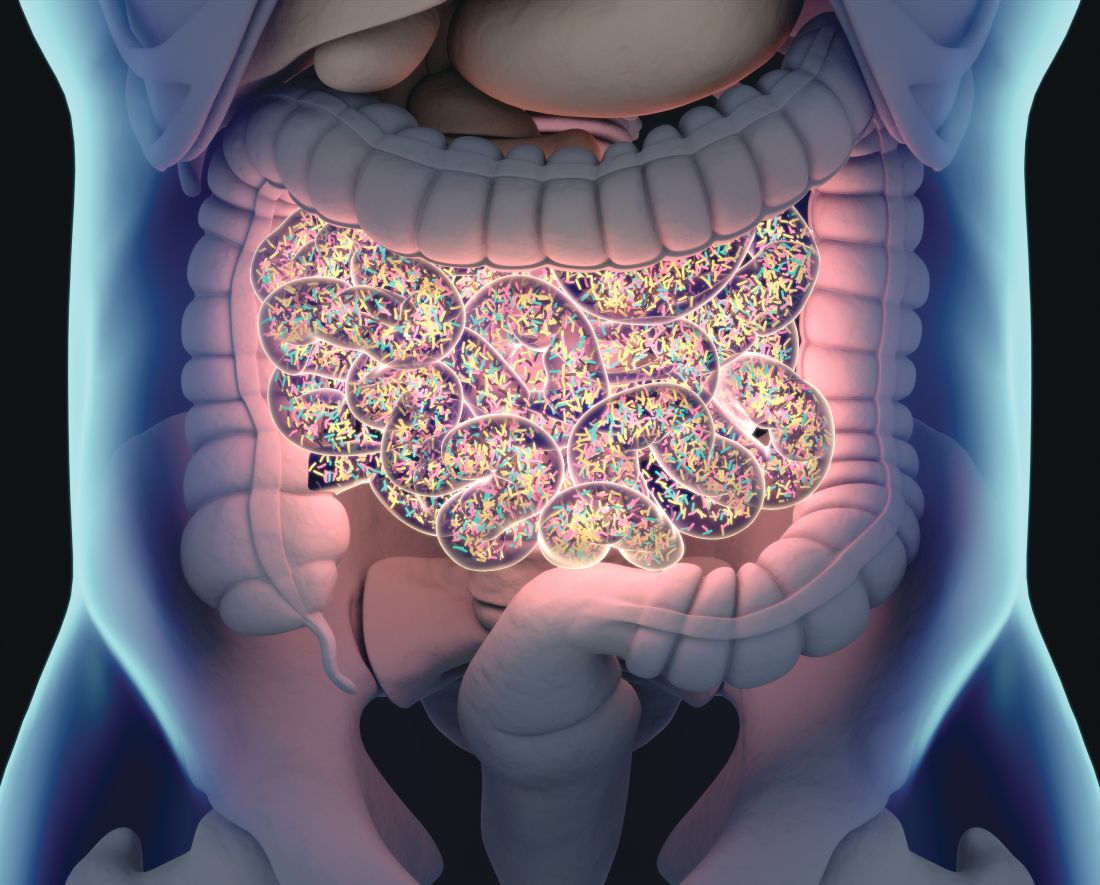
Turns out that individuals with more efficient digestive systems – those that extract more energy from the fuel supplied to them by the busy mouths above – tend to gain more weight than those with less efficient guts, even when they eat the same food, according to a recent study published in Microbiome.
The researchers took a look at the composition of gut microbes in a group of 85 volunteers and found that about 40% had microbiomes dominated by Bacteroides bacteria, which are more effective at extracting nutrients from food. That group also weighed 10% more on average, amounting to an extra 9 kg.
In a rather blatant demonstration of efficiency, the investigators also measured the speed of the participants’ digestion, as they had hypothesized that those with the longest digestive travel times would be the ones who harvested the most nutrition from their food. That was not the case.
The study subjects with the most efficient gut bacteria “also have the fastest passage through the gastrointestinal system, which has given us something to think about,” senior author Henrik Roager of the University of Copenhagen said in a written statement.
You know what gives us something to think about? Stool energy density and intestinal transit time and faecal bacterial cell counts, that’s what. Ick. Sometimes science is gross.
Here’s another thought, though: Seeing faecal instead of fecal is kind of funny to our American eyes, but adding that extra letter is also inefficient, which could mean that it’s good. So, in the spirit of embracing the inefficient as a new year begins, we’re resolving to wrap our editorial arms around faecal and the faeces it represents. Well, not literally, of course. More like we’re embracing the spirit of faeces.
Leave the mouthwash. Take the yogurt
Most of us have experienced some sort of bad breath. It’s common in the morning right after waking up, but it also may be a sign for underlying medical issues like dental problems or acid reflux. Wherever it comes from, we always want to get rid of it. A recent meta-analysis in BMJ Open may have found the answer in some common foods.
For those with halitosis, the basic problem is that the bacteria in their mouths are not happy about where they are. The researchers looked at 130 studies and found seven that suggested fermented food has some effect in combating bad breath.
Now when we say fermented food, we’re not talking about that science project waiting to happen in the back of the refrigerator. Think yogurt, sourdough bread, or miso soup. Anything that contains probiotic bacteria.
Matthew J. Messina, DDS, assistant professor of dentistry at Ohio State University, who was not involved with the study, told Healthline that “the whole idea behind probiotics is [bacteria replacement]. Supplant the ‘bad guys’ with the ‘good guys,’ then we’ll end up with a better result.” Essentially balancing the scales in your mouth.
It may not be a long-term solution, Dr. Messina said, but the short-term data are positive. So if you experience bad breath from time to time, try a little bowl of yogurt instead of chewing gum. If nothing else, the bacteria in your mouth will thank you.
You can talk the silly talk, but can you walk the silly walk?
The Ministry of Silly Walks sketch from Monty Python is an enduring comedy classic, and one of surprising relevance for doctors. After all, this isn’t the first time a study has analyzed the unusual strides of Mr. Putey and Mr. Teabag.
The BMJ Christmas edition truly is the gift that keeps on giving. For this plunge into the Flying Circus, the study authors recruited a small group of fairly average adults and had them walk normally around a track for 5 minutes, monitoring their oxygen intake and energy expenditure. After that, the study participants imitated Mr. Putey’s walk and then Mr. Teabag’s.
In the sketch, Mr. Teabag notes that Mr. Putey’s walk is “not particularly silly,” which is borne out in the research. When imitating Mr. Putey’s walk, oxygen intake and energy expenditure were barely higher than a normal walk, not enough to achieve a meaningful difference. Hopefully he’ll get that government grant to further develop his silly walk, because right now Mr. Putey’s walk simply doesn’t cut it.
Mr. Teabag’s walk is a different story and the very image of inefficiency. Oxygen intake was 2.5 times higher than during the normal walk, and energy expenditure was noticeably higher (8 kcal in men and 5.2 kcal in women). In fact, the walk was so inefficient and its effect so drastic it actually reached the level of vigorous exercise. Thanks to this, the study authors noted that just 11 minutes a day of walking like Mr. Teabag would be enough to reach the general goal of 75 minutes of vigorous exercise per week. Boosting that to 12-19 minutes would increase daily energy expenditure by 100 kcal.
The study authors wrote, “Had an initiative to promote inefficient movement been adopted in the early 1970s, we might now be living among a healthier society. Efforts to promote higher energy – and perhaps more joyful – walking should ensure inclusivity and inefficiency for all.” We think they just advocated for a real-life Ministry of Silly Walks. Well, there have been worse ideas. Just look at Twitter.
When efficient gut microbes go bad
With the latest news from the Ministry of Silly Walks, is it time for humans to embrace all things inefficient? Maybe.
Turns out that individuals with more efficient digestive systems – those that extract more energy from the fuel supplied to them by the busy mouths above – tend to gain more weight than those with less efficient guts, even when they eat the same food, according to a recent study published in Microbiome.
The researchers took a look at the composition of gut microbes in a group of 85 volunteers and found that about 40% had microbiomes dominated by Bacteroides bacteria, which are more effective at extracting nutrients from food. That group also weighed 10% more on average, amounting to an extra 9 kg.
In a rather blatant demonstration of efficiency, the investigators also measured the speed of the participants’ digestion, as they had hypothesized that those with the longest digestive travel times would be the ones who harvested the most nutrition from their food. That was not the case.
The study subjects with the most efficient gut bacteria “also have the fastest passage through the gastrointestinal system, which has given us something to think about,” senior author Henrik Roager of the University of Copenhagen said in a written statement.
You know what gives us something to think about? Stool energy density and intestinal transit time and faecal bacterial cell counts, that’s what. Ick. Sometimes science is gross.
Here’s another thought, though: Seeing faecal instead of fecal is kind of funny to our American eyes, but adding that extra letter is also inefficient, which could mean that it’s good. So, in the spirit of embracing the inefficient as a new year begins, we’re resolving to wrap our editorial arms around faecal and the faeces it represents. Well, not literally, of course. More like we’re embracing the spirit of faeces.
Leave the mouthwash. Take the yogurt
Most of us have experienced some sort of bad breath. It’s common in the morning right after waking up, but it also may be a sign for underlying medical issues like dental problems or acid reflux. Wherever it comes from, we always want to get rid of it. A recent meta-analysis in BMJ Open may have found the answer in some common foods.
For those with halitosis, the basic problem is that the bacteria in their mouths are not happy about where they are. The researchers looked at 130 studies and found seven that suggested fermented food has some effect in combating bad breath.
Now when we say fermented food, we’re not talking about that science project waiting to happen in the back of the refrigerator. Think yogurt, sourdough bread, or miso soup. Anything that contains probiotic bacteria.
Matthew J. Messina, DDS, assistant professor of dentistry at Ohio State University, who was not involved with the study, told Healthline that “the whole idea behind probiotics is [bacteria replacement]. Supplant the ‘bad guys’ with the ‘good guys,’ then we’ll end up with a better result.” Essentially balancing the scales in your mouth.
It may not be a long-term solution, Dr. Messina said, but the short-term data are positive. So if you experience bad breath from time to time, try a little bowl of yogurt instead of chewing gum. If nothing else, the bacteria in your mouth will thank you.
You can talk the silly talk, but can you walk the silly walk?
The Ministry of Silly Walks sketch from Monty Python is an enduring comedy classic, and one of surprising relevance for doctors. After all, this isn’t the first time a study has analyzed the unusual strides of Mr. Putey and Mr. Teabag.
The BMJ Christmas edition truly is the gift that keeps on giving. For this plunge into the Flying Circus, the study authors recruited a small group of fairly average adults and had them walk normally around a track for 5 minutes, monitoring their oxygen intake and energy expenditure. After that, the study participants imitated Mr. Putey’s walk and then Mr. Teabag’s.
In the sketch, Mr. Teabag notes that Mr. Putey’s walk is “not particularly silly,” which is borne out in the research. When imitating Mr. Putey’s walk, oxygen intake and energy expenditure were barely higher than a normal walk, not enough to achieve a meaningful difference. Hopefully he’ll get that government grant to further develop his silly walk, because right now Mr. Putey’s walk simply doesn’t cut it.
Mr. Teabag’s walk is a different story and the very image of inefficiency. Oxygen intake was 2.5 times higher than during the normal walk, and energy expenditure was noticeably higher (8 kcal in men and 5.2 kcal in women). In fact, the walk was so inefficient and its effect so drastic it actually reached the level of vigorous exercise. Thanks to this, the study authors noted that just 11 minutes a day of walking like Mr. Teabag would be enough to reach the general goal of 75 minutes of vigorous exercise per week. Boosting that to 12-19 minutes would increase daily energy expenditure by 100 kcal.
The study authors wrote, “Had an initiative to promote inefficient movement been adopted in the early 1970s, we might now be living among a healthier society. Efforts to promote higher energy – and perhaps more joyful – walking should ensure inclusivity and inefficiency for all.” We think they just advocated for a real-life Ministry of Silly Walks. Well, there have been worse ideas. Just look at Twitter.
When efficient gut microbes go bad
With the latest news from the Ministry of Silly Walks, is it time for humans to embrace all things inefficient? Maybe.
Turns out that individuals with more efficient digestive systems – those that extract more energy from the fuel supplied to them by the busy mouths above – tend to gain more weight than those with less efficient guts, even when they eat the same food, according to a recent study published in Microbiome.
The researchers took a look at the composition of gut microbes in a group of 85 volunteers and found that about 40% had microbiomes dominated by Bacteroides bacteria, which are more effective at extracting nutrients from food. That group also weighed 10% more on average, amounting to an extra 9 kg.
In a rather blatant demonstration of efficiency, the investigators also measured the speed of the participants’ digestion, as they had hypothesized that those with the longest digestive travel times would be the ones who harvested the most nutrition from their food. That was not the case.
The study subjects with the most efficient gut bacteria “also have the fastest passage through the gastrointestinal system, which has given us something to think about,” senior author Henrik Roager of the University of Copenhagen said in a written statement.
You know what gives us something to think about? Stool energy density and intestinal transit time and faecal bacterial cell counts, that’s what. Ick. Sometimes science is gross.
Here’s another thought, though: Seeing faecal instead of fecal is kind of funny to our American eyes, but adding that extra letter is also inefficient, which could mean that it’s good. So, in the spirit of embracing the inefficient as a new year begins, we’re resolving to wrap our editorial arms around faecal and the faeces it represents. Well, not literally, of course. More like we’re embracing the spirit of faeces.

Commentary: Bimekizumab, and PsA's Relationships With AS and Crohn's Disease, January 2023

Two new papers published recently provide evidence of the efficacy and safety of bimekizumab in psoriatic arthritis (PsA). Bimekizumab is a novel bispecific monoclonal antibody targeting interleukin (IL)-17A and IL-17F and is already approved for the treatment of chronic plaque psoriasis. McInnes and colleagues reported the results of the phase 3 BE OPTIMAL study, which included 852 patients with active PsA who were naive to biologic disease-modifying antirheumatic drugs (bDMARD) and were randomly assigned to receive bimekizumab, placebo, or adalimumab. At week 16, a significantly higher proportion of patients receiving bimekizumab vs placebo achieved ≥ 50% improvement in American College of Rheumatology response (ACR50; 44% vs 10%; odds ratio [OR] 7.1; P < .0001). Compared with placebo, significant improvements were also noted in psoriasis, enthesitis, and dactylitis in the bimekizumab group and there was less progression of radiographic damage.
Bimekizumab was also demonstrated to be beneficial in PsA patients with inadequate response or intolerance to tumor necrosis factor inhibitors (TNFi). In the phase 3 BE COMPLETE study, which included 400 patients with active PsA and previous inadequate response or intolerance to TNFi, patients were randomly assigned to receive 160 mg subcutaneous bimekizumab every 4 weeks or placebo. Merola and colleagues reported that at week 16, a significantly higher proportion of patients receiving bimekizumab vs placebo achieved ACR50 response (43% vs 7%; OR 11.1; P < .0001). Thus, bimekizumab is a welcome addition to the treatment portfolio we have for PsA. In regard to side effects of special concern when inhibiting IL-17, bimekizumab was associated with higher risk for oral and genital candidiasis, occurring in 4% of the treated patients within 16 weeks in the two studies; however, no cases of systemic fungal infections occurred. The incidence of inflammatory bowel disease was also very low, but head-to-head studies against other available agents would be required to help rheumatologists decide the place of bimekizumab in PsA management.
A common clinical question is whether axial PsA is similar to ankylosing spondylitis (AS) with psoriasis. Assuming that it is, clinicians have used treatments approved for AS for managing axial PsA. Recent studies have questioned this assumption, however. Michelena and colleagues conducted a cross-sectional study that included 109 patients with axial PsA and 127 patients with AS and psoriasis from the REGISPONSER registry. Compared with patients with AS and psoriasis, patients with human leukocyte antigen (HLA)-B27–negative axial PsA had less inflammatory pain (P = .002), anterior uveitis (P = .014), and structural damage (P < .001), along with a higher prevalence of nail disease (P = .009). Patients with HLA-B27–positive axial PsA vs AS and psoriasis were similar but had less structural damage to the spine (P < .001). Thus, there seem to be significant clinical and genetic differences between these two diseases that require further investigation. Lack of an accepted definition of axial PsA, however, is a hindrance to multiple high-quality genetic, clinical, and interventional studies comparing axial PsA and AS with psoriasis.
Observational studies have recognized the clinical and familial association between psoriatic disease and Crohn's disease (CD), but such cross-sectional or retrospective studies cannot identify causal relationships. Mendelian randomization is a method used to identify causal relationships. Using this method, Sun and colleagues demonstrated that PsA was associated with a 31.9% increased risk for CD (P < .001) and genetically predicted CD was linked to a 44.8% higher risk for PsA (P = .001). No such association was found with ulcerative colitis. Thus, there is a bidirectional causal relationship between the two diseases. Patients with PsA should be evaluated for symptoms of CD, and those with CD for psoriatic disease, to facilitate early diagnosis and better long-term outcomes.
Two new papers published recently provide evidence of the efficacy and safety of bimekizumab in psoriatic arthritis (PsA). Bimekizumab is a novel bispecific monoclonal antibody targeting interleukin (IL)-17A and IL-17F and is already approved for the treatment of chronic plaque psoriasis. McInnes and colleagues reported the results of the phase 3 BE OPTIMAL study, which included 852 patients with active PsA who were naive to biologic disease-modifying antirheumatic drugs (bDMARD) and were randomly assigned to receive bimekizumab, placebo, or adalimumab. At week 16, a significantly higher proportion of patients receiving bimekizumab vs placebo achieved ≥ 50% improvement in American College of Rheumatology response (ACR50; 44% vs 10%; odds ratio [OR] 7.1; P < .0001). Compared with placebo, significant improvements were also noted in psoriasis, enthesitis, and dactylitis in the bimekizumab group and there was less progression of radiographic damage.
Bimekizumab was also demonstrated to be beneficial in PsA patients with inadequate response or intolerance to tumor necrosis factor inhibitors (TNFi). In the phase 3 BE COMPLETE study, which included 400 patients with active PsA and previous inadequate response or intolerance to TNFi, patients were randomly assigned to receive 160 mg subcutaneous bimekizumab every 4 weeks or placebo. Merola and colleagues reported that at week 16, a significantly higher proportion of patients receiving bimekizumab vs placebo achieved ACR50 response (43% vs 7%; OR 11.1; P < .0001). Thus, bimekizumab is a welcome addition to the treatment portfolio we have for PsA. In regard to side effects of special concern when inhibiting IL-17, bimekizumab was associated with higher risk for oral and genital candidiasis, occurring in 4% of the treated patients within 16 weeks in the two studies; however, no cases of systemic fungal infections occurred. The incidence of inflammatory bowel disease was also very low, but head-to-head studies against other available agents would be required to help rheumatologists decide the place of bimekizumab in PsA management.
A common clinical question is whether axial PsA is similar to ankylosing spondylitis (AS) with psoriasis. Assuming that it is, clinicians have used treatments approved for AS for managing axial PsA. Recent studies have questioned this assumption, however. Michelena and colleagues conducted a cross-sectional study that included 109 patients with axial PsA and 127 patients with AS and psoriasis from the REGISPONSER registry. Compared with patients with AS and psoriasis, patients with human leukocyte antigen (HLA)-B27–negative axial PsA had less inflammatory pain (P = .002), anterior uveitis (P = .014), and structural damage (P < .001), along with a higher prevalence of nail disease (P = .009). Patients with HLA-B27–positive axial PsA vs AS and psoriasis were similar but had less structural damage to the spine (P < .001). Thus, there seem to be significant clinical and genetic differences between these two diseases that require further investigation. Lack of an accepted definition of axial PsA, however, is a hindrance to multiple high-quality genetic, clinical, and interventional studies comparing axial PsA and AS with psoriasis.
Observational studies have recognized the clinical and familial association between psoriatic disease and Crohn's disease (CD), but such cross-sectional or retrospective studies cannot identify causal relationships. Mendelian randomization is a method used to identify causal relationships. Using this method, Sun and colleagues demonstrated that PsA was associated with a 31.9% increased risk for CD (P < .001) and genetically predicted CD was linked to a 44.8% higher risk for PsA (P = .001). No such association was found with ulcerative colitis. Thus, there is a bidirectional causal relationship between the two diseases. Patients with PsA should be evaluated for symptoms of CD, and those with CD for psoriatic disease, to facilitate early diagnosis and better long-term outcomes.
Two new papers published recently provide evidence of the efficacy and safety of bimekizumab in psoriatic arthritis (PsA). Bimekizumab is a novel bispecific monoclonal antibody targeting interleukin (IL)-17A and IL-17F and is already approved for the treatment of chronic plaque psoriasis. McInnes and colleagues reported the results of the phase 3 BE OPTIMAL study, which included 852 patients with active PsA who were naive to biologic disease-modifying antirheumatic drugs (bDMARD) and were randomly assigned to receive bimekizumab, placebo, or adalimumab. At week 16, a significantly higher proportion of patients receiving bimekizumab vs placebo achieved ≥ 50% improvement in American College of Rheumatology response (ACR50; 44% vs 10%; odds ratio [OR] 7.1; P < .0001). Compared with placebo, significant improvements were also noted in psoriasis, enthesitis, and dactylitis in the bimekizumab group and there was less progression of radiographic damage.
Bimekizumab was also demonstrated to be beneficial in PsA patients with inadequate response or intolerance to tumor necrosis factor inhibitors (TNFi). In the phase 3 BE COMPLETE study, which included 400 patients with active PsA and previous inadequate response or intolerance to TNFi, patients were randomly assigned to receive 160 mg subcutaneous bimekizumab every 4 weeks or placebo. Merola and colleagues reported that at week 16, a significantly higher proportion of patients receiving bimekizumab vs placebo achieved ACR50 response (43% vs 7%; OR 11.1; P < .0001). Thus, bimekizumab is a welcome addition to the treatment portfolio we have for PsA. In regard to side effects of special concern when inhibiting IL-17, bimekizumab was associated with higher risk for oral and genital candidiasis, occurring in 4% of the treated patients within 16 weeks in the two studies; however, no cases of systemic fungal infections occurred. The incidence of inflammatory bowel disease was also very low, but head-to-head studies against other available agents would be required to help rheumatologists decide the place of bimekizumab in PsA management.
A common clinical question is whether axial PsA is similar to ankylosing spondylitis (AS) with psoriasis. Assuming that it is, clinicians have used treatments approved for AS for managing axial PsA. Recent studies have questioned this assumption, however. Michelena and colleagues conducted a cross-sectional study that included 109 patients with axial PsA and 127 patients with AS and psoriasis from the REGISPONSER registry. Compared with patients with AS and psoriasis, patients with human leukocyte antigen (HLA)-B27–negative axial PsA had less inflammatory pain (P = .002), anterior uveitis (P = .014), and structural damage (P < .001), along with a higher prevalence of nail disease (P = .009). Patients with HLA-B27–positive axial PsA vs AS and psoriasis were similar but had less structural damage to the spine (P < .001). Thus, there seem to be significant clinical and genetic differences between these two diseases that require further investigation. Lack of an accepted definition of axial PsA, however, is a hindrance to multiple high-quality genetic, clinical, and interventional studies comparing axial PsA and AS with psoriasis.
Observational studies have recognized the clinical and familial association between psoriatic disease and Crohn's disease (CD), but such cross-sectional or retrospective studies cannot identify causal relationships. Mendelian randomization is a method used to identify causal relationships. Using this method, Sun and colleagues demonstrated that PsA was associated with a 31.9% increased risk for CD (P < .001) and genetically predicted CD was linked to a 44.8% higher risk for PsA (P = .001). No such association was found with ulcerative colitis. Thus, there is a bidirectional causal relationship between the two diseases. Patients with PsA should be evaluated for symptoms of CD, and those with CD for psoriatic disease, to facilitate early diagnosis and better long-term outcomes.
Commentary: Research on Potential Migraine Triggers, January 2023
January's theme is migraine triggers. We'll take a look at three recent studies that have tried to better determine the nature of specific triggers for headache.
One of the most common and reportedly consistent migraine triggers is exposure to alcohol, and the International Classification of Headache Disorders (ICHD-3) includes alcohol-induced headache as a secondary headache. Little is known regarding the association between migraine and alcohol. Vives-Mestres and colleagues investigated the alcohol intake of people using a digital health diary for headache. They specifically looked at the 48 hours preceding a migraine attack and whether alcohol was consumed, and also the number of beverages consumed. This was further adjusted for sex, age, and average weekly alcohol intake.
The N1-Headache Tracker is a digital headache diary that patients use to track their daily headache symptoms and inform them of potential migraine risk factors. Over a 90-day period, this study followed patients that did not meet the criteria for a diagnosis of chronic migraine. They also reported on their intake to the platform that they regularly consume alcohol. Of note, persons who never tracked alcohol consumption were excluded from this study. On intake to the platform, alcohol exposure was characterized both as whether daily consumption of alcohol was occurring and as the total daily number of alcoholic beverages.
The primary outcome of this study was migraine attack 1 day after alcohol consumption. Participants were specifically asked if their headaches were diagnosed as migraine by a physician. Migraine attack onset was considered binary, and a logistic model was used to estimate the probability of having a migraine attack on any given day with the association of alcohol intake for up to 48 hours prior to that day.
A total of 487 people with migraine were included in this trial and they collectively contributed over 43,000 diary days; almost 6000 were first days of a migraine attack. Overall alcohol consumption was not considered high and was noted to vary between groups; people with lower frequency migraine tended to have higher rates of alcohol intake. No significant correlation was observed between the presence of migraine attacks within 48 hours after alcohol consumption. This did not vary among different probability models; a population-level model showed that the probability of a migraine attack 2 days after alcohol intake was 25% lower than the probability of an attack with no alcohol consumption. This was also true after adjustment for age, sex, and average number of alcoholic beverages per week.
The association between migraine and alcohol is complicated, and the concept of migraine triggers in general is very complex. Although over 70% of people with migraine say that they have a consistent trigger, and alcohol is consistently at the top of the list of those reported triggers, there does not appear to be a direct correlation between migraine and alcohol exposure. The greatest caveat of this study is the fact that people with chronic migraine were excluded. Further research should specifically investigate triggers such as alcohol in this population.
The use of proton pump inhibitors (PPI) has been shown in previous studies over the past few years to be associated with a number of neurologic events and risks, including impaired hearing, vision, and memory, as well as migraine occurrence. The specifics of this association are not well known — specifically, whether the duration of use is the main factor, or whether it is acute exposure to a PPI medication that is a trigger. Kang and colleagues reviewed data in the Korean national database and developed a case-control model to study this association specifically.
The migraine and control groups were equally matched: They had the same demographics, smoking status, alcohol consumption, blood pressure range, fasting glucose, and total cholesterol. Past and current PPI use and comparisons of migraine occurrence were further differentiated among patients who were exposed to PPI medications for < 30 days, 30-365 days, and > 365 days.
The use of PPI treatments was noted to be linked to increased migraine regardless of duration, and regardless of the acute presence of the PPI. Even a history of prior PPI use was noted to increase the odds ratio of migraine development. This was significant among all subgroups, independent of age, sex, and other comorbidities. There was no difference in the presence of aura associated with migraine.
As we noted above, the concept of migraine triggers is overall poorly understood. This is even more the case when it comes to historical exposures. Although the use of PPI medications appears to be associated with the occurrence of migraine in this population, these medications are necessary in many instances, including in patients with severe gastritis and gastroesophageal reflux refractory to diet changes. It remains to be seen precisely how PPI medications would potentially lead to a higher incidence of migraine.
Among many of the triggers discussed, specific foods are commonly thought to be associated with migraine. Although there is scant evidence for a specific diet to improve migraine frequency, many patients are very interested in potential dietary changes that may help them. Prior studies and reviews have looked at gluten-free, dairy-free, low-carbohydrate, low-tyramine, and elimination diets — all of which were not associated with a significant improvement in migraine frequency or severity. Bakıran and colleagues sought to investigate an antioxidant-rich diet that included polyphenols and carotenoids — substances that may improve systemic inflammation, glucose metabolism, and oxidative stress.
Phytochemical-rich foods include fruits and vegetables (excluding potatoes) as well as nuts, whole grains, pulses, and olive oil. The phytochemical index is a tool used by dietitians and nutritionists to assess the phytochemical content in a diet.
A total of 90 patients who had a diagnosis of episodic migraine by a neurologist were enrolled. Individuals were excluded if they had a body mass index > 40 or < 18 or had other significant chronic comorbidities, such as hypertension, diabetes, hepatic or renal disease, or other neurologic conditions. Participants filled out a headache diary over 3 months; the Migraine Disability Assessment (MIDAS) questionnaire was also followed in order to assess migraine-related disability. Diet quality was cataloged as per patient records; patients also filled out a 3-day nonconsecutive food diary. This information was added to a food software program that calculated specific nutrients, including the phytochemical index.
Participants were divided into groups with good diet quality and poor diet quality based on their phytochemical index. No differences were seen in migraine frequency or disability between these groups, although mean attack duration was lower in those with poor diet quality. Severity was noted to be higher in those with poor diet quality; 75% of participants with poor diet quality experienced severe attacks.
Overall, the results of this study are very mixed. Participants on the recommended high phytochemical diet were seen to have lower severity of migraine but a prolonged duration of attack. There also was no correlation between this diet and either frequency or disability. This was a small study, and further research should focus on this among other diet changes that have the possibility to improve the quality of life of people with migraine.
January's theme is migraine triggers. We'll take a look at three recent studies that have tried to better determine the nature of specific triggers for headache.
One of the most common and reportedly consistent migraine triggers is exposure to alcohol, and the International Classification of Headache Disorders (ICHD-3) includes alcohol-induced headache as a secondary headache. Little is known regarding the association between migraine and alcohol. Vives-Mestres and colleagues investigated the alcohol intake of people using a digital health diary for headache. They specifically looked at the 48 hours preceding a migraine attack and whether alcohol was consumed, and also the number of beverages consumed. This was further adjusted for sex, age, and average weekly alcohol intake.
The N1-Headache Tracker is a digital headache diary that patients use to track their daily headache symptoms and inform them of potential migraine risk factors. Over a 90-day period, this study followed patients that did not meet the criteria for a diagnosis of chronic migraine. They also reported on their intake to the platform that they regularly consume alcohol. Of note, persons who never tracked alcohol consumption were excluded from this study. On intake to the platform, alcohol exposure was characterized both as whether daily consumption of alcohol was occurring and as the total daily number of alcoholic beverages.
The primary outcome of this study was migraine attack 1 day after alcohol consumption. Participants were specifically asked if their headaches were diagnosed as migraine by a physician. Migraine attack onset was considered binary, and a logistic model was used to estimate the probability of having a migraine attack on any given day with the association of alcohol intake for up to 48 hours prior to that day.
A total of 487 people with migraine were included in this trial and they collectively contributed over 43,000 diary days; almost 6000 were first days of a migraine attack. Overall alcohol consumption was not considered high and was noted to vary between groups; people with lower frequency migraine tended to have higher rates of alcohol intake. No significant correlation was observed between the presence of migraine attacks within 48 hours after alcohol consumption. This did not vary among different probability models; a population-level model showed that the probability of a migraine attack 2 days after alcohol intake was 25% lower than the probability of an attack with no alcohol consumption. This was also true after adjustment for age, sex, and average number of alcoholic beverages per week.
The association between migraine and alcohol is complicated, and the concept of migraine triggers in general is very complex. Although over 70% of people with migraine say that they have a consistent trigger, and alcohol is consistently at the top of the list of those reported triggers, there does not appear to be a direct correlation between migraine and alcohol exposure. The greatest caveat of this study is the fact that people with chronic migraine were excluded. Further research should specifically investigate triggers such as alcohol in this population.
The use of proton pump inhibitors (PPI) has been shown in previous studies over the past few years to be associated with a number of neurologic events and risks, including impaired hearing, vision, and memory, as well as migraine occurrence. The specifics of this association are not well known — specifically, whether the duration of use is the main factor, or whether it is acute exposure to a PPI medication that is a trigger. Kang and colleagues reviewed data in the Korean national database and developed a case-control model to study this association specifically.
The migraine and control groups were equally matched: They had the same demographics, smoking status, alcohol consumption, blood pressure range, fasting glucose, and total cholesterol. Past and current PPI use and comparisons of migraine occurrence were further differentiated among patients who were exposed to PPI medications for < 30 days, 30-365 days, and > 365 days.
The use of PPI treatments was noted to be linked to increased migraine regardless of duration, and regardless of the acute presence of the PPI. Even a history of prior PPI use was noted to increase the odds ratio of migraine development. This was significant among all subgroups, independent of age, sex, and other comorbidities. There was no difference in the presence of aura associated with migraine.
As we noted above, the concept of migraine triggers is overall poorly understood. This is even more the case when it comes to historical exposures. Although the use of PPI medications appears to be associated with the occurrence of migraine in this population, these medications are necessary in many instances, including in patients with severe gastritis and gastroesophageal reflux refractory to diet changes. It remains to be seen precisely how PPI medications would potentially lead to a higher incidence of migraine.
Among many of the triggers discussed, specific foods are commonly thought to be associated with migraine. Although there is scant evidence for a specific diet to improve migraine frequency, many patients are very interested in potential dietary changes that may help them. Prior studies and reviews have looked at gluten-free, dairy-free, low-carbohydrate, low-tyramine, and elimination diets — all of which were not associated with a significant improvement in migraine frequency or severity. Bakıran and colleagues sought to investigate an antioxidant-rich diet that included polyphenols and carotenoids — substances that may improve systemic inflammation, glucose metabolism, and oxidative stress.
Phytochemical-rich foods include fruits and vegetables (excluding potatoes) as well as nuts, whole grains, pulses, and olive oil. The phytochemical index is a tool used by dietitians and nutritionists to assess the phytochemical content in a diet.
A total of 90 patients who had a diagnosis of episodic migraine by a neurologist were enrolled. Individuals were excluded if they had a body mass index > 40 or < 18 or had other significant chronic comorbidities, such as hypertension, diabetes, hepatic or renal disease, or other neurologic conditions. Participants filled out a headache diary over 3 months; the Migraine Disability Assessment (MIDAS) questionnaire was also followed in order to assess migraine-related disability. Diet quality was cataloged as per patient records; patients also filled out a 3-day nonconsecutive food diary. This information was added to a food software program that calculated specific nutrients, including the phytochemical index.
Participants were divided into groups with good diet quality and poor diet quality based on their phytochemical index. No differences were seen in migraine frequency or disability between these groups, although mean attack duration was lower in those with poor diet quality. Severity was noted to be higher in those with poor diet quality; 75% of participants with poor diet quality experienced severe attacks.
Overall, the results of this study are very mixed. Participants on the recommended high phytochemical diet were seen to have lower severity of migraine but a prolonged duration of attack. There also was no correlation between this diet and either frequency or disability. This was a small study, and further research should focus on this among other diet changes that have the possibility to improve the quality of life of people with migraine.
January's theme is migraine triggers. We'll take a look at three recent studies that have tried to better determine the nature of specific triggers for headache.
One of the most common and reportedly consistent migraine triggers is exposure to alcohol, and the International Classification of Headache Disorders (ICHD-3) includes alcohol-induced headache as a secondary headache. Little is known regarding the association between migraine and alcohol. Vives-Mestres and colleagues investigated the alcohol intake of people using a digital health diary for headache. They specifically looked at the 48 hours preceding a migraine attack and whether alcohol was consumed, and also the number of beverages consumed. This was further adjusted for sex, age, and average weekly alcohol intake.
The N1-Headache Tracker is a digital headache diary that patients use to track their daily headache symptoms and inform them of potential migraine risk factors. Over a 90-day period, this study followed patients that did not meet the criteria for a diagnosis of chronic migraine. They also reported on their intake to the platform that they regularly consume alcohol. Of note, persons who never tracked alcohol consumption were excluded from this study. On intake to the platform, alcohol exposure was characterized both as whether daily consumption of alcohol was occurring and as the total daily number of alcoholic beverages.
The primary outcome of this study was migraine attack 1 day after alcohol consumption. Participants were specifically asked if their headaches were diagnosed as migraine by a physician. Migraine attack onset was considered binary, and a logistic model was used to estimate the probability of having a migraine attack on any given day with the association of alcohol intake for up to 48 hours prior to that day.
A total of 487 people with migraine were included in this trial and they collectively contributed over 43,000 diary days; almost 6000 were first days of a migraine attack. Overall alcohol consumption was not considered high and was noted to vary between groups; people with lower frequency migraine tended to have higher rates of alcohol intake. No significant correlation was observed between the presence of migraine attacks within 48 hours after alcohol consumption. This did not vary among different probability models; a population-level model showed that the probability of a migraine attack 2 days after alcohol intake was 25% lower than the probability of an attack with no alcohol consumption. This was also true after adjustment for age, sex, and average number of alcoholic beverages per week.
The association between migraine and alcohol is complicated, and the concept of migraine triggers in general is very complex. Although over 70% of people with migraine say that they have a consistent trigger, and alcohol is consistently at the top of the list of those reported triggers, there does not appear to be a direct correlation between migraine and alcohol exposure. The greatest caveat of this study is the fact that people with chronic migraine were excluded. Further research should specifically investigate triggers such as alcohol in this population.
The use of proton pump inhibitors (PPI) has been shown in previous studies over the past few years to be associated with a number of neurologic events and risks, including impaired hearing, vision, and memory, as well as migraine occurrence. The specifics of this association are not well known — specifically, whether the duration of use is the main factor, or whether it is acute exposure to a PPI medication that is a trigger. Kang and colleagues reviewed data in the Korean national database and developed a case-control model to study this association specifically.
The migraine and control groups were equally matched: They had the same demographics, smoking status, alcohol consumption, blood pressure range, fasting glucose, and total cholesterol. Past and current PPI use and comparisons of migraine occurrence were further differentiated among patients who were exposed to PPI medications for < 30 days, 30-365 days, and > 365 days.
The use of PPI treatments was noted to be linked to increased migraine regardless of duration, and regardless of the acute presence of the PPI. Even a history of prior PPI use was noted to increase the odds ratio of migraine development. This was significant among all subgroups, independent of age, sex, and other comorbidities. There was no difference in the presence of aura associated with migraine.
As we noted above, the concept of migraine triggers is overall poorly understood. This is even more the case when it comes to historical exposures. Although the use of PPI medications appears to be associated with the occurrence of migraine in this population, these medications are necessary in many instances, including in patients with severe gastritis and gastroesophageal reflux refractory to diet changes. It remains to be seen precisely how PPI medications would potentially lead to a higher incidence of migraine.
Among many of the triggers discussed, specific foods are commonly thought to be associated with migraine. Although there is scant evidence for a specific diet to improve migraine frequency, many patients are very interested in potential dietary changes that may help them. Prior studies and reviews have looked at gluten-free, dairy-free, low-carbohydrate, low-tyramine, and elimination diets — all of which were not associated with a significant improvement in migraine frequency or severity. Bakıran and colleagues sought to investigate an antioxidant-rich diet that included polyphenols and carotenoids — substances that may improve systemic inflammation, glucose metabolism, and oxidative stress.
Phytochemical-rich foods include fruits and vegetables (excluding potatoes) as well as nuts, whole grains, pulses, and olive oil. The phytochemical index is a tool used by dietitians and nutritionists to assess the phytochemical content in a diet.
A total of 90 patients who had a diagnosis of episodic migraine by a neurologist were enrolled. Individuals were excluded if they had a body mass index > 40 or < 18 or had other significant chronic comorbidities, such as hypertension, diabetes, hepatic or renal disease, or other neurologic conditions. Participants filled out a headache diary over 3 months; the Migraine Disability Assessment (MIDAS) questionnaire was also followed in order to assess migraine-related disability. Diet quality was cataloged as per patient records; patients also filled out a 3-day nonconsecutive food diary. This information was added to a food software program that calculated specific nutrients, including the phytochemical index.
Participants were divided into groups with good diet quality and poor diet quality based on their phytochemical index. No differences were seen in migraine frequency or disability between these groups, although mean attack duration was lower in those with poor diet quality. Severity was noted to be higher in those with poor diet quality; 75% of participants with poor diet quality experienced severe attacks.
Overall, the results of this study are very mixed. Participants on the recommended high phytochemical diet were seen to have lower severity of migraine but a prolonged duration of attack. There also was no correlation between this diet and either frequency or disability. This was a small study, and further research should focus on this among other diet changes that have the possibility to improve the quality of life of people with migraine.
Atypical Keratotic Nodule on the Knuckle
The Diagnosis: Atypical Mycobacterial Infection
The history of rapid growth followed by shrinkage as well as the craterlike clinical appearance of our patient’s lesion were suspicious for the keratoacanthoma variant of squamous cell carcinoma (SCC). Periodic acid–Schiff green staining was negative for fungal or bacterial organisms, and the biopsy findings of keratinocyte atypia and irregular epidermal proliferation seemed to confirm our suspicion for well-differentiated SCC (Figure 1). Our patient subsequently was scheduled for Mohs micrographic surgery. Fortunately, a sample of tissue had been sent for panculture—bacterial, fungal, and mycobacterial—to rule out infectious etiologies, given the history of possible traumatic inoculation, and returned positive for Mycobacterium marinum infection prior to the surgery. Mohs surgery was canceled, and he was referred to an infectious disease specialist who started antibiotic treatment with azithromycin, ethambutol, and rifabutin. After 1 month of treatment the lesion substantially improved (Figure 2), further supporting the diagnosis of M marinum infection over SCC.
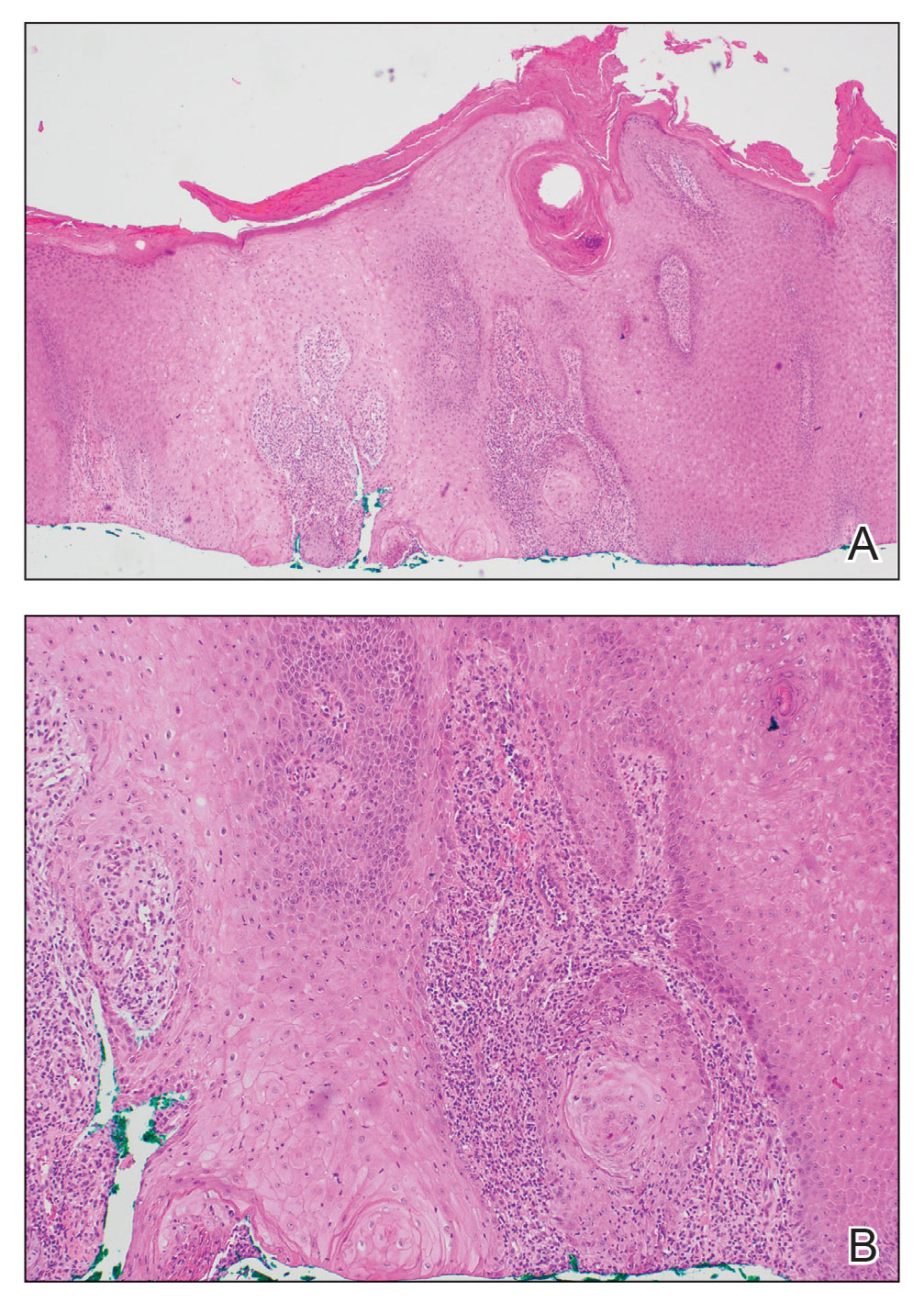
The differential diagnosis also included sporotrichosis, leishmaniasis, and chromoblastomycosis. Sporotrichosis lesions typically develop as multiple nodules and ulcers along a path of lymphatic drainage and can exhibit asteroid bodies and cigar-shaped yeast forms on histology. Chromoblastomycosis may display pseudoepitheliomatous hyperplasia and granulomatous inflammation; however, pathognomonic pigmented Medlar bodies also likely would be present.1 Leishmaniasis has a wide variety of presentations; however, it typically occurs in patients with exposure to endemic areas outside of the United States. Although leishmaniasis may demonstrate pseudoepitheliomatous hyperplasia, ulceration, and mixed inflammation on histology, it also likely would show amastigotes within dermal macrophages.2
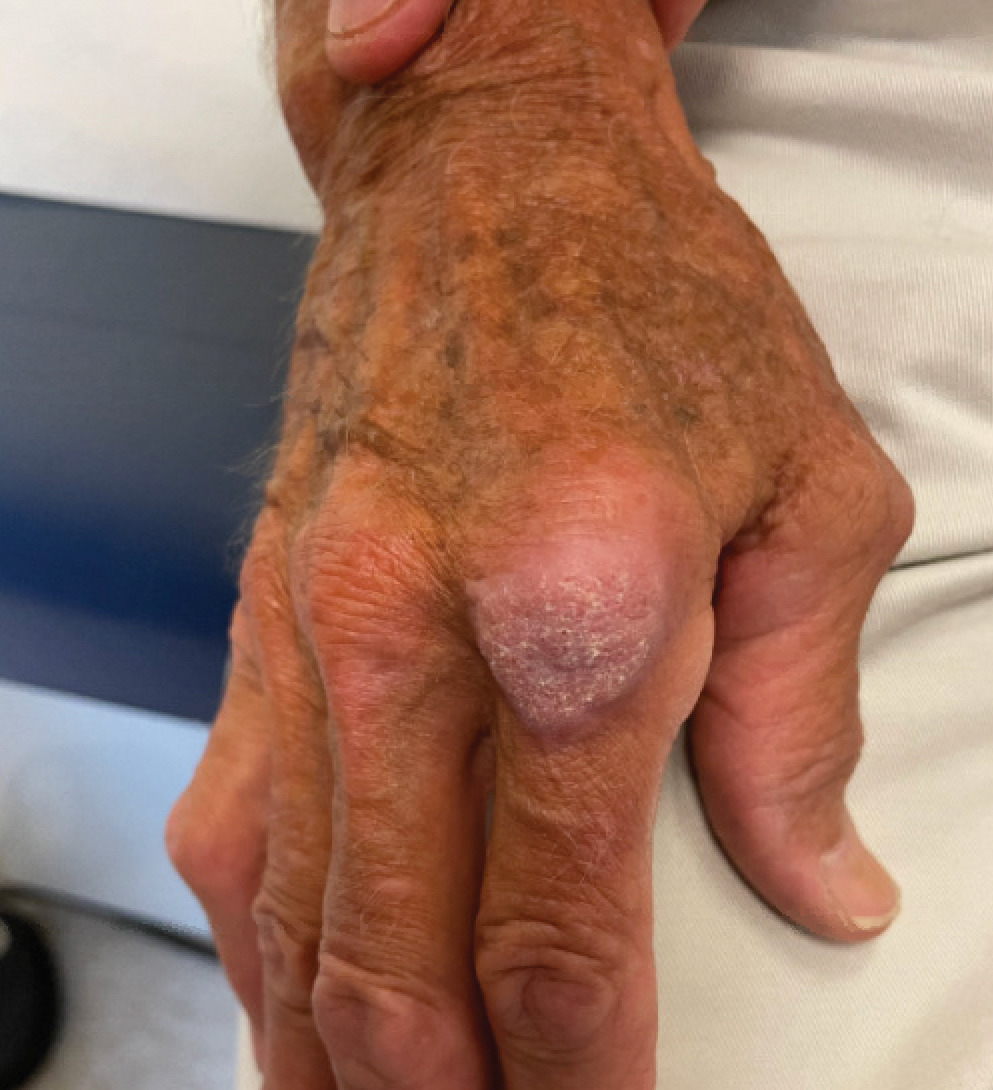
Atypical mycobacterial infections initially may be misdiagnosed as SCC due to their tendency to induce irregular acanthosis in the form of pseudoepitheliomatous hyperplasia as well as mild keratinocyte atypia secondary to inflammation.3,4 Our case is unique because it occurred with M marinum infection specifically. The histopathologic findings of M marinum infections are variable and may additionally include granulomas, most commonly suppurative; intraepithelial abscesses; small vessel proliferation; dermal fibrosis; multinucleated giant cells; and transepidermal elimination.4,5 Periodic acid–Schiff, Ziehl-Neelsen (acid-fast bacilli), and Fite staining may be used to distinguish M marinum infection from SCC but have low sensitivities (approximately 30%). Culture remains the most reliable test, with a sensitivity of nearly 80%.5-7 In our patient, a Periodic acid–Schiff stain was obtained prior to receiving culture results, and acid-fast bacilli and Fite staining were added after the culture returned positive; however, all 3 stains failed to highlight any mycobacteria.
The primary risk factor for infection with M marinum is contact with aquatic environments or marine animals, and most cases involve the fingers or the hand.6 After we reached the diagnosis and further discussed the patient’s history, he recalled fishing for and cleaning raw shrimp around the time that he had a splinter. The Infectious Diseases Society of America recommends a treatment course extending 1 to 2 months after clinical symptoms resolve with ethambutol in addition to clarithromycin or azithromycin.8 If the infection is near a joint, rifampin should be empirically added to account for a potentially deeper infection. Imaging should be obtained to evaluate for joint space involvement, with magnetic resonance imaging being the preferred modality. If joint space involvement is confirmed, surgical debridement is indicated. Surgical debridement also is indicated for infections that fail to respond to antibiotic therapy.8
This case highlights M marinum infection as a potential mimicker of SCC, particularly if the biopsy is relatively superficial, as often occurs when obtained via the common shave technique. The distinction is critical, as M marinum infection is highly treatable and inappropriate surgery on the typical hand and finger locations may subject patients to substantial morbidity, such as the need for a skin graft, reduced mobility from scarring, or risk for serious wound infection.9 For superficial biopsies of an atypical squamous process, pathologists also may consider routinely recommending tissue culture, especially for hand and finger locations or when a history of local trauma is reported, instead of recommending complete excision or repeat biopsy alone.
- Elewski BE, Hughey LC, Hunt KM, et al. Fungal diseases. In: Bolognia J, Schaffer JV, Cerroni L, eds. Dermatology. 4th ed. Elsevier; 2018:1329-1363.
- Bravo FG. Protozoa and worms. In: Bolognia J, Schaffer JV, Cerroni L, eds. Dermatology. 4th ed. Elsevier; 2018:1470-1502.
- Zayour M, Lazova R. Pseudoepitheliomatous hyperplasia: a review. Am J Dermatopathol. 2011;33:112-122; quiz 123-126. doi:10.1097 /DAD.0b013e3181fcfb47
- Li JJ, Beresford R, Fyfe J, et al. Clinical and histopathological features of cutaneous nontuberculous mycobacterial infection: a review of 13 cases. J Cutan Pathol. 2017;44:433-443. doi:10.1111/cup.12903
- Abbas O, Marrouch N, Kattar MM, et al. Cutaneous non-tuberculous mycobacterial infections: a clinical and histopathological study of 17 cases from Lebanon. J Eur Acad Dermatol Venereol. 2011;25:33-42. doi:10.1111/j.1468-3083.2010.03684.x
- Johnson MG, Stout JE. Twenty-eight cases of Mycobacterium marinum infection: retrospective case series and literature review. Infection. 2015;43:655-662. doi:10.1007/s15010-015-0776-8
- Aubry A, Mougari F, Reibel F, et al. Mycobacterium marinum. Microbiol Spectr. 2017;5. doi:10.1128/microbiolspec.TNMI7-0038-2016
- Griffith DE, Aksamit T, Brown-Elliott BA, et al. An official ATS/IDSA statement: diagnosis, treatment, and prevention of nontuberculous mycobacterial diseases. Am J Respir Crit Care Med. 2007;175:367-416. doi:10.1164/rccm.200604-571ST
- Alam M, Ibrahim O, Nodzenski M, et al. Adverse events associated with Mohs micrographic surgery: multicenter prospective cohort study of 20,821 cases at 23 centers. JAMA Dermatol. 2013;149:1378-1385. doi:10.1001/jamadermatol.2013.6255
The Diagnosis: Atypical Mycobacterial Infection
The history of rapid growth followed by shrinkage as well as the craterlike clinical appearance of our patient’s lesion were suspicious for the keratoacanthoma variant of squamous cell carcinoma (SCC). Periodic acid–Schiff green staining was negative for fungal or bacterial organisms, and the biopsy findings of keratinocyte atypia and irregular epidermal proliferation seemed to confirm our suspicion for well-differentiated SCC (Figure 1). Our patient subsequently was scheduled for Mohs micrographic surgery. Fortunately, a sample of tissue had been sent for panculture—bacterial, fungal, and mycobacterial—to rule out infectious etiologies, given the history of possible traumatic inoculation, and returned positive for Mycobacterium marinum infection prior to the surgery. Mohs surgery was canceled, and he was referred to an infectious disease specialist who started antibiotic treatment with azithromycin, ethambutol, and rifabutin. After 1 month of treatment the lesion substantially improved (Figure 2), further supporting the diagnosis of M marinum infection over SCC.
The differential diagnosis also included sporotrichosis, leishmaniasis, and chromoblastomycosis. Sporotrichosis lesions typically develop as multiple nodules and ulcers along a path of lymphatic drainage and can exhibit asteroid bodies and cigar-shaped yeast forms on histology. Chromoblastomycosis may display pseudoepitheliomatous hyperplasia and granulomatous inflammation; however, pathognomonic pigmented Medlar bodies also likely would be present.1 Leishmaniasis has a wide variety of presentations; however, it typically occurs in patients with exposure to endemic areas outside of the United States. Although leishmaniasis may demonstrate pseudoepitheliomatous hyperplasia, ulceration, and mixed inflammation on histology, it also likely would show amastigotes within dermal macrophages.2
Atypical mycobacterial infections initially may be misdiagnosed as SCC due to their tendency to induce irregular acanthosis in the form of pseudoepitheliomatous hyperplasia as well as mild keratinocyte atypia secondary to inflammation.3,4 Our case is unique because it occurred with M marinum infection specifically. The histopathologic findings of M marinum infections are variable and may additionally include granulomas, most commonly suppurative; intraepithelial abscesses; small vessel proliferation; dermal fibrosis; multinucleated giant cells; and transepidermal elimination.4,5 Periodic acid–Schiff, Ziehl-Neelsen (acid-fast bacilli), and Fite staining may be used to distinguish M marinum infection from SCC but have low sensitivities (approximately 30%). Culture remains the most reliable test, with a sensitivity of nearly 80%.5-7 In our patient, a Periodic acid–Schiff stain was obtained prior to receiving culture results, and acid-fast bacilli and Fite staining were added after the culture returned positive; however, all 3 stains failed to highlight any mycobacteria.
The primary risk factor for infection with M marinum is contact with aquatic environments or marine animals, and most cases involve the fingers or the hand.6 After we reached the diagnosis and further discussed the patient’s history, he recalled fishing for and cleaning raw shrimp around the time that he had a splinter. The Infectious Diseases Society of America recommends a treatment course extending 1 to 2 months after clinical symptoms resolve with ethambutol in addition to clarithromycin or azithromycin.8 If the infection is near a joint, rifampin should be empirically added to account for a potentially deeper infection. Imaging should be obtained to evaluate for joint space involvement, with magnetic resonance imaging being the preferred modality. If joint space involvement is confirmed, surgical debridement is indicated. Surgical debridement also is indicated for infections that fail to respond to antibiotic therapy.8
This case highlights M marinum infection as a potential mimicker of SCC, particularly if the biopsy is relatively superficial, as often occurs when obtained via the common shave technique. The distinction is critical, as M marinum infection is highly treatable and inappropriate surgery on the typical hand and finger locations may subject patients to substantial morbidity, such as the need for a skin graft, reduced mobility from scarring, or risk for serious wound infection.9 For superficial biopsies of an atypical squamous process, pathologists also may consider routinely recommending tissue culture, especially for hand and finger locations or when a history of local trauma is reported, instead of recommending complete excision or repeat biopsy alone.
The Diagnosis: Atypical Mycobacterial Infection
The history of rapid growth followed by shrinkage as well as the craterlike clinical appearance of our patient’s lesion were suspicious for the keratoacanthoma variant of squamous cell carcinoma (SCC). Periodic acid–Schiff green staining was negative for fungal or bacterial organisms, and the biopsy findings of keratinocyte atypia and irregular epidermal proliferation seemed to confirm our suspicion for well-differentiated SCC (Figure 1). Our patient subsequently was scheduled for Mohs micrographic surgery. Fortunately, a sample of tissue had been sent for panculture—bacterial, fungal, and mycobacterial—to rule out infectious etiologies, given the history of possible traumatic inoculation, and returned positive for Mycobacterium marinum infection prior to the surgery. Mohs surgery was canceled, and he was referred to an infectious disease specialist who started antibiotic treatment with azithromycin, ethambutol, and rifabutin. After 1 month of treatment the lesion substantially improved (Figure 2), further supporting the diagnosis of M marinum infection over SCC.
The differential diagnosis also included sporotrichosis, leishmaniasis, and chromoblastomycosis. Sporotrichosis lesions typically develop as multiple nodules and ulcers along a path of lymphatic drainage and can exhibit asteroid bodies and cigar-shaped yeast forms on histology. Chromoblastomycosis may display pseudoepitheliomatous hyperplasia and granulomatous inflammation; however, pathognomonic pigmented Medlar bodies also likely would be present.1 Leishmaniasis has a wide variety of presentations; however, it typically occurs in patients with exposure to endemic areas outside of the United States. Although leishmaniasis may demonstrate pseudoepitheliomatous hyperplasia, ulceration, and mixed inflammation on histology, it also likely would show amastigotes within dermal macrophages.2
Atypical mycobacterial infections initially may be misdiagnosed as SCC due to their tendency to induce irregular acanthosis in the form of pseudoepitheliomatous hyperplasia as well as mild keratinocyte atypia secondary to inflammation.3,4 Our case is unique because it occurred with M marinum infection specifically. The histopathologic findings of M marinum infections are variable and may additionally include granulomas, most commonly suppurative; intraepithelial abscesses; small vessel proliferation; dermal fibrosis; multinucleated giant cells; and transepidermal elimination.4,5 Periodic acid–Schiff, Ziehl-Neelsen (acid-fast bacilli), and Fite staining may be used to distinguish M marinum infection from SCC but have low sensitivities (approximately 30%). Culture remains the most reliable test, with a sensitivity of nearly 80%.5-7 In our patient, a Periodic acid–Schiff stain was obtained prior to receiving culture results, and acid-fast bacilli and Fite staining were added after the culture returned positive; however, all 3 stains failed to highlight any mycobacteria.
The primary risk factor for infection with M marinum is contact with aquatic environments or marine animals, and most cases involve the fingers or the hand.6 After we reached the diagnosis and further discussed the patient’s history, he recalled fishing for and cleaning raw shrimp around the time that he had a splinter. The Infectious Diseases Society of America recommends a treatment course extending 1 to 2 months after clinical symptoms resolve with ethambutol in addition to clarithromycin or azithromycin.8 If the infection is near a joint, rifampin should be empirically added to account for a potentially deeper infection. Imaging should be obtained to evaluate for joint space involvement, with magnetic resonance imaging being the preferred modality. If joint space involvement is confirmed, surgical debridement is indicated. Surgical debridement also is indicated for infections that fail to respond to antibiotic therapy.8
This case highlights M marinum infection as a potential mimicker of SCC, particularly if the biopsy is relatively superficial, as often occurs when obtained via the common shave technique. The distinction is critical, as M marinum infection is highly treatable and inappropriate surgery on the typical hand and finger locations may subject patients to substantial morbidity, such as the need for a skin graft, reduced mobility from scarring, or risk for serious wound infection.9 For superficial biopsies of an atypical squamous process, pathologists also may consider routinely recommending tissue culture, especially for hand and finger locations or when a history of local trauma is reported, instead of recommending complete excision or repeat biopsy alone.
- Elewski BE, Hughey LC, Hunt KM, et al. Fungal diseases. In: Bolognia J, Schaffer JV, Cerroni L, eds. Dermatology. 4th ed. Elsevier; 2018:1329-1363.
- Bravo FG. Protozoa and worms. In: Bolognia J, Schaffer JV, Cerroni L, eds. Dermatology. 4th ed. Elsevier; 2018:1470-1502.
- Zayour M, Lazova R. Pseudoepitheliomatous hyperplasia: a review. Am J Dermatopathol. 2011;33:112-122; quiz 123-126. doi:10.1097 /DAD.0b013e3181fcfb47
- Li JJ, Beresford R, Fyfe J, et al. Clinical and histopathological features of cutaneous nontuberculous mycobacterial infection: a review of 13 cases. J Cutan Pathol. 2017;44:433-443. doi:10.1111/cup.12903
- Abbas O, Marrouch N, Kattar MM, et al. Cutaneous non-tuberculous mycobacterial infections: a clinical and histopathological study of 17 cases from Lebanon. J Eur Acad Dermatol Venereol. 2011;25:33-42. doi:10.1111/j.1468-3083.2010.03684.x
- Johnson MG, Stout JE. Twenty-eight cases of Mycobacterium marinum infection: retrospective case series and literature review. Infection. 2015;43:655-662. doi:10.1007/s15010-015-0776-8
- Aubry A, Mougari F, Reibel F, et al. Mycobacterium marinum. Microbiol Spectr. 2017;5. doi:10.1128/microbiolspec.TNMI7-0038-2016
- Griffith DE, Aksamit T, Brown-Elliott BA, et al. An official ATS/IDSA statement: diagnosis, treatment, and prevention of nontuberculous mycobacterial diseases. Am J Respir Crit Care Med. 2007;175:367-416. doi:10.1164/rccm.200604-571ST
- Alam M, Ibrahim O, Nodzenski M, et al. Adverse events associated with Mohs micrographic surgery: multicenter prospective cohort study of 20,821 cases at 23 centers. JAMA Dermatol. 2013;149:1378-1385. doi:10.1001/jamadermatol.2013.6255
- Elewski BE, Hughey LC, Hunt KM, et al. Fungal diseases. In: Bolognia J, Schaffer JV, Cerroni L, eds. Dermatology. 4th ed. Elsevier; 2018:1329-1363.
- Bravo FG. Protozoa and worms. In: Bolognia J, Schaffer JV, Cerroni L, eds. Dermatology. 4th ed. Elsevier; 2018:1470-1502.
- Zayour M, Lazova R. Pseudoepitheliomatous hyperplasia: a review. Am J Dermatopathol. 2011;33:112-122; quiz 123-126. doi:10.1097 /DAD.0b013e3181fcfb47
- Li JJ, Beresford R, Fyfe J, et al. Clinical and histopathological features of cutaneous nontuberculous mycobacterial infection: a review of 13 cases. J Cutan Pathol. 2017;44:433-443. doi:10.1111/cup.12903
- Abbas O, Marrouch N, Kattar MM, et al. Cutaneous non-tuberculous mycobacterial infections: a clinical and histopathological study of 17 cases from Lebanon. J Eur Acad Dermatol Venereol. 2011;25:33-42. doi:10.1111/j.1468-3083.2010.03684.x
- Johnson MG, Stout JE. Twenty-eight cases of Mycobacterium marinum infection: retrospective case series and literature review. Infection. 2015;43:655-662. doi:10.1007/s15010-015-0776-8
- Aubry A, Mougari F, Reibel F, et al. Mycobacterium marinum. Microbiol Spectr. 2017;5. doi:10.1128/microbiolspec.TNMI7-0038-2016
- Griffith DE, Aksamit T, Brown-Elliott BA, et al. An official ATS/IDSA statement: diagnosis, treatment, and prevention of nontuberculous mycobacterial diseases. Am J Respir Crit Care Med. 2007;175:367-416. doi:10.1164/rccm.200604-571ST
- Alam M, Ibrahim O, Nodzenski M, et al. Adverse events associated with Mohs micrographic surgery: multicenter prospective cohort study of 20,821 cases at 23 centers. JAMA Dermatol. 2013;149:1378-1385. doi:10.1001/jamadermatol.2013.6255
A 75-year-old man presented with a lesion on the knuckle of 5 months’ duration. He reported that the lesion initially grew very quickly before shrinking down to its current size. He denied any bleeding or pain but thought he may have had a splinter in the area around the time the lesion appeared. He reported spending a lot of time outdoors and noted several recent insect and tick bites. He also owned a boat and frequently went fishing. He previously had been treated for actinic keratoses but had no history of skin cancer and no family history of melanoma. Physical examination revealed a 2-cm erythematous nodule with central hyperkeratosis overlying the metacarpophalangeal joint of the right index finger. A shave biopsy was performed.