User login
Long-term use of ADHD meds and CVD risk: New data
results of a large Swedish nested case-control study suggest.
The increased risk was evident only for hypertension and arterial disease, was dose dependent, and was higher for stimulant than nonstimulant ADHD medications.
“Clinicians should be vigilant in monitoring signs and symptoms of cardiovascular diseases, particularly among those receiving higher doses,” Zheng Chang, PhD, principal researcher, department of medical epidemiology and biostatistics, Karolinska Institutet, Stockholm, said in an interview.
“Treatment decisions, as always, should be based on careful weighing of potential benefits and risks at individual patient level, rather than simple one-size-fits-all recommendations,” Dr. Chang added.
The study was published online in JAMA Psychiatry
Filling in the research gaps
The use of medications to treat ADHD has increased markedly over the past decades in both children and adults. The potential risk for CVD associated with long-term ADHD medication use remains unclear. Most “longitudinal” studies that have looked at the association have an average follow-up time of no more than 2 years, the authors note.
In contrast, the Swedish study assessed the association between cumulative use of ADHD medication in children and adults followed for up to 14 years and also looked at whether associations differ across types of medication and dosages, types of CVD, gender, and age.
Among 278,027 individuals aged 6-64 years diagnosed with ADHD or dispensed ADHD medication, 10,388 with CVD were identified and matched to 51,672 controls without CVD.
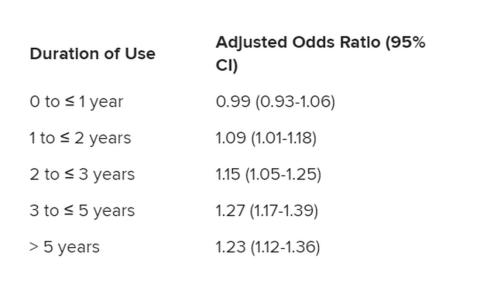
Longer cumulative duration of ADHD medication use was associated with a statistically significant increased risk for CVD, compared with no use.
When the risk for specific CVDs was examined, long-term use of ADHD medication (compared with no use) was associated with an increased risk for hypertension and arterial disease but not arrhythmias, heart failure, ischemic heart disease, thromboembolic disease, or cerebrovascular disease.
For hypertension, the adjusted odds ratio was 1.72 (95% confidence interval, 1.51-1.97) for 3 to ≤ 5 years and 1.80 (95% CI, 1.55-2.08) for > 5 years of medication use. For arterial disease, the AOR was 1.65 (95% CI, 1.11-2.45) for 3 to ≤ 5 years and 1.49 (95% CI, 0.96-2.32) for > 5 years of use.
Stimulants confer greatest risk
Across the 14-year follow-up period, each additional year of ADHD medication use was associated with an average 4% increased CVD risk, with a larger 8% increased risk in the first 3 years of cumulative use, followed by stable risk over the remaining follow-up.
Similar risks were observed in children and adults, as well as in females and males.
When focusing on specific ADHD medications, compared with no use, long-term use of the stimulant methylphenidate was associated with an increased risk for CVD (AOR, 1.20 [95% CI, 1.10-1.31] for 3 to ≤ 5 years and 1.19 [95% CI, 1.08-1.31] for > 5 years).
The same was true for long-term use of the stimulant lisdexamfetamine (AOR, 1.23 [95% CI, 1.05-1.44] for 2 to ≤ 3 years and 1.17 [95% CI, 0.98-1.40] for > 3 years).
In contrast, use of the nonstimulant atomoxetine was associated with elevated CVD risk only for the first year of use (AOR, 1.07; 95% CI, 1.01-1.13).
The increased risk for CVD occurred only above certain average daily doses: 45 mg for methylphenidate and lisdexamfetamine, 22.5 mg for amphetamines, and 120 mg for atomoxetine.
The authors note that, although they accounted for a wide range of potential confounding variables, considering the observational nature of the study and the possibility of residual confounding, they could not prove causality.
‘Tricky trade-offs’
The coauthors of an editorial in JAMA Psychiatry (2023 Nov 22. doi: 10.1001/jamapsychiatry.2023.4126) note that the study “should remind us that clinical decision-making is often based on tricky trade-offs that should be considered at the individual patient level.”
Given that hypertension is the leading cause of CV morbidity and mortality worldwide, the increased likelihood of hypertension with long-term use of ADHD medications “cannot be disregarded,” write Samuele Cortese, MD, PhD, and Cristiano Fava, MD, PhD, with University of Southampton (England).
“These findings are especially relevant given the reported association between ADHD and physical conditions, such as obesity, which further contribute to increased cardiovascular risk,” they add.
Dr. Cortese and Dr. Fava say that the increased CV risk – averaging 4% per year and stabilizing after 3 years of treatment – “should be carefully weighed against the established benefits, on a case-by-case basis.”
“Importantly,” they write, “large real-world self-controlled studies have shown that individuals with ADHD experience significantly fewer unintentional physical injuries, motor vehicle crashes, substance use disorders, and criminal acts, as well as improved academic functioning, during periods when they are taking, compared with periods when they are not taking, methylphenidate.”
The risk-benefit ratio, however, may be lower in people with preexisting heart conditions. However, more evidence and precise recommendations are needed in relation to the treatment of individuals with ADHD and preexisting CV conditions, the editorial writers say.
This study was supported by grants from the Swedish Research Council for Health, Working Life, and Welfare and the European Union’s Horizon 2020 research and innovation program. The authors and editorial writers have no relevant conflicts of interest.
A version of this article appeared on Medscape.com.
results of a large Swedish nested case-control study suggest.
The increased risk was evident only for hypertension and arterial disease, was dose dependent, and was higher for stimulant than nonstimulant ADHD medications.
“Clinicians should be vigilant in monitoring signs and symptoms of cardiovascular diseases, particularly among those receiving higher doses,” Zheng Chang, PhD, principal researcher, department of medical epidemiology and biostatistics, Karolinska Institutet, Stockholm, said in an interview.
“Treatment decisions, as always, should be based on careful weighing of potential benefits and risks at individual patient level, rather than simple one-size-fits-all recommendations,” Dr. Chang added.
The study was published online in JAMA Psychiatry
Filling in the research gaps
The use of medications to treat ADHD has increased markedly over the past decades in both children and adults. The potential risk for CVD associated with long-term ADHD medication use remains unclear. Most “longitudinal” studies that have looked at the association have an average follow-up time of no more than 2 years, the authors note.
In contrast, the Swedish study assessed the association between cumulative use of ADHD medication in children and adults followed for up to 14 years and also looked at whether associations differ across types of medication and dosages, types of CVD, gender, and age.
Among 278,027 individuals aged 6-64 years diagnosed with ADHD or dispensed ADHD medication, 10,388 with CVD were identified and matched to 51,672 controls without CVD.
Longer cumulative duration of ADHD medication use was associated with a statistically significant increased risk for CVD, compared with no use.
When the risk for specific CVDs was examined, long-term use of ADHD medication (compared with no use) was associated with an increased risk for hypertension and arterial disease but not arrhythmias, heart failure, ischemic heart disease, thromboembolic disease, or cerebrovascular disease.
For hypertension, the adjusted odds ratio was 1.72 (95% confidence interval, 1.51-1.97) for 3 to ≤ 5 years and 1.80 (95% CI, 1.55-2.08) for > 5 years of medication use. For arterial disease, the AOR was 1.65 (95% CI, 1.11-2.45) for 3 to ≤ 5 years and 1.49 (95% CI, 0.96-2.32) for > 5 years of use.
Stimulants confer greatest risk
Across the 14-year follow-up period, each additional year of ADHD medication use was associated with an average 4% increased CVD risk, with a larger 8% increased risk in the first 3 years of cumulative use, followed by stable risk over the remaining follow-up.
Similar risks were observed in children and adults, as well as in females and males.
When focusing on specific ADHD medications, compared with no use, long-term use of the stimulant methylphenidate was associated with an increased risk for CVD (AOR, 1.20 [95% CI, 1.10-1.31] for 3 to ≤ 5 years and 1.19 [95% CI, 1.08-1.31] for > 5 years).
The same was true for long-term use of the stimulant lisdexamfetamine (AOR, 1.23 [95% CI, 1.05-1.44] for 2 to ≤ 3 years and 1.17 [95% CI, 0.98-1.40] for > 3 years).
In contrast, use of the nonstimulant atomoxetine was associated with elevated CVD risk only for the first year of use (AOR, 1.07; 95% CI, 1.01-1.13).
The increased risk for CVD occurred only above certain average daily doses: 45 mg for methylphenidate and lisdexamfetamine, 22.5 mg for amphetamines, and 120 mg for atomoxetine.
The authors note that, although they accounted for a wide range of potential confounding variables, considering the observational nature of the study and the possibility of residual confounding, they could not prove causality.
‘Tricky trade-offs’
The coauthors of an editorial in JAMA Psychiatry (2023 Nov 22. doi: 10.1001/jamapsychiatry.2023.4126) note that the study “should remind us that clinical decision-making is often based on tricky trade-offs that should be considered at the individual patient level.”
Given that hypertension is the leading cause of CV morbidity and mortality worldwide, the increased likelihood of hypertension with long-term use of ADHD medications “cannot be disregarded,” write Samuele Cortese, MD, PhD, and Cristiano Fava, MD, PhD, with University of Southampton (England).
“These findings are especially relevant given the reported association between ADHD and physical conditions, such as obesity, which further contribute to increased cardiovascular risk,” they add.
Dr. Cortese and Dr. Fava say that the increased CV risk – averaging 4% per year and stabilizing after 3 years of treatment – “should be carefully weighed against the established benefits, on a case-by-case basis.”
“Importantly,” they write, “large real-world self-controlled studies have shown that individuals with ADHD experience significantly fewer unintentional physical injuries, motor vehicle crashes, substance use disorders, and criminal acts, as well as improved academic functioning, during periods when they are taking, compared with periods when they are not taking, methylphenidate.”
The risk-benefit ratio, however, may be lower in people with preexisting heart conditions. However, more evidence and precise recommendations are needed in relation to the treatment of individuals with ADHD and preexisting CV conditions, the editorial writers say.
This study was supported by grants from the Swedish Research Council for Health, Working Life, and Welfare and the European Union’s Horizon 2020 research and innovation program. The authors and editorial writers have no relevant conflicts of interest.
A version of this article appeared on Medscape.com.
results of a large Swedish nested case-control study suggest.
The increased risk was evident only for hypertension and arterial disease, was dose dependent, and was higher for stimulant than nonstimulant ADHD medications.
“Clinicians should be vigilant in monitoring signs and symptoms of cardiovascular diseases, particularly among those receiving higher doses,” Zheng Chang, PhD, principal researcher, department of medical epidemiology and biostatistics, Karolinska Institutet, Stockholm, said in an interview.
“Treatment decisions, as always, should be based on careful weighing of potential benefits and risks at individual patient level, rather than simple one-size-fits-all recommendations,” Dr. Chang added.
The study was published online in JAMA Psychiatry
Filling in the research gaps
The use of medications to treat ADHD has increased markedly over the past decades in both children and adults. The potential risk for CVD associated with long-term ADHD medication use remains unclear. Most “longitudinal” studies that have looked at the association have an average follow-up time of no more than 2 years, the authors note.
In contrast, the Swedish study assessed the association between cumulative use of ADHD medication in children and adults followed for up to 14 years and also looked at whether associations differ across types of medication and dosages, types of CVD, gender, and age.
Among 278,027 individuals aged 6-64 years diagnosed with ADHD or dispensed ADHD medication, 10,388 with CVD were identified and matched to 51,672 controls without CVD.
Longer cumulative duration of ADHD medication use was associated with a statistically significant increased risk for CVD, compared with no use.
When the risk for specific CVDs was examined, long-term use of ADHD medication (compared with no use) was associated with an increased risk for hypertension and arterial disease but not arrhythmias, heart failure, ischemic heart disease, thromboembolic disease, or cerebrovascular disease.
For hypertension, the adjusted odds ratio was 1.72 (95% confidence interval, 1.51-1.97) for 3 to ≤ 5 years and 1.80 (95% CI, 1.55-2.08) for > 5 years of medication use. For arterial disease, the AOR was 1.65 (95% CI, 1.11-2.45) for 3 to ≤ 5 years and 1.49 (95% CI, 0.96-2.32) for > 5 years of use.
Stimulants confer greatest risk
Across the 14-year follow-up period, each additional year of ADHD medication use was associated with an average 4% increased CVD risk, with a larger 8% increased risk in the first 3 years of cumulative use, followed by stable risk over the remaining follow-up.
Similar risks were observed in children and adults, as well as in females and males.
When focusing on specific ADHD medications, compared with no use, long-term use of the stimulant methylphenidate was associated with an increased risk for CVD (AOR, 1.20 [95% CI, 1.10-1.31] for 3 to ≤ 5 years and 1.19 [95% CI, 1.08-1.31] for > 5 years).
The same was true for long-term use of the stimulant lisdexamfetamine (AOR, 1.23 [95% CI, 1.05-1.44] for 2 to ≤ 3 years and 1.17 [95% CI, 0.98-1.40] for > 3 years).
In contrast, use of the nonstimulant atomoxetine was associated with elevated CVD risk only for the first year of use (AOR, 1.07; 95% CI, 1.01-1.13).
The increased risk for CVD occurred only above certain average daily doses: 45 mg for methylphenidate and lisdexamfetamine, 22.5 mg for amphetamines, and 120 mg for atomoxetine.
The authors note that, although they accounted for a wide range of potential confounding variables, considering the observational nature of the study and the possibility of residual confounding, they could not prove causality.
‘Tricky trade-offs’
The coauthors of an editorial in JAMA Psychiatry (2023 Nov 22. doi: 10.1001/jamapsychiatry.2023.4126) note that the study “should remind us that clinical decision-making is often based on tricky trade-offs that should be considered at the individual patient level.”
Given that hypertension is the leading cause of CV morbidity and mortality worldwide, the increased likelihood of hypertension with long-term use of ADHD medications “cannot be disregarded,” write Samuele Cortese, MD, PhD, and Cristiano Fava, MD, PhD, with University of Southampton (England).
“These findings are especially relevant given the reported association between ADHD and physical conditions, such as obesity, which further contribute to increased cardiovascular risk,” they add.
Dr. Cortese and Dr. Fava say that the increased CV risk – averaging 4% per year and stabilizing after 3 years of treatment – “should be carefully weighed against the established benefits, on a case-by-case basis.”
“Importantly,” they write, “large real-world self-controlled studies have shown that individuals with ADHD experience significantly fewer unintentional physical injuries, motor vehicle crashes, substance use disorders, and criminal acts, as well as improved academic functioning, during periods when they are taking, compared with periods when they are not taking, methylphenidate.”
The risk-benefit ratio, however, may be lower in people with preexisting heart conditions. However, more evidence and precise recommendations are needed in relation to the treatment of individuals with ADHD and preexisting CV conditions, the editorial writers say.
This study was supported by grants from the Swedish Research Council for Health, Working Life, and Welfare and the European Union’s Horizon 2020 research and innovation program. The authors and editorial writers have no relevant conflicts of interest.
A version of this article appeared on Medscape.com.
FROM JAMA PSYCHIATRY
Physicians: Don’t ignore sexuality in your dying patients
I have a long history of being interested in conversations that others avoid. In medical school, I felt that we didn’t talk enough about death, so I organized a lecture series on end-of-life care for my fellow students. Now, as a sexual medicine specialist, I have other conversations from which many medical providers shy away. So, buckle up!
A key question in palliative care is: How do you want to live the life you have left? And where does the wide range of human pleasures fit in? In her book The Pleasure Zone, sex therapist Stella Resnick describes eight kinds of pleasure:
- pain relief
- play, humor, movement, and sound
- mental
- emotional
- sensual
- spiritual
- primal (just being)
- sexual
At the end of life, both medically and culturally, we pay attention to many of these pleasures. But sexuality is often ignored.
Sexuality – which can be defined as the experience of oneself as a sexual being – may include how sex is experienced in relationships or with oneself, sexual orientation, body image, gender expression and identity, as well as sexual satisfaction and pleasure. People may have different priorities at different times regarding their sexuality, but sexuality is a key aspect of feeling fully alive and human across the lifespan. At the end of life, sexuality, sexual expression, and physical connection may play even more important roles than previously.
‘I just want to be able to have sex with my husband again’
Z was a 75-year-old woman who came to me for help with vaginal stenosis. Her cancer treatments were not going well. I asked her one of my typical questions: “What does sex mean to you?”
Sexual pleasure was “glue” – a critical way for her to connect with her sense of self and with her husband, a man of few words. She described transcendent experiences with partnered sex during her life. Finally, she explained, she was saddened by the idea of not experiencing that again before she died.
As medical providers, we don’t all need to be sex experts, but our patients should be able to have open and shame-free conversations with us about these issues at all stages of life. Up to 86% of palliative care patients want the chance to discuss their sexual concerns with a skilled clinician, and many consider this issue important to their psychological well-being. And yet, 91% reported that sexuality had not been addressed in their care.
In a Canadian study of 10 palliative care patients (and their partners), all but one felt that their medical providers should initiate conversations about sexuality and the effect of illness on sexual experience. They felt that this communication should be an integral component of care. The one person who disagreed said it was appropriate for clinicians to ask patients whether they wanted to talk about sexuality.
Before this study, sexuality had been discussed with only one participant. Here’s the magic part: Several of the patients reported that the study itself was therapeutic. This is my clinical experience as well. More often than not, open and shame-free clinical discussions about sexuality led to patients reflecting: “I’ve never been able to say this to another person, and now I feel so much better.”
One study of palliative care nurses found that while the nurses acknowledged the importance of addressing sexuality, their way of addressing sexuality followed cultural myths and norms or relied on their own experience rather than knowledge-based guidelines. Why? One explanation could be that clinicians raised and educated in North America probably did not get adequate training on this topic. We need to do better.
Second, cultural concepts that equate sexuality with healthy and able bodies who are partnered, young, cisgender, and heterosexual make it hard to conceive of how to relate sexuality to other bodies. We’ve been steeped in the biases of our culture.
Some medical providers avoid the topic because they feel vulnerable, fearful that a conversation about sexuality with a patient will reveal something about themselves. Others may simply deny the possibility that sexual function changes in the face of serious illness or that this could be a priority for their patients. Of course, we have a million other things to talk about – I get it.
Views on sex and sexuality affect how clinicians approach these conversations as well. A study of palliative care professionals described themes among those who did and did not address the topic. The professionals who did not discuss sexuality endorsed a narrow definition of sex based on genital sexual acts between two partners, usually heterosexual. Among these clinicians, when the issue came up, patients had raised the topic. They talked about sex using jokes and euphemisms (“are you still enjoying ‘good moments’ with your partner?”), perhaps to ease their own discomfort.
On the other hand, professionals who more frequently discussed sexuality with their patients endorsed a more holistic concept of sexuality: including genital and nongenital contact as well as nonphysical components like verbal communication and emotions. These clinicians found sexuality applicable to all individuals across the lifespan. They were more likely to initiate discussions about the effect of medications or illness on sexual function and address the need for equipment, such as a larger hospital bed.
I’m hoping that you might one day find yourself in the second group. Our patients at the end of life need our help in accessing the full range of pleasure in their lives. We need better medical education on how to help with sexual concerns when they arise (an article for another day), but we can start right now by simply initiating open, shame-free sexual health conversations. This is often the most important therapeutic intervention.
Dr. Kranz, Clinical Assistant Professor of Obstetrics/Gynecology and Family Medicine, University of Rochester (N.Y.) Medical Center, has disclosed no relevant financial relationships.
A version of this article first appeared on Medscape.com.
I have a long history of being interested in conversations that others avoid. In medical school, I felt that we didn’t talk enough about death, so I organized a lecture series on end-of-life care for my fellow students. Now, as a sexual medicine specialist, I have other conversations from which many medical providers shy away. So, buckle up!
A key question in palliative care is: How do you want to live the life you have left? And where does the wide range of human pleasures fit in? In her book The Pleasure Zone, sex therapist Stella Resnick describes eight kinds of pleasure:
- pain relief
- play, humor, movement, and sound
- mental
- emotional
- sensual
- spiritual
- primal (just being)
- sexual
At the end of life, both medically and culturally, we pay attention to many of these pleasures. But sexuality is often ignored.
Sexuality – which can be defined as the experience of oneself as a sexual being – may include how sex is experienced in relationships or with oneself, sexual orientation, body image, gender expression and identity, as well as sexual satisfaction and pleasure. People may have different priorities at different times regarding their sexuality, but sexuality is a key aspect of feeling fully alive and human across the lifespan. At the end of life, sexuality, sexual expression, and physical connection may play even more important roles than previously.
‘I just want to be able to have sex with my husband again’
Z was a 75-year-old woman who came to me for help with vaginal stenosis. Her cancer treatments were not going well. I asked her one of my typical questions: “What does sex mean to you?”
Sexual pleasure was “glue” – a critical way for her to connect with her sense of self and with her husband, a man of few words. She described transcendent experiences with partnered sex during her life. Finally, she explained, she was saddened by the idea of not experiencing that again before she died.
As medical providers, we don’t all need to be sex experts, but our patients should be able to have open and shame-free conversations with us about these issues at all stages of life. Up to 86% of palliative care patients want the chance to discuss their sexual concerns with a skilled clinician, and many consider this issue important to their psychological well-being. And yet, 91% reported that sexuality had not been addressed in their care.
In a Canadian study of 10 palliative care patients (and their partners), all but one felt that their medical providers should initiate conversations about sexuality and the effect of illness on sexual experience. They felt that this communication should be an integral component of care. The one person who disagreed said it was appropriate for clinicians to ask patients whether they wanted to talk about sexuality.
Before this study, sexuality had been discussed with only one participant. Here’s the magic part: Several of the patients reported that the study itself was therapeutic. This is my clinical experience as well. More often than not, open and shame-free clinical discussions about sexuality led to patients reflecting: “I’ve never been able to say this to another person, and now I feel so much better.”
One study of palliative care nurses found that while the nurses acknowledged the importance of addressing sexuality, their way of addressing sexuality followed cultural myths and norms or relied on their own experience rather than knowledge-based guidelines. Why? One explanation could be that clinicians raised and educated in North America probably did not get adequate training on this topic. We need to do better.
Second, cultural concepts that equate sexuality with healthy and able bodies who are partnered, young, cisgender, and heterosexual make it hard to conceive of how to relate sexuality to other bodies. We’ve been steeped in the biases of our culture.
Some medical providers avoid the topic because they feel vulnerable, fearful that a conversation about sexuality with a patient will reveal something about themselves. Others may simply deny the possibility that sexual function changes in the face of serious illness or that this could be a priority for their patients. Of course, we have a million other things to talk about – I get it.
Views on sex and sexuality affect how clinicians approach these conversations as well. A study of palliative care professionals described themes among those who did and did not address the topic. The professionals who did not discuss sexuality endorsed a narrow definition of sex based on genital sexual acts between two partners, usually heterosexual. Among these clinicians, when the issue came up, patients had raised the topic. They talked about sex using jokes and euphemisms (“are you still enjoying ‘good moments’ with your partner?”), perhaps to ease their own discomfort.
On the other hand, professionals who more frequently discussed sexuality with their patients endorsed a more holistic concept of sexuality: including genital and nongenital contact as well as nonphysical components like verbal communication and emotions. These clinicians found sexuality applicable to all individuals across the lifespan. They were more likely to initiate discussions about the effect of medications or illness on sexual function and address the need for equipment, such as a larger hospital bed.
I’m hoping that you might one day find yourself in the second group. Our patients at the end of life need our help in accessing the full range of pleasure in their lives. We need better medical education on how to help with sexual concerns when they arise (an article for another day), but we can start right now by simply initiating open, shame-free sexual health conversations. This is often the most important therapeutic intervention.
Dr. Kranz, Clinical Assistant Professor of Obstetrics/Gynecology and Family Medicine, University of Rochester (N.Y.) Medical Center, has disclosed no relevant financial relationships.
A version of this article first appeared on Medscape.com.
I have a long history of being interested in conversations that others avoid. In medical school, I felt that we didn’t talk enough about death, so I organized a lecture series on end-of-life care for my fellow students. Now, as a sexual medicine specialist, I have other conversations from which many medical providers shy away. So, buckle up!
A key question in palliative care is: How do you want to live the life you have left? And where does the wide range of human pleasures fit in? In her book The Pleasure Zone, sex therapist Stella Resnick describes eight kinds of pleasure:
- pain relief
- play, humor, movement, and sound
- mental
- emotional
- sensual
- spiritual
- primal (just being)
- sexual
At the end of life, both medically and culturally, we pay attention to many of these pleasures. But sexuality is often ignored.
Sexuality – which can be defined as the experience of oneself as a sexual being – may include how sex is experienced in relationships or with oneself, sexual orientation, body image, gender expression and identity, as well as sexual satisfaction and pleasure. People may have different priorities at different times regarding their sexuality, but sexuality is a key aspect of feeling fully alive and human across the lifespan. At the end of life, sexuality, sexual expression, and physical connection may play even more important roles than previously.
‘I just want to be able to have sex with my husband again’
Z was a 75-year-old woman who came to me for help with vaginal stenosis. Her cancer treatments were not going well. I asked her one of my typical questions: “What does sex mean to you?”
Sexual pleasure was “glue” – a critical way for her to connect with her sense of self and with her husband, a man of few words. She described transcendent experiences with partnered sex during her life. Finally, she explained, she was saddened by the idea of not experiencing that again before she died.
As medical providers, we don’t all need to be sex experts, but our patients should be able to have open and shame-free conversations with us about these issues at all stages of life. Up to 86% of palliative care patients want the chance to discuss their sexual concerns with a skilled clinician, and many consider this issue important to their psychological well-being. And yet, 91% reported that sexuality had not been addressed in their care.
In a Canadian study of 10 palliative care patients (and their partners), all but one felt that their medical providers should initiate conversations about sexuality and the effect of illness on sexual experience. They felt that this communication should be an integral component of care. The one person who disagreed said it was appropriate for clinicians to ask patients whether they wanted to talk about sexuality.
Before this study, sexuality had been discussed with only one participant. Here’s the magic part: Several of the patients reported that the study itself was therapeutic. This is my clinical experience as well. More often than not, open and shame-free clinical discussions about sexuality led to patients reflecting: “I’ve never been able to say this to another person, and now I feel so much better.”
One study of palliative care nurses found that while the nurses acknowledged the importance of addressing sexuality, their way of addressing sexuality followed cultural myths and norms or relied on their own experience rather than knowledge-based guidelines. Why? One explanation could be that clinicians raised and educated in North America probably did not get adequate training on this topic. We need to do better.
Second, cultural concepts that equate sexuality with healthy and able bodies who are partnered, young, cisgender, and heterosexual make it hard to conceive of how to relate sexuality to other bodies. We’ve been steeped in the biases of our culture.
Some medical providers avoid the topic because they feel vulnerable, fearful that a conversation about sexuality with a patient will reveal something about themselves. Others may simply deny the possibility that sexual function changes in the face of serious illness or that this could be a priority for their patients. Of course, we have a million other things to talk about – I get it.
Views on sex and sexuality affect how clinicians approach these conversations as well. A study of palliative care professionals described themes among those who did and did not address the topic. The professionals who did not discuss sexuality endorsed a narrow definition of sex based on genital sexual acts between two partners, usually heterosexual. Among these clinicians, when the issue came up, patients had raised the topic. They talked about sex using jokes and euphemisms (“are you still enjoying ‘good moments’ with your partner?”), perhaps to ease their own discomfort.
On the other hand, professionals who more frequently discussed sexuality with their patients endorsed a more holistic concept of sexuality: including genital and nongenital contact as well as nonphysical components like verbal communication and emotions. These clinicians found sexuality applicable to all individuals across the lifespan. They were more likely to initiate discussions about the effect of medications or illness on sexual function and address the need for equipment, such as a larger hospital bed.
I’m hoping that you might one day find yourself in the second group. Our patients at the end of life need our help in accessing the full range of pleasure in their lives. We need better medical education on how to help with sexual concerns when they arise (an article for another day), but we can start right now by simply initiating open, shame-free sexual health conversations. This is often the most important therapeutic intervention.
Dr. Kranz, Clinical Assistant Professor of Obstetrics/Gynecology and Family Medicine, University of Rochester (N.Y.) Medical Center, has disclosed no relevant financial relationships.
A version of this article first appeared on Medscape.com.
Commentary: Examining DMARD Use in PsA, December 2023

Limiting radiographic progression is an important long-term goal of treatment of PsA. In a post hoc analysis that included 449 biologic-naive patients with PsA from the DISCOVER-2 trial who received 100 mg guselkumab every 4 or 8 weeks, Mease and colleagues demonstrated that a greater improvement in the Disease Activity Index for PsA (DAPSA) scores as early as week 8 and the achievement of DAPSA low disease activity at week 8 were associated with a significantly lower progression of radiographic joint damage (total PsA-modified van der Heijde-Sharp score) through week 100. Thus, patients who respond well early have better long-term outcomes.
The safety of targeted therapies is always of concern and is inadequately addressed by individual clinical trials. Meta-analyses may provide further insights. In a network meta-analysis of 94 randomized controlled trials that included a total of 54,369 patients with PsA or psoriasis who were treated with 14 biologics, five small molecules, or placebo, Chiu and colleagues found that for patients with psoriasis, infliximab, deucravacitinib, and bimekizumab had the highest risks for infection. In patients with PsA, bimekizumab, apremilast, and 30 mg upadacitinib led to a significantly higher risk for infection compared with placebo, and 30 mg upadacitinib also increasing the risk for serious infection compared with placebo. The risk for infection in patients with PsA did not increase with most bDMARD and targeted synthetic DMARD (tsDMARD), except bimekizumab, apremilast, and 30 mg upadacitinib.
There is increasing recognition of the difficulty in managing patients with refractory PsA. One approach to such difficult-to-treat disease is dual targeted therapy (DTT). However, the safety of these combinations is of major concern. There is currently an ongoing clinical trial comparing a combination of guselkumab and golimumab vs guselkumab alone for treatment-resistant PsA. In the meantime, Valero-Martinez and colleagues have reported results from an observational, retrospective, cross-sectional study that included patients with refractory PsA (n = 14) or spondyloarthritis (n = 22) who simultaneously received two bDMARD or tsDMARD with different therapeutic targets. The most commonly used combinations were a tumor necrosis factor (TNF) inhibitor plus an interleukin (IL)-12/23 pathway inhibitor, followed by a TNF inhibitor plus an IL-17 inhibitor. They found that at a median exposure of 14.86 months, the DTT retention rate in patients with PsA was 42.8%, with 40.0% and 53.3% of patients achieving remission or low activity and major clinical improvements, respectively. Treatment discontinuation due to adverse events was reported in one patient with PsA and multiple comorbidities. Thus, DTT led to satisfactory clinical improvements and no serious adverse events in patients with refractory PsA. The results of larger observational and randomized trials are awaited.
Limiting radiographic progression is an important long-term goal of treatment of PsA. In a post hoc analysis that included 449 biologic-naive patients with PsA from the DISCOVER-2 trial who received 100 mg guselkumab every 4 or 8 weeks, Mease and colleagues demonstrated that a greater improvement in the Disease Activity Index for PsA (DAPSA) scores as early as week 8 and the achievement of DAPSA low disease activity at week 8 were associated with a significantly lower progression of radiographic joint damage (total PsA-modified van der Heijde-Sharp score) through week 100. Thus, patients who respond well early have better long-term outcomes.
The safety of targeted therapies is always of concern and is inadequately addressed by individual clinical trials. Meta-analyses may provide further insights. In a network meta-analysis of 94 randomized controlled trials that included a total of 54,369 patients with PsA or psoriasis who were treated with 14 biologics, five small molecules, or placebo, Chiu and colleagues found that for patients with psoriasis, infliximab, deucravacitinib, and bimekizumab had the highest risks for infection. In patients with PsA, bimekizumab, apremilast, and 30 mg upadacitinib led to a significantly higher risk for infection compared with placebo, and 30 mg upadacitinib also increasing the risk for serious infection compared with placebo. The risk for infection in patients with PsA did not increase with most bDMARD and targeted synthetic DMARD (tsDMARD), except bimekizumab, apremilast, and 30 mg upadacitinib.
There is increasing recognition of the difficulty in managing patients with refractory PsA. One approach to such difficult-to-treat disease is dual targeted therapy (DTT). However, the safety of these combinations is of major concern. There is currently an ongoing clinical trial comparing a combination of guselkumab and golimumab vs guselkumab alone for treatment-resistant PsA. In the meantime, Valero-Martinez and colleagues have reported results from an observational, retrospective, cross-sectional study that included patients with refractory PsA (n = 14) or spondyloarthritis (n = 22) who simultaneously received two bDMARD or tsDMARD with different therapeutic targets. The most commonly used combinations were a tumor necrosis factor (TNF) inhibitor plus an interleukin (IL)-12/23 pathway inhibitor, followed by a TNF inhibitor plus an IL-17 inhibitor. They found that at a median exposure of 14.86 months, the DTT retention rate in patients with PsA was 42.8%, with 40.0% and 53.3% of patients achieving remission or low activity and major clinical improvements, respectively. Treatment discontinuation due to adverse events was reported in one patient with PsA and multiple comorbidities. Thus, DTT led to satisfactory clinical improvements and no serious adverse events in patients with refractory PsA. The results of larger observational and randomized trials are awaited.
Limiting radiographic progression is an important long-term goal of treatment of PsA. In a post hoc analysis that included 449 biologic-naive patients with PsA from the DISCOVER-2 trial who received 100 mg guselkumab every 4 or 8 weeks, Mease and colleagues demonstrated that a greater improvement in the Disease Activity Index for PsA (DAPSA) scores as early as week 8 and the achievement of DAPSA low disease activity at week 8 were associated with a significantly lower progression of radiographic joint damage (total PsA-modified van der Heijde-Sharp score) through week 100. Thus, patients who respond well early have better long-term outcomes.
The safety of targeted therapies is always of concern and is inadequately addressed by individual clinical trials. Meta-analyses may provide further insights. In a network meta-analysis of 94 randomized controlled trials that included a total of 54,369 patients with PsA or psoriasis who were treated with 14 biologics, five small molecules, or placebo, Chiu and colleagues found that for patients with psoriasis, infliximab, deucravacitinib, and bimekizumab had the highest risks for infection. In patients with PsA, bimekizumab, apremilast, and 30 mg upadacitinib led to a significantly higher risk for infection compared with placebo, and 30 mg upadacitinib also increasing the risk for serious infection compared with placebo. The risk for infection in patients with PsA did not increase with most bDMARD and targeted synthetic DMARD (tsDMARD), except bimekizumab, apremilast, and 30 mg upadacitinib.
There is increasing recognition of the difficulty in managing patients with refractory PsA. One approach to such difficult-to-treat disease is dual targeted therapy (DTT). However, the safety of these combinations is of major concern. There is currently an ongoing clinical trial comparing a combination of guselkumab and golimumab vs guselkumab alone for treatment-resistant PsA. In the meantime, Valero-Martinez and colleagues have reported results from an observational, retrospective, cross-sectional study that included patients with refractory PsA (n = 14) or spondyloarthritis (n = 22) who simultaneously received two bDMARD or tsDMARD with different therapeutic targets. The most commonly used combinations were a tumor necrosis factor (TNF) inhibitor plus an interleukin (IL)-12/23 pathway inhibitor, followed by a TNF inhibitor plus an IL-17 inhibitor. They found that at a median exposure of 14.86 months, the DTT retention rate in patients with PsA was 42.8%, with 40.0% and 53.3% of patients achieving remission or low activity and major clinical improvements, respectively. Treatment discontinuation due to adverse events was reported in one patient with PsA and multiple comorbidities. Thus, DTT led to satisfactory clinical improvements and no serious adverse events in patients with refractory PsA. The results of larger observational and randomized trials are awaited.
Not all exercise is beneficial: The physical activity paradox explained
In the pursuit of optimal health, regular physical activity (PA) is recommended to protect against dementia, cardiovascular disease (CVD), cancer, and other noncommunicable diseases. A significant body of research suggests the benefits of PA are positively correlated with higher frequency and intensity – with more often deemed better. This research has spawned a focus on increasing step counts and investing in standing desks and other interventions aimed at keeping people active.
But , but they also actually experience an increased risk for the very conditions that PA is intended to prevent.
A study published recently in The Lancet Regional Health – Europe used registry data from more than 7,000 adults in Norway, following them from age 33 to 65 years, to assess PA trajectories and risks for later-life mild cognitive impairment (MCI) and dementia at age 70 or older.
“Incorporating a life-course perspective gives a broader picture of how participants’ occupational histories relate to cognitive impairment later in life,” principal investigator Vegard Skirbekk, PhD, Columbia University Mailman School of Public Health, New York, said in an interview. Other studies typically have assessed occupational PA at a single time point, often close to the end of an individual’s career, and largely relied on self-report, he said.
Study participants worked in more than 300 different occupations. General physical activities performed on the included jobs required “considerable” use of arms and legs and moving the whole body, such as climbing, lifting, balancing, walking, stooping, and handling of materials.
Dr. Skirbekk and colleagues grouped participants into four PA trajectories over the 44-year study period: stable low, increasing then decreasing, stable intermediate, and stable high.
A total of 902 individuals were diagnosed with dementia and 2,407 with MCI at age 70 years or older. After adjustment, risks for MCI and dementia were 15.5% for those with higher occupational PA scores in the latter part of their working life and 9% for those with lower physical demands. The researchers concluded that “consistently working in an occupation with intermediate or high occupational PA was linked to an increased risk of cognitive impairment.”
The findings support those of the Copenhagen Male Study. Published in 2020, this longitudinal study compared leisure-time and occupational PA among more than 4,000 men in Denmark aged 40-59 at baseline in 1970-1971 and followed them until they turned 60. After adjustment, participants with high occupational PA had a 55% greater risk of developing dementia compared with those doing sedentary work.
Good vs. bad PA
“[T]he WHO [World Health Organization] guide to preventing dementia and disease on the whole mentions physical activity as an important factor. But our study suggests that it must be a ‘good’ form of physical activity, which hard physical work is not,” said Kirsten Nabe-Nielsen, PhD, lead author of this study
Beyond dementia, another recent study adds to a wealth of data on associations between occupational PA and cardiovascular risks. The cross-sectional analysis of U.S. data from the National Institute for Occupational Safety and Health showed that odds of CVD were higher when participants were “always” performing total occupational activity (odds ratio [OR], 1.99), occupational exertion (OR, 2.15), or occupational standing and walking around (OR, 1.84) compared with “never” engaging in these activities.
The contrasting effects of leisure-time vs. occupational PA constitute the “physical activity paradox” hypothesis. Starting in 2011, multiple studies by Andreas Holtermann, PhD, of the National Research Centre for the Working Environment lend support to the PA paradox theory, as do subsequent studies by others.
Although only “marginally considered” until a few years ago, recent large cohort studies seem to confirm the paradox, Pier Luigi Temporelli, MD wrote in a recent editorial.
In separate interviews, Dr. Skirbekk and lead author Tyler Quinn, PhD, MS, West Virginia University, Morgantown, pointed to the PA paradox as an explanation for their own recent findings, suggesting that the mechanisms that underlie it probably are responsible for the associated deleterious effects of occupational PA on the brain and heart, and even mortality.
“It’s well established that PA in your leisure time can be positive, but in the workplace, the results are quite the opposite,” Dr. Skirbekk said. “The specific mechanisms for why occupational PA is associated with elevated dementia risk are still not well understood and we need more knowledge. But we know that higher occupational physical demands have been linked to smaller hippocampal volume and poorer memory performance.”
Furthermore, he said, individuals working in jobs with high demands, both psychological and physical, combined with low job control perform more poorly on cognitive testing later in life.
“We looked mainly at professions where people have heavy workloads and you have much less autonomy, such as nursing assistants, office cleaners, childcare workers, and other personal care workers,” he said. “You cannot sit. You have somebody relying on you. It’s not all pleasure, and it can be very hard. That’s where we find the associations.”
Lack of autonomy
Specific characteristics indirectly associated with high occupational PA jobs – low cognitive stimuli, lifestyle factors, and socioeconomic influences – as well as factors directly related to high occupational PA, such as long hours, repetitive tasks, low levels of control, and stress, could also adversely affect cognitive trajectories, Dr. Skirbekk explained.
“By contrast, leisure-time physical activities tend to be of much shorter duration; are associated with socialization, play, [and] positive emotions; and [include] the opportunity to take breaks or shift to other types of activities if one prefers,” he said. “It may also be that too little or too much PA could be adversely related to cognitive outcomes – hence moderate activity levels, for example 10,000 steps a day, are still likely beneficial for cognitive functioning.”
Dr. Quinn said most of the CVD risk linked to occupational PA has to do with long periods of exertion such as lifting and carrying objects. While occupational standing and walking all day are also linked to CVD risk, they’re not as risky as lifting and carrying, he said.
Like Dr. Skirbekk, Dr. Quinn noted that individuals can take a break from leisure-time PA when they are tired, but occupational PA doesn’t have that same autonomy to allow for recovery.
“So, in many cases, individuals are not getting the recovery their body needs to actually experience PA benefits, because those benefits come during rest,” Dr. Quinn said.
“We’ve shown that PA at work raises acute cardiovascular responses, which are related to cardiovascular risk. For example, 24-hour and waking heart rate and diastolic blood pressure, as well as nonwork diastolic blood pressure, all were significantly higher on workdays versus non-workdays,” he said.
Dr. Quinn also said that psychological stress at work amplifies risk. “A person who does PA at work and is stressed is likely to be at greater risk than someone who has a physically active job but doesn’t have psychological stress combined with it.”
Research gaps
However, Dr. Skirbekk noted that there are strategies that can reduce the risk for MCI and dementia despite high levels of occupational PA. “It is often difficult to change professions, and even if you do, it won’t immediately affect cognition. But altering one’s lifestyle is likely to have effects on cognitive development across the life cycle.
“Many clinicians say they always advise lifestyle changes, but nothing happens. But it makes sense to emphasize that these changes – stopping smoking, eating well, getting proper sleep, etc. – affect not only cardiovascular risk but also cognition. And I think clinicians should also take a patient’s occupation into account during any evaluation,” Dr. Skirbekk noted.
Dr. Quinn said it isn’t realistic to expect workers to come up with solutions to the PA paradox because many don’t have the autonomy to be able to mitigate their occupational risk.
“I think administrative controls and policy changes eventually will be the levers of change. We’re not quite there yet, but those are the types of things we should do when we’re trying to reduce loads in some way, or reduce the time that people spend doing certain tasks we know are potentially bad,” he said.
However, not everyone agrees that occupational PA doesn’t confer the same benefits of leisure-time PA, at least with respect to cardiovascular risk. For example, the Prospective Urban Rural Epidemiology (PURE) study, which includes a cohort of 130,000 people from 17 high-income, middle-income, and low-income countries, concluded that both higher recreational and nonrecreational PA were associated with a lower risk for mortality and CVD events.
What additional research is needed to clarify the effects of occupational and leisure-time activity and to address conflicting findings?
“Even studies coming out now regarding the effects of occupational PA have mainly used older data,” Dr. Skirbekk noted. “Labor markets and job demands have changed over time. There are different types of tasks and skills required now than there were 20 or 40 years ago. And of course, working from home is a recent phenomenon that’s happened on a large scale and might affect daily routines, sleep patterns, and also cognition. We need a better understanding of what the consequences might be.”
Health inequity issue
More research is also necessary to understand the social determinants of cognitive decline, impairment, and dementia, he said. “Many of the studies we see today are based on self-report of what someone has done in the past, which is particularly problematic for individuals who are impaired or who give interviews with others, which can induce biases.”
Dr. Quinn suggests that PA guidelines may need to differentiate between occupational and leisure-time PA to better reflect current research findings.
Meanwhile, Dr. Skirbekk and Dr. Quinn both point to the toll that occupational PA takes on the brain and body in lower-income workers as an important health equity issue.
“Our national guidelines for PA include occupational activity,” said Dr. Quinn. “But it’s clear that a lot of people who are getting a lot of occupational PA, particularly socioeconomic and racial/ethnic minorities, are not benefiting from it.”
Dr. Holtermann, who has arguably done the most research to date on the PA paradox, noted in a recent editorial that the majority of workers with high occupational PA have a low socioeconomic position and therefore “improving our understanding of the underlying mechanisms behind the PA health paradox and identifying new intervention targets along those pathways will be an important step to reduce socioeconomic health inequalities across the globe.”
A version of this article first appeared on Medscape.com.
In the pursuit of optimal health, regular physical activity (PA) is recommended to protect against dementia, cardiovascular disease (CVD), cancer, and other noncommunicable diseases. A significant body of research suggests the benefits of PA are positively correlated with higher frequency and intensity – with more often deemed better. This research has spawned a focus on increasing step counts and investing in standing desks and other interventions aimed at keeping people active.
But , but they also actually experience an increased risk for the very conditions that PA is intended to prevent.
A study published recently in The Lancet Regional Health – Europe used registry data from more than 7,000 adults in Norway, following them from age 33 to 65 years, to assess PA trajectories and risks for later-life mild cognitive impairment (MCI) and dementia at age 70 or older.
“Incorporating a life-course perspective gives a broader picture of how participants’ occupational histories relate to cognitive impairment later in life,” principal investigator Vegard Skirbekk, PhD, Columbia University Mailman School of Public Health, New York, said in an interview. Other studies typically have assessed occupational PA at a single time point, often close to the end of an individual’s career, and largely relied on self-report, he said.
Study participants worked in more than 300 different occupations. General physical activities performed on the included jobs required “considerable” use of arms and legs and moving the whole body, such as climbing, lifting, balancing, walking, stooping, and handling of materials.
Dr. Skirbekk and colleagues grouped participants into four PA trajectories over the 44-year study period: stable low, increasing then decreasing, stable intermediate, and stable high.
A total of 902 individuals were diagnosed with dementia and 2,407 with MCI at age 70 years or older. After adjustment, risks for MCI and dementia were 15.5% for those with higher occupational PA scores in the latter part of their working life and 9% for those with lower physical demands. The researchers concluded that “consistently working in an occupation with intermediate or high occupational PA was linked to an increased risk of cognitive impairment.”
The findings support those of the Copenhagen Male Study. Published in 2020, this longitudinal study compared leisure-time and occupational PA among more than 4,000 men in Denmark aged 40-59 at baseline in 1970-1971 and followed them until they turned 60. After adjustment, participants with high occupational PA had a 55% greater risk of developing dementia compared with those doing sedentary work.
Good vs. bad PA
“[T]he WHO [World Health Organization] guide to preventing dementia and disease on the whole mentions physical activity as an important factor. But our study suggests that it must be a ‘good’ form of physical activity, which hard physical work is not,” said Kirsten Nabe-Nielsen, PhD, lead author of this study
Beyond dementia, another recent study adds to a wealth of data on associations between occupational PA and cardiovascular risks. The cross-sectional analysis of U.S. data from the National Institute for Occupational Safety and Health showed that odds of CVD were higher when participants were “always” performing total occupational activity (odds ratio [OR], 1.99), occupational exertion (OR, 2.15), or occupational standing and walking around (OR, 1.84) compared with “never” engaging in these activities.
The contrasting effects of leisure-time vs. occupational PA constitute the “physical activity paradox” hypothesis. Starting in 2011, multiple studies by Andreas Holtermann, PhD, of the National Research Centre for the Working Environment lend support to the PA paradox theory, as do subsequent studies by others.
Although only “marginally considered” until a few years ago, recent large cohort studies seem to confirm the paradox, Pier Luigi Temporelli, MD wrote in a recent editorial.
In separate interviews, Dr. Skirbekk and lead author Tyler Quinn, PhD, MS, West Virginia University, Morgantown, pointed to the PA paradox as an explanation for their own recent findings, suggesting that the mechanisms that underlie it probably are responsible for the associated deleterious effects of occupational PA on the brain and heart, and even mortality.
“It’s well established that PA in your leisure time can be positive, but in the workplace, the results are quite the opposite,” Dr. Skirbekk said. “The specific mechanisms for why occupational PA is associated with elevated dementia risk are still not well understood and we need more knowledge. But we know that higher occupational physical demands have been linked to smaller hippocampal volume and poorer memory performance.”
Furthermore, he said, individuals working in jobs with high demands, both psychological and physical, combined with low job control perform more poorly on cognitive testing later in life.
“We looked mainly at professions where people have heavy workloads and you have much less autonomy, such as nursing assistants, office cleaners, childcare workers, and other personal care workers,” he said. “You cannot sit. You have somebody relying on you. It’s not all pleasure, and it can be very hard. That’s where we find the associations.”
Lack of autonomy
Specific characteristics indirectly associated with high occupational PA jobs – low cognitive stimuli, lifestyle factors, and socioeconomic influences – as well as factors directly related to high occupational PA, such as long hours, repetitive tasks, low levels of control, and stress, could also adversely affect cognitive trajectories, Dr. Skirbekk explained.
“By contrast, leisure-time physical activities tend to be of much shorter duration; are associated with socialization, play, [and] positive emotions; and [include] the opportunity to take breaks or shift to other types of activities if one prefers,” he said. “It may also be that too little or too much PA could be adversely related to cognitive outcomes – hence moderate activity levels, for example 10,000 steps a day, are still likely beneficial for cognitive functioning.”
Dr. Quinn said most of the CVD risk linked to occupational PA has to do with long periods of exertion such as lifting and carrying objects. While occupational standing and walking all day are also linked to CVD risk, they’re not as risky as lifting and carrying, he said.
Like Dr. Skirbekk, Dr. Quinn noted that individuals can take a break from leisure-time PA when they are tired, but occupational PA doesn’t have that same autonomy to allow for recovery.
“So, in many cases, individuals are not getting the recovery their body needs to actually experience PA benefits, because those benefits come during rest,” Dr. Quinn said.
“We’ve shown that PA at work raises acute cardiovascular responses, which are related to cardiovascular risk. For example, 24-hour and waking heart rate and diastolic blood pressure, as well as nonwork diastolic blood pressure, all were significantly higher on workdays versus non-workdays,” he said.
Dr. Quinn also said that psychological stress at work amplifies risk. “A person who does PA at work and is stressed is likely to be at greater risk than someone who has a physically active job but doesn’t have psychological stress combined with it.”
Research gaps
However, Dr. Skirbekk noted that there are strategies that can reduce the risk for MCI and dementia despite high levels of occupational PA. “It is often difficult to change professions, and even if you do, it won’t immediately affect cognition. But altering one’s lifestyle is likely to have effects on cognitive development across the life cycle.
“Many clinicians say they always advise lifestyle changes, but nothing happens. But it makes sense to emphasize that these changes – stopping smoking, eating well, getting proper sleep, etc. – affect not only cardiovascular risk but also cognition. And I think clinicians should also take a patient’s occupation into account during any evaluation,” Dr. Skirbekk noted.
Dr. Quinn said it isn’t realistic to expect workers to come up with solutions to the PA paradox because many don’t have the autonomy to be able to mitigate their occupational risk.
“I think administrative controls and policy changes eventually will be the levers of change. We’re not quite there yet, but those are the types of things we should do when we’re trying to reduce loads in some way, or reduce the time that people spend doing certain tasks we know are potentially bad,” he said.
However, not everyone agrees that occupational PA doesn’t confer the same benefits of leisure-time PA, at least with respect to cardiovascular risk. For example, the Prospective Urban Rural Epidemiology (PURE) study, which includes a cohort of 130,000 people from 17 high-income, middle-income, and low-income countries, concluded that both higher recreational and nonrecreational PA were associated with a lower risk for mortality and CVD events.
What additional research is needed to clarify the effects of occupational and leisure-time activity and to address conflicting findings?
“Even studies coming out now regarding the effects of occupational PA have mainly used older data,” Dr. Skirbekk noted. “Labor markets and job demands have changed over time. There are different types of tasks and skills required now than there were 20 or 40 years ago. And of course, working from home is a recent phenomenon that’s happened on a large scale and might affect daily routines, sleep patterns, and also cognition. We need a better understanding of what the consequences might be.”
Health inequity issue
More research is also necessary to understand the social determinants of cognitive decline, impairment, and dementia, he said. “Many of the studies we see today are based on self-report of what someone has done in the past, which is particularly problematic for individuals who are impaired or who give interviews with others, which can induce biases.”
Dr. Quinn suggests that PA guidelines may need to differentiate between occupational and leisure-time PA to better reflect current research findings.
Meanwhile, Dr. Skirbekk and Dr. Quinn both point to the toll that occupational PA takes on the brain and body in lower-income workers as an important health equity issue.
“Our national guidelines for PA include occupational activity,” said Dr. Quinn. “But it’s clear that a lot of people who are getting a lot of occupational PA, particularly socioeconomic and racial/ethnic minorities, are not benefiting from it.”
Dr. Holtermann, who has arguably done the most research to date on the PA paradox, noted in a recent editorial that the majority of workers with high occupational PA have a low socioeconomic position and therefore “improving our understanding of the underlying mechanisms behind the PA health paradox and identifying new intervention targets along those pathways will be an important step to reduce socioeconomic health inequalities across the globe.”
A version of this article first appeared on Medscape.com.
In the pursuit of optimal health, regular physical activity (PA) is recommended to protect against dementia, cardiovascular disease (CVD), cancer, and other noncommunicable diseases. A significant body of research suggests the benefits of PA are positively correlated with higher frequency and intensity – with more often deemed better. This research has spawned a focus on increasing step counts and investing in standing desks and other interventions aimed at keeping people active.
But , but they also actually experience an increased risk for the very conditions that PA is intended to prevent.
A study published recently in The Lancet Regional Health – Europe used registry data from more than 7,000 adults in Norway, following them from age 33 to 65 years, to assess PA trajectories and risks for later-life mild cognitive impairment (MCI) and dementia at age 70 or older.
“Incorporating a life-course perspective gives a broader picture of how participants’ occupational histories relate to cognitive impairment later in life,” principal investigator Vegard Skirbekk, PhD, Columbia University Mailman School of Public Health, New York, said in an interview. Other studies typically have assessed occupational PA at a single time point, often close to the end of an individual’s career, and largely relied on self-report, he said.
Study participants worked in more than 300 different occupations. General physical activities performed on the included jobs required “considerable” use of arms and legs and moving the whole body, such as climbing, lifting, balancing, walking, stooping, and handling of materials.
Dr. Skirbekk and colleagues grouped participants into four PA trajectories over the 44-year study period: stable low, increasing then decreasing, stable intermediate, and stable high.
A total of 902 individuals were diagnosed with dementia and 2,407 with MCI at age 70 years or older. After adjustment, risks for MCI and dementia were 15.5% for those with higher occupational PA scores in the latter part of their working life and 9% for those with lower physical demands. The researchers concluded that “consistently working in an occupation with intermediate or high occupational PA was linked to an increased risk of cognitive impairment.”
The findings support those of the Copenhagen Male Study. Published in 2020, this longitudinal study compared leisure-time and occupational PA among more than 4,000 men in Denmark aged 40-59 at baseline in 1970-1971 and followed them until they turned 60. After adjustment, participants with high occupational PA had a 55% greater risk of developing dementia compared with those doing sedentary work.
Good vs. bad PA
“[T]he WHO [World Health Organization] guide to preventing dementia and disease on the whole mentions physical activity as an important factor. But our study suggests that it must be a ‘good’ form of physical activity, which hard physical work is not,” said Kirsten Nabe-Nielsen, PhD, lead author of this study
Beyond dementia, another recent study adds to a wealth of data on associations between occupational PA and cardiovascular risks. The cross-sectional analysis of U.S. data from the National Institute for Occupational Safety and Health showed that odds of CVD were higher when participants were “always” performing total occupational activity (odds ratio [OR], 1.99), occupational exertion (OR, 2.15), or occupational standing and walking around (OR, 1.84) compared with “never” engaging in these activities.
The contrasting effects of leisure-time vs. occupational PA constitute the “physical activity paradox” hypothesis. Starting in 2011, multiple studies by Andreas Holtermann, PhD, of the National Research Centre for the Working Environment lend support to the PA paradox theory, as do subsequent studies by others.
Although only “marginally considered” until a few years ago, recent large cohort studies seem to confirm the paradox, Pier Luigi Temporelli, MD wrote in a recent editorial.
In separate interviews, Dr. Skirbekk and lead author Tyler Quinn, PhD, MS, West Virginia University, Morgantown, pointed to the PA paradox as an explanation for their own recent findings, suggesting that the mechanisms that underlie it probably are responsible for the associated deleterious effects of occupational PA on the brain and heart, and even mortality.
“It’s well established that PA in your leisure time can be positive, but in the workplace, the results are quite the opposite,” Dr. Skirbekk said. “The specific mechanisms for why occupational PA is associated with elevated dementia risk are still not well understood and we need more knowledge. But we know that higher occupational physical demands have been linked to smaller hippocampal volume and poorer memory performance.”
Furthermore, he said, individuals working in jobs with high demands, both psychological and physical, combined with low job control perform more poorly on cognitive testing later in life.
“We looked mainly at professions where people have heavy workloads and you have much less autonomy, such as nursing assistants, office cleaners, childcare workers, and other personal care workers,” he said. “You cannot sit. You have somebody relying on you. It’s not all pleasure, and it can be very hard. That’s where we find the associations.”
Lack of autonomy
Specific characteristics indirectly associated with high occupational PA jobs – low cognitive stimuli, lifestyle factors, and socioeconomic influences – as well as factors directly related to high occupational PA, such as long hours, repetitive tasks, low levels of control, and stress, could also adversely affect cognitive trajectories, Dr. Skirbekk explained.
“By contrast, leisure-time physical activities tend to be of much shorter duration; are associated with socialization, play, [and] positive emotions; and [include] the opportunity to take breaks or shift to other types of activities if one prefers,” he said. “It may also be that too little or too much PA could be adversely related to cognitive outcomes – hence moderate activity levels, for example 10,000 steps a day, are still likely beneficial for cognitive functioning.”
Dr. Quinn said most of the CVD risk linked to occupational PA has to do with long periods of exertion such as lifting and carrying objects. While occupational standing and walking all day are also linked to CVD risk, they’re not as risky as lifting and carrying, he said.
Like Dr. Skirbekk, Dr. Quinn noted that individuals can take a break from leisure-time PA when they are tired, but occupational PA doesn’t have that same autonomy to allow for recovery.
“So, in many cases, individuals are not getting the recovery their body needs to actually experience PA benefits, because those benefits come during rest,” Dr. Quinn said.
“We’ve shown that PA at work raises acute cardiovascular responses, which are related to cardiovascular risk. For example, 24-hour and waking heart rate and diastolic blood pressure, as well as nonwork diastolic blood pressure, all were significantly higher on workdays versus non-workdays,” he said.
Dr. Quinn also said that psychological stress at work amplifies risk. “A person who does PA at work and is stressed is likely to be at greater risk than someone who has a physically active job but doesn’t have psychological stress combined with it.”
Research gaps
However, Dr. Skirbekk noted that there are strategies that can reduce the risk for MCI and dementia despite high levels of occupational PA. “It is often difficult to change professions, and even if you do, it won’t immediately affect cognition. But altering one’s lifestyle is likely to have effects on cognitive development across the life cycle.
“Many clinicians say they always advise lifestyle changes, but nothing happens. But it makes sense to emphasize that these changes – stopping smoking, eating well, getting proper sleep, etc. – affect not only cardiovascular risk but also cognition. And I think clinicians should also take a patient’s occupation into account during any evaluation,” Dr. Skirbekk noted.
Dr. Quinn said it isn’t realistic to expect workers to come up with solutions to the PA paradox because many don’t have the autonomy to be able to mitigate their occupational risk.
“I think administrative controls and policy changes eventually will be the levers of change. We’re not quite there yet, but those are the types of things we should do when we’re trying to reduce loads in some way, or reduce the time that people spend doing certain tasks we know are potentially bad,” he said.
However, not everyone agrees that occupational PA doesn’t confer the same benefits of leisure-time PA, at least with respect to cardiovascular risk. For example, the Prospective Urban Rural Epidemiology (PURE) study, which includes a cohort of 130,000 people from 17 high-income, middle-income, and low-income countries, concluded that both higher recreational and nonrecreational PA were associated with a lower risk for mortality and CVD events.
What additional research is needed to clarify the effects of occupational and leisure-time activity and to address conflicting findings?
“Even studies coming out now regarding the effects of occupational PA have mainly used older data,” Dr. Skirbekk noted. “Labor markets and job demands have changed over time. There are different types of tasks and skills required now than there were 20 or 40 years ago. And of course, working from home is a recent phenomenon that’s happened on a large scale and might affect daily routines, sleep patterns, and also cognition. We need a better understanding of what the consequences might be.”
Health inequity issue
More research is also necessary to understand the social determinants of cognitive decline, impairment, and dementia, he said. “Many of the studies we see today are based on self-report of what someone has done in the past, which is particularly problematic for individuals who are impaired or who give interviews with others, which can induce biases.”
Dr. Quinn suggests that PA guidelines may need to differentiate between occupational and leisure-time PA to better reflect current research findings.
Meanwhile, Dr. Skirbekk and Dr. Quinn both point to the toll that occupational PA takes on the brain and body in lower-income workers as an important health equity issue.
“Our national guidelines for PA include occupational activity,” said Dr. Quinn. “But it’s clear that a lot of people who are getting a lot of occupational PA, particularly socioeconomic and racial/ethnic minorities, are not benefiting from it.”
Dr. Holtermann, who has arguably done the most research to date on the PA paradox, noted in a recent editorial that the majority of workers with high occupational PA have a low socioeconomic position and therefore “improving our understanding of the underlying mechanisms behind the PA health paradox and identifying new intervention targets along those pathways will be an important step to reduce socioeconomic health inequalities across the globe.”
A version of this article first appeared on Medscape.com.
The Lancet Regional Health – Europe
Chronic pain in the United States: New data
data from the Centers for Disease Control and Prevention show.
Results from the annual National Health Interview Survey (NHIS) show that over-the-counter (OTC) pain relievers were the most commonly used pharmacologic treatment and exercise was the most common choice among nonpharmacologic options.
The results also revealed that prescription opioid use for chronic pain decreased from 15.2% in 2019 to 13.5% in 2020. However, there was no corresponding increase in nonpharmacologic therapies, despite current CDC guidelines that recommend maximizing the use of medication alternatives.
“Public health efforts may reduce health inequities by increasing access to pain management therapies so that all persons with chronic pain can receive safe and effective care,” S. Michaela Rikard, PhD, and colleagues wrote.
The findings were published online in a research letter in Annals of Internal Medicine.
Among 31,500 survey respondents, 7,400 indicated that they had pain on most days or every day for the past 3 months.
The survey collected data on self-reported opioid prescriptions in the past 3 months, as well as prescription and nonprescription opiate use during the same time period.
Among adult respondents, 60% used a combination of pharmacologic and nonpharmacologic treatments for pain and almost 27% used medications alone. Older adults, those with low incomes, uninsured individuals, and those living in the South were among those least likely to turn to nonpharmacologic treatment for pain.
After exercise, complementary therapies were the most commonly used nonpharmacologic options, including massage, meditation, or guided imagery, and spinal manipulation or other forms of chiropractic care.
For those taking medications, 76% self-reported using OTC pain relievers for pain, followed by prescription nonopioids (31%) and prescription opioids (13.5%).
Of those who used both pharmacologic and nonpharmacologic therapies, about half reported nonopioid and nonpharmacologic therapy use and 8% reported combined use of opioids, nonopioids, and nonpharmacologic therapy.
After adjustment for multiple factors, investigators found those who were older, had public insurance, or had more severe pain were more likely to use prescription opioids. They also reported severe pain (22%), but 4% reported only mild pain.
Study limitations included generalizability only to noninstitutionalized civilian adults, potential recall bias, and cross-sectional results that do not include patient or treatment history.
“Despite its limitations, this study identifies opportunities to improve guideline-concordant use of pharmacologic and nonpharmacologic therapies among adults with chronic pain,” the authors wrote.
There was no specific funding source for the study. The authors have reported no relevant financial disclosures.
A version of this article first appeared on Medscape.com.
data from the Centers for Disease Control and Prevention show.
Results from the annual National Health Interview Survey (NHIS) show that over-the-counter (OTC) pain relievers were the most commonly used pharmacologic treatment and exercise was the most common choice among nonpharmacologic options.
The results also revealed that prescription opioid use for chronic pain decreased from 15.2% in 2019 to 13.5% in 2020. However, there was no corresponding increase in nonpharmacologic therapies, despite current CDC guidelines that recommend maximizing the use of medication alternatives.
“Public health efforts may reduce health inequities by increasing access to pain management therapies so that all persons with chronic pain can receive safe and effective care,” S. Michaela Rikard, PhD, and colleagues wrote.
The findings were published online in a research letter in Annals of Internal Medicine.
Among 31,500 survey respondents, 7,400 indicated that they had pain on most days or every day for the past 3 months.
The survey collected data on self-reported opioid prescriptions in the past 3 months, as well as prescription and nonprescription opiate use during the same time period.
Among adult respondents, 60% used a combination of pharmacologic and nonpharmacologic treatments for pain and almost 27% used medications alone. Older adults, those with low incomes, uninsured individuals, and those living in the South were among those least likely to turn to nonpharmacologic treatment for pain.
After exercise, complementary therapies were the most commonly used nonpharmacologic options, including massage, meditation, or guided imagery, and spinal manipulation or other forms of chiropractic care.
For those taking medications, 76% self-reported using OTC pain relievers for pain, followed by prescription nonopioids (31%) and prescription opioids (13.5%).
Of those who used both pharmacologic and nonpharmacologic therapies, about half reported nonopioid and nonpharmacologic therapy use and 8% reported combined use of opioids, nonopioids, and nonpharmacologic therapy.
After adjustment for multiple factors, investigators found those who were older, had public insurance, or had more severe pain were more likely to use prescription opioids. They also reported severe pain (22%), but 4% reported only mild pain.
Study limitations included generalizability only to noninstitutionalized civilian adults, potential recall bias, and cross-sectional results that do not include patient or treatment history.
“Despite its limitations, this study identifies opportunities to improve guideline-concordant use of pharmacologic and nonpharmacologic therapies among adults with chronic pain,” the authors wrote.
There was no specific funding source for the study. The authors have reported no relevant financial disclosures.
A version of this article first appeared on Medscape.com.
data from the Centers for Disease Control and Prevention show.
Results from the annual National Health Interview Survey (NHIS) show that over-the-counter (OTC) pain relievers were the most commonly used pharmacologic treatment and exercise was the most common choice among nonpharmacologic options.
The results also revealed that prescription opioid use for chronic pain decreased from 15.2% in 2019 to 13.5% in 2020. However, there was no corresponding increase in nonpharmacologic therapies, despite current CDC guidelines that recommend maximizing the use of medication alternatives.
“Public health efforts may reduce health inequities by increasing access to pain management therapies so that all persons with chronic pain can receive safe and effective care,” S. Michaela Rikard, PhD, and colleagues wrote.
The findings were published online in a research letter in Annals of Internal Medicine.
Among 31,500 survey respondents, 7,400 indicated that they had pain on most days or every day for the past 3 months.
The survey collected data on self-reported opioid prescriptions in the past 3 months, as well as prescription and nonprescription opiate use during the same time period.
Among adult respondents, 60% used a combination of pharmacologic and nonpharmacologic treatments for pain and almost 27% used medications alone. Older adults, those with low incomes, uninsured individuals, and those living in the South were among those least likely to turn to nonpharmacologic treatment for pain.
After exercise, complementary therapies were the most commonly used nonpharmacologic options, including massage, meditation, or guided imagery, and spinal manipulation or other forms of chiropractic care.
For those taking medications, 76% self-reported using OTC pain relievers for pain, followed by prescription nonopioids (31%) and prescription opioids (13.5%).
Of those who used both pharmacologic and nonpharmacologic therapies, about half reported nonopioid and nonpharmacologic therapy use and 8% reported combined use of opioids, nonopioids, and nonpharmacologic therapy.
After adjustment for multiple factors, investigators found those who were older, had public insurance, or had more severe pain were more likely to use prescription opioids. They also reported severe pain (22%), but 4% reported only mild pain.
Study limitations included generalizability only to noninstitutionalized civilian adults, potential recall bias, and cross-sectional results that do not include patient or treatment history.
“Despite its limitations, this study identifies opportunities to improve guideline-concordant use of pharmacologic and nonpharmacologic therapies among adults with chronic pain,” the authors wrote.
There was no specific funding source for the study. The authors have reported no relevant financial disclosures.
A version of this article first appeared on Medscape.com.
FROM ANNALS OF INTERNAL MEDICINE
Alzheimer’s blood test coming within 5 years, UK group pledges
Alzheimer’s Research UK, the Alzheimer’s Society, and the National Institute for Health and Care Research (NIHR) are collaborating and leading AD researchers to bring a diagnostic blood test to the UK’s National Health Service (NHS).
“Dementia affects around 900,000 people in the UK today, and that number is expected to rise to 1.4 million by 2040. It is the UK’s biggest killer,” Fiona Carragher, with the Alzheimer’s Society, said during a media briefing announcing the project.
Yet, many people face a very long wait of up to 2-4 years to get a dementia diagnosis, and many cases remain undiagnosed, she noted.
A chief reason is lack of access to specialized diagnostic testing. Currently, only 2% of people in the United Kingdom have access to advanced diagnostic tests such as PET scans and lumbar punctures owing to limited availability.
“Getting an early and accurate diagnosis is the pivotal first step to getting help today and unlocking hope for the future” and blood biomarkers provide a “real opportunity to disrupt the diagnostic paradigm,” Ms. Carragher said. It also offers greater opportunities to participate in research and clinical trials, she added.
Attitude shift
Susan Kohlhaas, PhD, with Alzheimer’s Research UK, noted that attitudes toward dementia diagnosis have changed in the past few years. The days when people may have not wanted to know if they have dementia are gone.
Data from the latest wave of the Alzheimer’s Research UK Dementia Attitudes Monitor survey show that 9 in 10 people would seek a diagnosis from their provider. “That’s been driven by awareness of treatments and things that people can proactively do to try and slow disease progression,” Dr. Kohlhaas said.
“As new treatments for dementia become available there will to be a surge in people seeking a diagnosis. At the moment, we don’t have adequate infrastructure to cope with that demand,” Dr. Kohlhaas added.
She noted that blood tests are starting to show their potential as an effective part of the diagnosis and are widely used in research.
“In some cases, they are similar in sensitivity to gold-standard PET scans and lumbar punctures, and they’re less expensive and potentially more scalable on the NHS. What we need to do over the next several years is to understand how they fit into the clinical pathway,” Dr. Kohlhaas said.
The project will involve working with leading dementia researchers to pilot the implementation of potential blood tests in the NHS that can give an early and accurate diagnose of dementia.
The project, which kicks off in January 2024, will receive £5 million ($6.13 million) awarded by the UK Postcode Dream Fund. Specific details regarding the leadership team, participating centers, and specific blood biomarker tests to be trialed will be announced then.
Ms. Carragher and Dr. Kohlhaas reported no relevant financial conflicts of interest.
A version of this article appeared on Medscape.com.
Alzheimer’s Research UK, the Alzheimer’s Society, and the National Institute for Health and Care Research (NIHR) are collaborating and leading AD researchers to bring a diagnostic blood test to the UK’s National Health Service (NHS).
“Dementia affects around 900,000 people in the UK today, and that number is expected to rise to 1.4 million by 2040. It is the UK’s biggest killer,” Fiona Carragher, with the Alzheimer’s Society, said during a media briefing announcing the project.
Yet, many people face a very long wait of up to 2-4 years to get a dementia diagnosis, and many cases remain undiagnosed, she noted.
A chief reason is lack of access to specialized diagnostic testing. Currently, only 2% of people in the United Kingdom have access to advanced diagnostic tests such as PET scans and lumbar punctures owing to limited availability.
“Getting an early and accurate diagnosis is the pivotal first step to getting help today and unlocking hope for the future” and blood biomarkers provide a “real opportunity to disrupt the diagnostic paradigm,” Ms. Carragher said. It also offers greater opportunities to participate in research and clinical trials, she added.
Attitude shift
Susan Kohlhaas, PhD, with Alzheimer’s Research UK, noted that attitudes toward dementia diagnosis have changed in the past few years. The days when people may have not wanted to know if they have dementia are gone.
Data from the latest wave of the Alzheimer’s Research UK Dementia Attitudes Monitor survey show that 9 in 10 people would seek a diagnosis from their provider. “That’s been driven by awareness of treatments and things that people can proactively do to try and slow disease progression,” Dr. Kohlhaas said.
“As new treatments for dementia become available there will to be a surge in people seeking a diagnosis. At the moment, we don’t have adequate infrastructure to cope with that demand,” Dr. Kohlhaas added.
She noted that blood tests are starting to show their potential as an effective part of the diagnosis and are widely used in research.
“In some cases, they are similar in sensitivity to gold-standard PET scans and lumbar punctures, and they’re less expensive and potentially more scalable on the NHS. What we need to do over the next several years is to understand how they fit into the clinical pathway,” Dr. Kohlhaas said.
The project will involve working with leading dementia researchers to pilot the implementation of potential blood tests in the NHS that can give an early and accurate diagnose of dementia.
The project, which kicks off in January 2024, will receive £5 million ($6.13 million) awarded by the UK Postcode Dream Fund. Specific details regarding the leadership team, participating centers, and specific blood biomarker tests to be trialed will be announced then.
Ms. Carragher and Dr. Kohlhaas reported no relevant financial conflicts of interest.
A version of this article appeared on Medscape.com.
Alzheimer’s Research UK, the Alzheimer’s Society, and the National Institute for Health and Care Research (NIHR) are collaborating and leading AD researchers to bring a diagnostic blood test to the UK’s National Health Service (NHS).
“Dementia affects around 900,000 people in the UK today, and that number is expected to rise to 1.4 million by 2040. It is the UK’s biggest killer,” Fiona Carragher, with the Alzheimer’s Society, said during a media briefing announcing the project.
Yet, many people face a very long wait of up to 2-4 years to get a dementia diagnosis, and many cases remain undiagnosed, she noted.
A chief reason is lack of access to specialized diagnostic testing. Currently, only 2% of people in the United Kingdom have access to advanced diagnostic tests such as PET scans and lumbar punctures owing to limited availability.
“Getting an early and accurate diagnosis is the pivotal first step to getting help today and unlocking hope for the future” and blood biomarkers provide a “real opportunity to disrupt the diagnostic paradigm,” Ms. Carragher said. It also offers greater opportunities to participate in research and clinical trials, she added.
Attitude shift
Susan Kohlhaas, PhD, with Alzheimer’s Research UK, noted that attitudes toward dementia diagnosis have changed in the past few years. The days when people may have not wanted to know if they have dementia are gone.
Data from the latest wave of the Alzheimer’s Research UK Dementia Attitudes Monitor survey show that 9 in 10 people would seek a diagnosis from their provider. “That’s been driven by awareness of treatments and things that people can proactively do to try and slow disease progression,” Dr. Kohlhaas said.
“As new treatments for dementia become available there will to be a surge in people seeking a diagnosis. At the moment, we don’t have adequate infrastructure to cope with that demand,” Dr. Kohlhaas added.
She noted that blood tests are starting to show their potential as an effective part of the diagnosis and are widely used in research.
“In some cases, they are similar in sensitivity to gold-standard PET scans and lumbar punctures, and they’re less expensive and potentially more scalable on the NHS. What we need to do over the next several years is to understand how they fit into the clinical pathway,” Dr. Kohlhaas said.
The project will involve working with leading dementia researchers to pilot the implementation of potential blood tests in the NHS that can give an early and accurate diagnose of dementia.
The project, which kicks off in January 2024, will receive £5 million ($6.13 million) awarded by the UK Postcode Dream Fund. Specific details regarding the leadership team, participating centers, and specific blood biomarker tests to be trialed will be announced then.
Ms. Carragher and Dr. Kohlhaas reported no relevant financial conflicts of interest.
A version of this article appeared on Medscape.com.
Military service linked to Alzheimer’s neuropathology
TOPLINE:
METHODOLOGY:
- The study included 597 male decedents who donated their brains to one of two Alzheimer’s Disease Research Center (ADRC) brain bank programs between 1986 and 2018.
- Researchers conducted public data tracing for historical information on military history, which included searching online commercial genealogical databases and paper archives.
- They evaluated tau tangles (using a B score of neurofibrillary tangle deposition in four stages: B0 [not present], B1 [transentorhinal stages], B2 [limbic stages], and B3 [isocortical stages]) and amyloid plaque pathology (using a C score that classifies neuritic amyloid plaque into four categories: no plaques, sparse, moderate, or frequent).
- The study involved three B score comparisons (1, 2, 3 vs. 0; 2, 3 vs. 0, 1; and 3 vs. 0, 1, 2) and two C score comparisons (sparse, moderate, or frequent vs. no plaques, and moderate or frequent vs. no plaque or sparse).
TAKEAWAY:
- Public record tracing determined that 60% of the sample of male decedents had a history of military service; the median year of birth was 1923 and the median year of death was 2007.
- After adjustment for age and year of death, those with a military service history had a 26% increased risk for a higher neuritic amyloid plaque C score compared with those without such history (odds ratio [OR], 1.26; 95% confidence interval [CI], 1.06-1.49), an increase that applied for both relevant comparisons.
- A history of military service was also associated with a 10% greater adjusted odds of a higher neurofibrillary tangle B score (OR, 1.10; 95% CI, 1.08-1.12), with the increase applying to all three comparisons.
- A sensitivity analysis that included both the male decedents and 556 female decedents (increasing the overall sample to 1,153) and was adjusted for sex in addition to age and year of death showed similar results to the male-only sample estimations for both B and C score comparisons.
IN PRACTICE:
Understanding how military service affects AD biological processes is “essential” from a research perspective, the investigators noted. These new findings “emphasize that targeted AD therapies in the veteran population are urgently needed.”
SOURCE:
The study was conducted by W. Ryan Powell, Center for Health Disparities Research and Department of Medicine, Geriatrics Division, University of Wisconsin School of Medicine and Public Health, and colleagues. It was published online in Alzheimer’s & Dementia.
LIMITATIONS:
Selection bias in brain donation is likely because ADRC cohorts are recruitment based. The study was unable to rigorously identify factors that may explain why individuals with military service are at greater risk of having amyloid and tau neuropathology (including the interplay between environmental and genetic risk factors such as apolipoprotein E status).
DISCLOSURES:
The study was supported by the National Institute on Aging. The authors reported no disclosures.
A version of this article appeared on Medscape.com.
TOPLINE:
METHODOLOGY:
- The study included 597 male decedents who donated their brains to one of two Alzheimer’s Disease Research Center (ADRC) brain bank programs between 1986 and 2018.
- Researchers conducted public data tracing for historical information on military history, which included searching online commercial genealogical databases and paper archives.
- They evaluated tau tangles (using a B score of neurofibrillary tangle deposition in four stages: B0 [not present], B1 [transentorhinal stages], B2 [limbic stages], and B3 [isocortical stages]) and amyloid plaque pathology (using a C score that classifies neuritic amyloid plaque into four categories: no plaques, sparse, moderate, or frequent).
- The study involved three B score comparisons (1, 2, 3 vs. 0; 2, 3 vs. 0, 1; and 3 vs. 0, 1, 2) and two C score comparisons (sparse, moderate, or frequent vs. no plaques, and moderate or frequent vs. no plaque or sparse).
TAKEAWAY:
- Public record tracing determined that 60% of the sample of male decedents had a history of military service; the median year of birth was 1923 and the median year of death was 2007.
- After adjustment for age and year of death, those with a military service history had a 26% increased risk for a higher neuritic amyloid plaque C score compared with those without such history (odds ratio [OR], 1.26; 95% confidence interval [CI], 1.06-1.49), an increase that applied for both relevant comparisons.
- A history of military service was also associated with a 10% greater adjusted odds of a higher neurofibrillary tangle B score (OR, 1.10; 95% CI, 1.08-1.12), with the increase applying to all three comparisons.
- A sensitivity analysis that included both the male decedents and 556 female decedents (increasing the overall sample to 1,153) and was adjusted for sex in addition to age and year of death showed similar results to the male-only sample estimations for both B and C score comparisons.
IN PRACTICE:
Understanding how military service affects AD biological processes is “essential” from a research perspective, the investigators noted. These new findings “emphasize that targeted AD therapies in the veteran population are urgently needed.”
SOURCE:
The study was conducted by W. Ryan Powell, Center for Health Disparities Research and Department of Medicine, Geriatrics Division, University of Wisconsin School of Medicine and Public Health, and colleagues. It was published online in Alzheimer’s & Dementia.
LIMITATIONS:
Selection bias in brain donation is likely because ADRC cohorts are recruitment based. The study was unable to rigorously identify factors that may explain why individuals with military service are at greater risk of having amyloid and tau neuropathology (including the interplay between environmental and genetic risk factors such as apolipoprotein E status).
DISCLOSURES:
The study was supported by the National Institute on Aging. The authors reported no disclosures.
A version of this article appeared on Medscape.com.
TOPLINE:
METHODOLOGY:
- The study included 597 male decedents who donated their brains to one of two Alzheimer’s Disease Research Center (ADRC) brain bank programs between 1986 and 2018.
- Researchers conducted public data tracing for historical information on military history, which included searching online commercial genealogical databases and paper archives.
- They evaluated tau tangles (using a B score of neurofibrillary tangle deposition in four stages: B0 [not present], B1 [transentorhinal stages], B2 [limbic stages], and B3 [isocortical stages]) and amyloid plaque pathology (using a C score that classifies neuritic amyloid plaque into four categories: no plaques, sparse, moderate, or frequent).
- The study involved three B score comparisons (1, 2, 3 vs. 0; 2, 3 vs. 0, 1; and 3 vs. 0, 1, 2) and two C score comparisons (sparse, moderate, or frequent vs. no plaques, and moderate or frequent vs. no plaque or sparse).
TAKEAWAY:
- Public record tracing determined that 60% of the sample of male decedents had a history of military service; the median year of birth was 1923 and the median year of death was 2007.
- After adjustment for age and year of death, those with a military service history had a 26% increased risk for a higher neuritic amyloid plaque C score compared with those without such history (odds ratio [OR], 1.26; 95% confidence interval [CI], 1.06-1.49), an increase that applied for both relevant comparisons.
- A history of military service was also associated with a 10% greater adjusted odds of a higher neurofibrillary tangle B score (OR, 1.10; 95% CI, 1.08-1.12), with the increase applying to all three comparisons.
- A sensitivity analysis that included both the male decedents and 556 female decedents (increasing the overall sample to 1,153) and was adjusted for sex in addition to age and year of death showed similar results to the male-only sample estimations for both B and C score comparisons.
IN PRACTICE:
Understanding how military service affects AD biological processes is “essential” from a research perspective, the investigators noted. These new findings “emphasize that targeted AD therapies in the veteran population are urgently needed.”
SOURCE:
The study was conducted by W. Ryan Powell, Center for Health Disparities Research and Department of Medicine, Geriatrics Division, University of Wisconsin School of Medicine and Public Health, and colleagues. It was published online in Alzheimer’s & Dementia.
LIMITATIONS:
Selection bias in brain donation is likely because ADRC cohorts are recruitment based. The study was unable to rigorously identify factors that may explain why individuals with military service are at greater risk of having amyloid and tau neuropathology (including the interplay between environmental and genetic risk factors such as apolipoprotein E status).
DISCLOSURES:
The study was supported by the National Institute on Aging. The authors reported no disclosures.
A version of this article appeared on Medscape.com.
Pandemic tied to a 50% drop in memory, executive function in older adults
TOPLINE:
This was attributed to an increase in known dementia risk factors, including increased alcohol use and a more sedentary lifestyle. This trend persisted into the second year of the pandemic, after social restrictions had eased.
METHODOLOGY:
- In total, 3,140 participants (54% women; mean age, 68 years) in the PROTECT study, a longitudinal aging study in the United Kingdom, completed annual cognitive assessments and self-reported questionnaires related to mental health and lifestyle.
- Investigators analyzed cognition across three time periods: during the year before the pandemic (March 2019 to February 2020), during pandemic year 1 (March 2020 to February 2021), and pandemic year 2 (March 2021 to February 2022).
- Investigators conducted a subanalysis on those with mild cognitive impairment and those with a history of COVID-19 (n = 752).
TAKEAWAY:
- During the first year of the pandemic, when there were societal lockdowns totaling 6 months, significant worsening of executive function and working memory was seen across the entire cohort (effect sizes, 0.15 and 0.51, respectively), in people with mild cognitive impairment (effect sizes, 0.13 and 0.40, respectively), and in those with a previous history of COVID-19 (effect sizes, 0.24 and 0.46, respectively).
- Worsening of working memory was sustained across the whole cohort in the second year of the pandemic after lockdowns were lifted (effect size, 0.47).
- Even after investigators removed data on people with mild cognitive impairment and COVID-19, the decline in executive function (effect size, 0.15; P < .0001) and working memory (effect size, 0.53; P < .0001) persisted.
- Cognitive decline was significantly associated with known risk factors for dementia, such as reduced exercise (P = .0049) and increased alcohol use (P = .049), across the whole cohort, as well as depression (P = .011) in those with a history of COVID-19 and loneliness (P = .0038) in those with mild cognitive impairment.
IN PRACTICE:
Investigators noted that these data add to existing knowledge of long-standing health consequences of COVID-19, especially for older people with memory problems. “On the positive note, there is evidence that lifestyle changes and improved health management can positively influence mental functioning,” study coauthor Dag Aarsland, MD, PhD, professor of old age psychiatry at the Institute of Psychiatry, Psychology & Neuroscience of King’s College London, said in a press release. “The current study underlines the importance of careful monitoring of people at risk during major events such as the pandemic.”
SOURCE:
The study was led by Anne Corbett, PhD, of University of Exeter, and was published online in The Lancet Healthy Longevity. The research was funded by the National Institute for Health and Care Research (NIHR) Biomedical Research Centre at South London and Maudsley NHS Foundation Trust and King’s College London and the NIHR Exeter Biomedical Research Centre.
LIMITATIONS:
The study relied on self-reported data. In addition, the PROTECT cohort is self-selected and may skew toward participants with higher education levels.
DISCLOSURES:
Dr. Corbett reported receiving funding from the NIHR and grants from Synexus, reMYND, and Novo Nordisk. Other disclosures are noted in the original article.
A version of this article appeared on Medscape.com.
TOPLINE:
This was attributed to an increase in known dementia risk factors, including increased alcohol use and a more sedentary lifestyle. This trend persisted into the second year of the pandemic, after social restrictions had eased.
METHODOLOGY:
- In total, 3,140 participants (54% women; mean age, 68 years) in the PROTECT study, a longitudinal aging study in the United Kingdom, completed annual cognitive assessments and self-reported questionnaires related to mental health and lifestyle.
- Investigators analyzed cognition across three time periods: during the year before the pandemic (March 2019 to February 2020), during pandemic year 1 (March 2020 to February 2021), and pandemic year 2 (March 2021 to February 2022).
- Investigators conducted a subanalysis on those with mild cognitive impairment and those with a history of COVID-19 (n = 752).
TAKEAWAY:
- During the first year of the pandemic, when there were societal lockdowns totaling 6 months, significant worsening of executive function and working memory was seen across the entire cohort (effect sizes, 0.15 and 0.51, respectively), in people with mild cognitive impairment (effect sizes, 0.13 and 0.40, respectively), and in those with a previous history of COVID-19 (effect sizes, 0.24 and 0.46, respectively).
- Worsening of working memory was sustained across the whole cohort in the second year of the pandemic after lockdowns were lifted (effect size, 0.47).
- Even after investigators removed data on people with mild cognitive impairment and COVID-19, the decline in executive function (effect size, 0.15; P < .0001) and working memory (effect size, 0.53; P < .0001) persisted.
- Cognitive decline was significantly associated with known risk factors for dementia, such as reduced exercise (P = .0049) and increased alcohol use (P = .049), across the whole cohort, as well as depression (P = .011) in those with a history of COVID-19 and loneliness (P = .0038) in those with mild cognitive impairment.
IN PRACTICE:
Investigators noted that these data add to existing knowledge of long-standing health consequences of COVID-19, especially for older people with memory problems. “On the positive note, there is evidence that lifestyle changes and improved health management can positively influence mental functioning,” study coauthor Dag Aarsland, MD, PhD, professor of old age psychiatry at the Institute of Psychiatry, Psychology & Neuroscience of King’s College London, said in a press release. “The current study underlines the importance of careful monitoring of people at risk during major events such as the pandemic.”
SOURCE:
The study was led by Anne Corbett, PhD, of University of Exeter, and was published online in The Lancet Healthy Longevity. The research was funded by the National Institute for Health and Care Research (NIHR) Biomedical Research Centre at South London and Maudsley NHS Foundation Trust and King’s College London and the NIHR Exeter Biomedical Research Centre.
LIMITATIONS:
The study relied on self-reported data. In addition, the PROTECT cohort is self-selected and may skew toward participants with higher education levels.
DISCLOSURES:
Dr. Corbett reported receiving funding from the NIHR and grants from Synexus, reMYND, and Novo Nordisk. Other disclosures are noted in the original article.
A version of this article appeared on Medscape.com.
TOPLINE:
This was attributed to an increase in known dementia risk factors, including increased alcohol use and a more sedentary lifestyle. This trend persisted into the second year of the pandemic, after social restrictions had eased.
METHODOLOGY:
- In total, 3,140 participants (54% women; mean age, 68 years) in the PROTECT study, a longitudinal aging study in the United Kingdom, completed annual cognitive assessments and self-reported questionnaires related to mental health and lifestyle.
- Investigators analyzed cognition across three time periods: during the year before the pandemic (March 2019 to February 2020), during pandemic year 1 (March 2020 to February 2021), and pandemic year 2 (March 2021 to February 2022).
- Investigators conducted a subanalysis on those with mild cognitive impairment and those with a history of COVID-19 (n = 752).
TAKEAWAY:
- During the first year of the pandemic, when there were societal lockdowns totaling 6 months, significant worsening of executive function and working memory was seen across the entire cohort (effect sizes, 0.15 and 0.51, respectively), in people with mild cognitive impairment (effect sizes, 0.13 and 0.40, respectively), and in those with a previous history of COVID-19 (effect sizes, 0.24 and 0.46, respectively).
- Worsening of working memory was sustained across the whole cohort in the second year of the pandemic after lockdowns were lifted (effect size, 0.47).
- Even after investigators removed data on people with mild cognitive impairment and COVID-19, the decline in executive function (effect size, 0.15; P < .0001) and working memory (effect size, 0.53; P < .0001) persisted.
- Cognitive decline was significantly associated with known risk factors for dementia, such as reduced exercise (P = .0049) and increased alcohol use (P = .049), across the whole cohort, as well as depression (P = .011) in those with a history of COVID-19 and loneliness (P = .0038) in those with mild cognitive impairment.
IN PRACTICE:
Investigators noted that these data add to existing knowledge of long-standing health consequences of COVID-19, especially for older people with memory problems. “On the positive note, there is evidence that lifestyle changes and improved health management can positively influence mental functioning,” study coauthor Dag Aarsland, MD, PhD, professor of old age psychiatry at the Institute of Psychiatry, Psychology & Neuroscience of King’s College London, said in a press release. “The current study underlines the importance of careful monitoring of people at risk during major events such as the pandemic.”
SOURCE:
The study was led by Anne Corbett, PhD, of University of Exeter, and was published online in The Lancet Healthy Longevity. The research was funded by the National Institute for Health and Care Research (NIHR) Biomedical Research Centre at South London and Maudsley NHS Foundation Trust and King’s College London and the NIHR Exeter Biomedical Research Centre.
LIMITATIONS:
The study relied on self-reported data. In addition, the PROTECT cohort is self-selected and may skew toward participants with higher education levels.
DISCLOSURES:
Dr. Corbett reported receiving funding from the NIHR and grants from Synexus, reMYND, and Novo Nordisk. Other disclosures are noted in the original article.
A version of this article appeared on Medscape.com.
At 52 weeks, complete hair regrowth rates still climbing on deuruxolitinib
BERLIN – at the annual congress of the European Academy of Dermatology and Venereology.
With response curves still climbing at follow-up to date, the results are “truly, truly remarkable,” said Brett King, MD, PhD, associate professor of dermatology, Yale University, New Haven, Conn.
Deuruxolitinib is a JAK inhibitor that has specificity for the 1 and 2 subtypes. At 24 weeks in the phase 3 THRIVE-AA1 and THRIVE-AA2 trials, presented at the American Academy of Dermatology annual meeting earlier this year, about 40% of those on the 12-mg twice-daily dose and 32% of those on the 8-mg twice-daily dose achieved a Severity of Alopecia Tool (SALT) score of ≤ 20%, signifying 80% or greater hair regrowth at 24 weeks. The placebo response was 0%.

By 52 weeks, the proportion had climbed to 62% among those on continuous deuruxolitinib whether maintained on the 8-mg or 12-mg twice daily doses. Among patients on placebo, 58.4% reached this endpoint after being switched at 24 weeks to the 12-mg twice daily dose. Of the patients on placebo switched to 8 mg twice daily, the 52-week response was 45.2%, according to Dr. King.
There were 741 patients available at 52 weeks for this on-going analysis. The mean SALT scores at entry exceeded 80%, meaning complete or near complete hair loss. The substantial proportion of patients who met the primary endpoint of SALT ≤ 20 at the end of the blinded period was encouraging, but Dr. King said that the 52-week results are important, not only showing the response was sustained, but that greater regrowth occurs over time.
“Alopecia takes time to treat,” said Dr. King, summarizing the lesson from these data. Moreover, he added that the long-term data are likely to under represent the absolute benefit even if no further growth is achieved with even longer follow-up. One reason is that missing long-term data were accounted for with a last-observation-carried-forward approach.
In other words, “this is the floor when considering response at 52 weeks,” Dr. King said. “In the real world, where adjunctive measures such as intralesional Kenalog [triamcinolone acetonide] or topical treatments are added, we are likely to do even better,” he added.
Adverse events remained low
Treatment-emergent adverse events remained low with “nothing particularly surprising,” Dr. King said. The rate of serious adverse events over 52 weeks was less than 2% on either dose of deuruxolitinib. The proportion of patients who discontinued treatment because of an adverse event was 0.7% in the 8-mg twice-daily arm and 1.1% in the 12-mg twice-daily arm.
Most approved oral JAK inhibitors carry a boxed warning based on a trial conducted with the relatively nonspecific tofacitinib. The trial enrolled older patients with rheumatoid arthritis at risk for thrombotic events, raising questions about its relevance to selective JAK inhibitors employed for other indications. There was only one thrombosis observed in the 52-week alopecia areata follow-up in a patient on deuruxolitinib. Dr. King noted that this patient, who was obese and was on the higher of the two doses, had multiple comorbidities, including systemic lupus erythematosus.
There were no major adverse cardiac events reported in long-term follow-up or cases of tuberculosis. The rate of opportunistic infections was 0.1% in the 8-mg twice-daily arm and 0.2% in the 12-mg twice-daily arm. Serious infections were observed in 0.6% and 0.4% of these two arms, respectively. There were four malignancies (0.5%) in each of the two study arms.
Of the side effects likely to be related to deuruxolitinib, acne was observed in about 10% of patients on either dose. The mechanism is unclear, but Dr. King reported this has been commonly observed with other JAK inhibitors.
Asked his opinion about the optimal starting dose of deuruxolitinib, Dr. King said, “in my mind, the efficacy of 8 mg is so impressive that I would not struggle at all in starting there,” noting that the higher dose could be considered with a slow or inadequate response.
Two JAK inhibitors are already approved
If approved for alopecia areata, deuruxolitinib will be the third JAK inhibitor available for this indication, following the recent approvals of baricitinib and ritlecitinib.
Calling JAK inhibitors “a major advance in the treatment of alopecia areata, particularly for those patients with severe, refractory disease,” Lynne Goldberg, MD, professor of dermatology at Boston University, and director of the hair clinic, Boston Medical Center, said that the proportion of patients with SALT scores ≤ 20 at 52-weeks is “huge.”
She is generally comfortable with the safety of the JAK inhibitors for alopecia areata.
“I believe that, in general, these medications are well tolerated in the alopecia areata population, particularly in otherwise healthy, young patients,” she said, indicating the benefit-to-risk ratio is particularly acceptable when disease is severe.
“This disease has tremendous emotional and functional implications, and many patients with severe or recurrent disease are willing to chance the side effects to live with a full head of hair,” she said. She added that well-informed patients can “make their own, individual assessment.”
Dr. King has financial relationships with approximately 20 pharmaceutical companies, including Concert Pharmaceuticals, which makes deuruxolitinib and provided funding for this study. Dr. Goldberg reports no financial conflicts relevant to this topic.
BERLIN – at the annual congress of the European Academy of Dermatology and Venereology.
With response curves still climbing at follow-up to date, the results are “truly, truly remarkable,” said Brett King, MD, PhD, associate professor of dermatology, Yale University, New Haven, Conn.
Deuruxolitinib is a JAK inhibitor that has specificity for the 1 and 2 subtypes. At 24 weeks in the phase 3 THRIVE-AA1 and THRIVE-AA2 trials, presented at the American Academy of Dermatology annual meeting earlier this year, about 40% of those on the 12-mg twice-daily dose and 32% of those on the 8-mg twice-daily dose achieved a Severity of Alopecia Tool (SALT) score of ≤ 20%, signifying 80% or greater hair regrowth at 24 weeks. The placebo response was 0%.
By 52 weeks, the proportion had climbed to 62% among those on continuous deuruxolitinib whether maintained on the 8-mg or 12-mg twice daily doses. Among patients on placebo, 58.4% reached this endpoint after being switched at 24 weeks to the 12-mg twice daily dose. Of the patients on placebo switched to 8 mg twice daily, the 52-week response was 45.2%, according to Dr. King.
There were 741 patients available at 52 weeks for this on-going analysis. The mean SALT scores at entry exceeded 80%, meaning complete or near complete hair loss. The substantial proportion of patients who met the primary endpoint of SALT ≤ 20 at the end of the blinded period was encouraging, but Dr. King said that the 52-week results are important, not only showing the response was sustained, but that greater regrowth occurs over time.
“Alopecia takes time to treat,” said Dr. King, summarizing the lesson from these data. Moreover, he added that the long-term data are likely to under represent the absolute benefit even if no further growth is achieved with even longer follow-up. One reason is that missing long-term data were accounted for with a last-observation-carried-forward approach.
In other words, “this is the floor when considering response at 52 weeks,” Dr. King said. “In the real world, where adjunctive measures such as intralesional Kenalog [triamcinolone acetonide] or topical treatments are added, we are likely to do even better,” he added.
Adverse events remained low
Treatment-emergent adverse events remained low with “nothing particularly surprising,” Dr. King said. The rate of serious adverse events over 52 weeks was less than 2% on either dose of deuruxolitinib. The proportion of patients who discontinued treatment because of an adverse event was 0.7% in the 8-mg twice-daily arm and 1.1% in the 12-mg twice-daily arm.
Most approved oral JAK inhibitors carry a boxed warning based on a trial conducted with the relatively nonspecific tofacitinib. The trial enrolled older patients with rheumatoid arthritis at risk for thrombotic events, raising questions about its relevance to selective JAK inhibitors employed for other indications. There was only one thrombosis observed in the 52-week alopecia areata follow-up in a patient on deuruxolitinib. Dr. King noted that this patient, who was obese and was on the higher of the two doses, had multiple comorbidities, including systemic lupus erythematosus.
There were no major adverse cardiac events reported in long-term follow-up or cases of tuberculosis. The rate of opportunistic infections was 0.1% in the 8-mg twice-daily arm and 0.2% in the 12-mg twice-daily arm. Serious infections were observed in 0.6% and 0.4% of these two arms, respectively. There were four malignancies (0.5%) in each of the two study arms.
Of the side effects likely to be related to deuruxolitinib, acne was observed in about 10% of patients on either dose. The mechanism is unclear, but Dr. King reported this has been commonly observed with other JAK inhibitors.
Asked his opinion about the optimal starting dose of deuruxolitinib, Dr. King said, “in my mind, the efficacy of 8 mg is so impressive that I would not struggle at all in starting there,” noting that the higher dose could be considered with a slow or inadequate response.
Two JAK inhibitors are already approved
If approved for alopecia areata, deuruxolitinib will be the third JAK inhibitor available for this indication, following the recent approvals of baricitinib and ritlecitinib.
Calling JAK inhibitors “a major advance in the treatment of alopecia areata, particularly for those patients with severe, refractory disease,” Lynne Goldberg, MD, professor of dermatology at Boston University, and director of the hair clinic, Boston Medical Center, said that the proportion of patients with SALT scores ≤ 20 at 52-weeks is “huge.”
She is generally comfortable with the safety of the JAK inhibitors for alopecia areata.
“I believe that, in general, these medications are well tolerated in the alopecia areata population, particularly in otherwise healthy, young patients,” she said, indicating the benefit-to-risk ratio is particularly acceptable when disease is severe.
“This disease has tremendous emotional and functional implications, and many patients with severe or recurrent disease are willing to chance the side effects to live with a full head of hair,” she said. She added that well-informed patients can “make their own, individual assessment.”
Dr. King has financial relationships with approximately 20 pharmaceutical companies, including Concert Pharmaceuticals, which makes deuruxolitinib and provided funding for this study. Dr. Goldberg reports no financial conflicts relevant to this topic.
BERLIN – at the annual congress of the European Academy of Dermatology and Venereology.
With response curves still climbing at follow-up to date, the results are “truly, truly remarkable,” said Brett King, MD, PhD, associate professor of dermatology, Yale University, New Haven, Conn.
Deuruxolitinib is a JAK inhibitor that has specificity for the 1 and 2 subtypes. At 24 weeks in the phase 3 THRIVE-AA1 and THRIVE-AA2 trials, presented at the American Academy of Dermatology annual meeting earlier this year, about 40% of those on the 12-mg twice-daily dose and 32% of those on the 8-mg twice-daily dose achieved a Severity of Alopecia Tool (SALT) score of ≤ 20%, signifying 80% or greater hair regrowth at 24 weeks. The placebo response was 0%.
By 52 weeks, the proportion had climbed to 62% among those on continuous deuruxolitinib whether maintained on the 8-mg or 12-mg twice daily doses. Among patients on placebo, 58.4% reached this endpoint after being switched at 24 weeks to the 12-mg twice daily dose. Of the patients on placebo switched to 8 mg twice daily, the 52-week response was 45.2%, according to Dr. King.
There were 741 patients available at 52 weeks for this on-going analysis. The mean SALT scores at entry exceeded 80%, meaning complete or near complete hair loss. The substantial proportion of patients who met the primary endpoint of SALT ≤ 20 at the end of the blinded period was encouraging, but Dr. King said that the 52-week results are important, not only showing the response was sustained, but that greater regrowth occurs over time.
“Alopecia takes time to treat,” said Dr. King, summarizing the lesson from these data. Moreover, he added that the long-term data are likely to under represent the absolute benefit even if no further growth is achieved with even longer follow-up. One reason is that missing long-term data were accounted for with a last-observation-carried-forward approach.
In other words, “this is the floor when considering response at 52 weeks,” Dr. King said. “In the real world, where adjunctive measures such as intralesional Kenalog [triamcinolone acetonide] or topical treatments are added, we are likely to do even better,” he added.
Adverse events remained low
Treatment-emergent adverse events remained low with “nothing particularly surprising,” Dr. King said. The rate of serious adverse events over 52 weeks was less than 2% on either dose of deuruxolitinib. The proportion of patients who discontinued treatment because of an adverse event was 0.7% in the 8-mg twice-daily arm and 1.1% in the 12-mg twice-daily arm.
Most approved oral JAK inhibitors carry a boxed warning based on a trial conducted with the relatively nonspecific tofacitinib. The trial enrolled older patients with rheumatoid arthritis at risk for thrombotic events, raising questions about its relevance to selective JAK inhibitors employed for other indications. There was only one thrombosis observed in the 52-week alopecia areata follow-up in a patient on deuruxolitinib. Dr. King noted that this patient, who was obese and was on the higher of the two doses, had multiple comorbidities, including systemic lupus erythematosus.
There were no major adverse cardiac events reported in long-term follow-up or cases of tuberculosis. The rate of opportunistic infections was 0.1% in the 8-mg twice-daily arm and 0.2% in the 12-mg twice-daily arm. Serious infections were observed in 0.6% and 0.4% of these two arms, respectively. There were four malignancies (0.5%) in each of the two study arms.
Of the side effects likely to be related to deuruxolitinib, acne was observed in about 10% of patients on either dose. The mechanism is unclear, but Dr. King reported this has been commonly observed with other JAK inhibitors.
Asked his opinion about the optimal starting dose of deuruxolitinib, Dr. King said, “in my mind, the efficacy of 8 mg is so impressive that I would not struggle at all in starting there,” noting that the higher dose could be considered with a slow or inadequate response.
Two JAK inhibitors are already approved
If approved for alopecia areata, deuruxolitinib will be the third JAK inhibitor available for this indication, following the recent approvals of baricitinib and ritlecitinib.
Calling JAK inhibitors “a major advance in the treatment of alopecia areata, particularly for those patients with severe, refractory disease,” Lynne Goldberg, MD, professor of dermatology at Boston University, and director of the hair clinic, Boston Medical Center, said that the proportion of patients with SALT scores ≤ 20 at 52-weeks is “huge.”
She is generally comfortable with the safety of the JAK inhibitors for alopecia areata.
“I believe that, in general, these medications are well tolerated in the alopecia areata population, particularly in otherwise healthy, young patients,” she said, indicating the benefit-to-risk ratio is particularly acceptable when disease is severe.
“This disease has tremendous emotional and functional implications, and many patients with severe or recurrent disease are willing to chance the side effects to live with a full head of hair,” she said. She added that well-informed patients can “make their own, individual assessment.”
Dr. King has financial relationships with approximately 20 pharmaceutical companies, including Concert Pharmaceuticals, which makes deuruxolitinib and provided funding for this study. Dr. Goldberg reports no financial conflicts relevant to this topic.
At THE EADV CONGRESS
Tapinarof effective for AD in patients as young as 2 years
BERLIN – of age, according to results of two pivotal trials presented at the at the annual congress of the European Academy of Dermatology and Venereology.
If approved for AD, one advantage of tapinarof cream relative to topical corticosteroids is potential use “without restrictions on duration, extent, or site of application,” reported Jonathan I. Silverberg, MD, PhD, MPH, director of clinical research, George Washington University, Washington.
Tapinarof cream, 1%, an aryl hydrocarbon receptor agonist, was approved in 2022 for treating plaque psoriasis in adults.

In the two phase 3 trials, ADORING 1 and ADORING 2, which were presented together at the meeting, the primary endpoint was Validated Investigator Global Assessment (vIGA) for AD of 0 (clear) or 1 (almost clear) at 8 weeks. For this endpoint and all secondary endpoints, the relative advantage of the active cream over the vehicle alone was about the same in both studies.
For example, the vIGA clear or almost clear response was met by 45.4% and 46.4% of those in the experimental arm of ADORING 1 and 2, respectively, but only 13.9% and 18.0% in the control arms (P < .0001 for both).
For the secondary endpoint of Eczema Area and Severity Index (EASI75), signifying 75% clearance of skin lesions, the response rates were 55.8% and 59.1% in the two trials, but only 22.9% and 24.1% in the respective control arms (P < .0001 for both).
The two identically designed trials randomized patients with moderate to severe AD in a 2:1 ratio to tapinarof cream or vehicle alone. There were 407 patients ages 2-81 years in ADORING I and 406 in ADORING 2. Patients were instructed to apply the active cream or vehicle once per day.
The safety data for tapinarof in these studies was generally consistent with the experience with this agent in plaque psoriasis. According to Dr. Silverberg, there was a modest increase in reports of headache early in this study, but these were transient. Follicular events were also more common on tapinarof than on its vehicle, but Dr. Silverberg said that the rate of discontinuations for adverse events, although low in both arms, was numerically lower in the active treatment arm in both trials.
“There were reports of contact dermatitis in the psoriasis studies, but we have not seen this in the AD trials,” Dr. Silverberg said.
Itch control evaluated
In a separate presentation of ADORING 1 and 2 results, Eric Simpson, MD, professor of dermatology, Oregon Health & Science University, Portland, provided detailed information about itch control, which was evaluated with the Peak Pruritus–Numerical Rating Scale (PP-NRS).

“The PP-NRS considers a person’s worst itch over the past 24 hours based on an 11-point scale,” explained Dr. Simpson, who said that patients scored itch daily with comparisons made at weeks 1, 2, 4, and 8.
Over time, pruritus scores fell in both groups, but reductions were far steeper among those in the active treatment arms.
“In ADORING 1, there were greater reductions in itch as early as day 1,” Dr. Simpson reported. Although the differences in itch were not detected until day 2 in ADORING 2, the differences were already significant and clinically meaningful in both studies by the end of the first week.
By week 8, the mean reductions in PP-NRS scores were 2.6 and 2.4 in the vehicle arms of ADORING 1 and 2, respectively. In the treatment arm, the reduction was 4.1 points in both arms (P < .0001 for both studies).
Forty-eight–week follow-up planned
More than 90% of patients in both studies have rolled over into the open-label extension ADORING 3 trial, with a planned follow-up of 48 weeks, according to Dr. Silverberg, who said that those in the placebo arm have been crossed over to tapinarof.
The response and the safety appear to be similar in adults and children, although Dr. Silverberg said that further analyses of outcomes by age are planned. He noted that there is also an ongoing study of tapinarof in children with plaque psoriasis.
In AD in particular, Dr. Silverberg said there is “an unmet need” for a topical nonsteroidal anti-inflammatory. While topical corticosteroids are a mainstay of AD therapy in children as well as adults, he noted the limitations of these drugs, including that they can only be applied for limited periods.
Tapinarof binds to the aryl hydrocarbon receptor (AhR), which regulates immune function in the skin and is expressed in many skin cell types. By inhibiting AhR, tapinarof blocks cytokine activation and has an antioxidant effect.
Adelaide A. Hebert, MD, professor and director of pediatric dermatology, McGovern Medical School at UTHealth, Houston, has participated in clinical studies of tapinarof for AD, and said she has been impressed with its efficacy and tolerability in children as well as adults. In the case of children, parents, as well as patients, “valued the rapid onset of disease control, the once-daily application regimen, and the itch control,” she said in an interview after the meeting.
If approved, Dr. Hebert said, “this novel steroid-free medication has the potential to change the management arena for pediatric and adult patients with moderate to severe atopic dermatitis.”
The recent introduction of new systemic therapies for AD, such as JAK inhibitors, has increased options for AD control, but “we still need effective and safe topical therapies, especially in children and young adults,” said Sonja Ständer, MD, head of the Interdisciplinary Center for Chronic Pruritus, University of Münster (Germany). Author of a comprehensive review article on AD in the New England Journal of Medicine 2 years ago, Dr. Ständer said results from the phase 3 topical tapinarof trials, as well as the phase 3 topical ruxolitinib trials, which were also presented as late breakers at the 2023 EADV meeting, provide “hope that an alternative to topical steroids will soon be available.”
Based on their safety and rapid control of itch in children with AD, “these will complement our current portfolio of topical therapies very well and have the potential to replace topical steroids early in therapy or to replace them altogether,” she told this news organization.
Dermavant Sciences, manufacturer of tapinarof, anticipates filing for Food and Drug Administration approval for AD in the first quarter of 2024, according to a company statement.
Dr. Silverberg and Dr. Simpson reported financial relationships with multiple pharmaceutical companies, including Dermavant, which provided funding for the ADORING trials. Dr. Hebert has financial relationship with more than 15 pharmaceutical companies, including Dermavent and other companies that have or are developing therapies for AD. Dr. Ständer reported financial relationships with Beiersdorf, Eli Lilly, Galderma, Kiniksa, Pfizer, and Sanofi.
BERLIN – of age, according to results of two pivotal trials presented at the at the annual congress of the European Academy of Dermatology and Venereology.
If approved for AD, one advantage of tapinarof cream relative to topical corticosteroids is potential use “without restrictions on duration, extent, or site of application,” reported Jonathan I. Silverberg, MD, PhD, MPH, director of clinical research, George Washington University, Washington.
Tapinarof cream, 1%, an aryl hydrocarbon receptor agonist, was approved in 2022 for treating plaque psoriasis in adults.
In the two phase 3 trials, ADORING 1 and ADORING 2, which were presented together at the meeting, the primary endpoint was Validated Investigator Global Assessment (vIGA) for AD of 0 (clear) or 1 (almost clear) at 8 weeks. For this endpoint and all secondary endpoints, the relative advantage of the active cream over the vehicle alone was about the same in both studies.
For example, the vIGA clear or almost clear response was met by 45.4% and 46.4% of those in the experimental arm of ADORING 1 and 2, respectively, but only 13.9% and 18.0% in the control arms (P < .0001 for both).
For the secondary endpoint of Eczema Area and Severity Index (EASI75), signifying 75% clearance of skin lesions, the response rates were 55.8% and 59.1% in the two trials, but only 22.9% and 24.1% in the respective control arms (P < .0001 for both).
The two identically designed trials randomized patients with moderate to severe AD in a 2:1 ratio to tapinarof cream or vehicle alone. There were 407 patients ages 2-81 years in ADORING I and 406 in ADORING 2. Patients were instructed to apply the active cream or vehicle once per day.
The safety data for tapinarof in these studies was generally consistent with the experience with this agent in plaque psoriasis. According to Dr. Silverberg, there was a modest increase in reports of headache early in this study, but these were transient. Follicular events were also more common on tapinarof than on its vehicle, but Dr. Silverberg said that the rate of discontinuations for adverse events, although low in both arms, was numerically lower in the active treatment arm in both trials.
“There were reports of contact dermatitis in the psoriasis studies, but we have not seen this in the AD trials,” Dr. Silverberg said.
Itch control evaluated
In a separate presentation of ADORING 1 and 2 results, Eric Simpson, MD, professor of dermatology, Oregon Health & Science University, Portland, provided detailed information about itch control, which was evaluated with the Peak Pruritus–Numerical Rating Scale (PP-NRS).
“The PP-NRS considers a person’s worst itch over the past 24 hours based on an 11-point scale,” explained Dr. Simpson, who said that patients scored itch daily with comparisons made at weeks 1, 2, 4, and 8.
Over time, pruritus scores fell in both groups, but reductions were far steeper among those in the active treatment arms.
“In ADORING 1, there were greater reductions in itch as early as day 1,” Dr. Simpson reported. Although the differences in itch were not detected until day 2 in ADORING 2, the differences were already significant and clinically meaningful in both studies by the end of the first week.
By week 8, the mean reductions in PP-NRS scores were 2.6 and 2.4 in the vehicle arms of ADORING 1 and 2, respectively. In the treatment arm, the reduction was 4.1 points in both arms (P < .0001 for both studies).
Forty-eight–week follow-up planned
More than 90% of patients in both studies have rolled over into the open-label extension ADORING 3 trial, with a planned follow-up of 48 weeks, according to Dr. Silverberg, who said that those in the placebo arm have been crossed over to tapinarof.
The response and the safety appear to be similar in adults and children, although Dr. Silverberg said that further analyses of outcomes by age are planned. He noted that there is also an ongoing study of tapinarof in children with plaque psoriasis.
In AD in particular, Dr. Silverberg said there is “an unmet need” for a topical nonsteroidal anti-inflammatory. While topical corticosteroids are a mainstay of AD therapy in children as well as adults, he noted the limitations of these drugs, including that they can only be applied for limited periods.
Tapinarof binds to the aryl hydrocarbon receptor (AhR), which regulates immune function in the skin and is expressed in many skin cell types. By inhibiting AhR, tapinarof blocks cytokine activation and has an antioxidant effect.
Adelaide A. Hebert, MD, professor and director of pediatric dermatology, McGovern Medical School at UTHealth, Houston, has participated in clinical studies of tapinarof for AD, and said she has been impressed with its efficacy and tolerability in children as well as adults. In the case of children, parents, as well as patients, “valued the rapid onset of disease control, the once-daily application regimen, and the itch control,” she said in an interview after the meeting.
If approved, Dr. Hebert said, “this novel steroid-free medication has the potential to change the management arena for pediatric and adult patients with moderate to severe atopic dermatitis.”
The recent introduction of new systemic therapies for AD, such as JAK inhibitors, has increased options for AD control, but “we still need effective and safe topical therapies, especially in children and young adults,” said Sonja Ständer, MD, head of the Interdisciplinary Center for Chronic Pruritus, University of Münster (Germany). Author of a comprehensive review article on AD in the New England Journal of Medicine 2 years ago, Dr. Ständer said results from the phase 3 topical tapinarof trials, as well as the phase 3 topical ruxolitinib trials, which were also presented as late breakers at the 2023 EADV meeting, provide “hope that an alternative to topical steroids will soon be available.”
Based on their safety and rapid control of itch in children with AD, “these will complement our current portfolio of topical therapies very well and have the potential to replace topical steroids early in therapy or to replace them altogether,” she told this news organization.
Dermavant Sciences, manufacturer of tapinarof, anticipates filing for Food and Drug Administration approval for AD in the first quarter of 2024, according to a company statement.
Dr. Silverberg and Dr. Simpson reported financial relationships with multiple pharmaceutical companies, including Dermavant, which provided funding for the ADORING trials. Dr. Hebert has financial relationship with more than 15 pharmaceutical companies, including Dermavent and other companies that have or are developing therapies for AD. Dr. Ständer reported financial relationships with Beiersdorf, Eli Lilly, Galderma, Kiniksa, Pfizer, and Sanofi.
BERLIN – of age, according to results of two pivotal trials presented at the at the annual congress of the European Academy of Dermatology and Venereology.
If approved for AD, one advantage of tapinarof cream relative to topical corticosteroids is potential use “without restrictions on duration, extent, or site of application,” reported Jonathan I. Silverberg, MD, PhD, MPH, director of clinical research, George Washington University, Washington.
Tapinarof cream, 1%, an aryl hydrocarbon receptor agonist, was approved in 2022 for treating plaque psoriasis in adults.
In the two phase 3 trials, ADORING 1 and ADORING 2, which were presented together at the meeting, the primary endpoint was Validated Investigator Global Assessment (vIGA) for AD of 0 (clear) or 1 (almost clear) at 8 weeks. For this endpoint and all secondary endpoints, the relative advantage of the active cream over the vehicle alone was about the same in both studies.
For example, the vIGA clear or almost clear response was met by 45.4% and 46.4% of those in the experimental arm of ADORING 1 and 2, respectively, but only 13.9% and 18.0% in the control arms (P < .0001 for both).
For the secondary endpoint of Eczema Area and Severity Index (EASI75), signifying 75% clearance of skin lesions, the response rates were 55.8% and 59.1% in the two trials, but only 22.9% and 24.1% in the respective control arms (P < .0001 for both).
The two identically designed trials randomized patients with moderate to severe AD in a 2:1 ratio to tapinarof cream or vehicle alone. There were 407 patients ages 2-81 years in ADORING I and 406 in ADORING 2. Patients were instructed to apply the active cream or vehicle once per day.
The safety data for tapinarof in these studies was generally consistent with the experience with this agent in plaque psoriasis. According to Dr. Silverberg, there was a modest increase in reports of headache early in this study, but these were transient. Follicular events were also more common on tapinarof than on its vehicle, but Dr. Silverberg said that the rate of discontinuations for adverse events, although low in both arms, was numerically lower in the active treatment arm in both trials.
“There were reports of contact dermatitis in the psoriasis studies, but we have not seen this in the AD trials,” Dr. Silverberg said.
Itch control evaluated
In a separate presentation of ADORING 1 and 2 results, Eric Simpson, MD, professor of dermatology, Oregon Health & Science University, Portland, provided detailed information about itch control, which was evaluated with the Peak Pruritus–Numerical Rating Scale (PP-NRS).
“The PP-NRS considers a person’s worst itch over the past 24 hours based on an 11-point scale,” explained Dr. Simpson, who said that patients scored itch daily with comparisons made at weeks 1, 2, 4, and 8.
Over time, pruritus scores fell in both groups, but reductions were far steeper among those in the active treatment arms.
“In ADORING 1, there were greater reductions in itch as early as day 1,” Dr. Simpson reported. Although the differences in itch were not detected until day 2 in ADORING 2, the differences were already significant and clinically meaningful in both studies by the end of the first week.
By week 8, the mean reductions in PP-NRS scores were 2.6 and 2.4 in the vehicle arms of ADORING 1 and 2, respectively. In the treatment arm, the reduction was 4.1 points in both arms (P < .0001 for both studies).
Forty-eight–week follow-up planned
More than 90% of patients in both studies have rolled over into the open-label extension ADORING 3 trial, with a planned follow-up of 48 weeks, according to Dr. Silverberg, who said that those in the placebo arm have been crossed over to tapinarof.
The response and the safety appear to be similar in adults and children, although Dr. Silverberg said that further analyses of outcomes by age are planned. He noted that there is also an ongoing study of tapinarof in children with plaque psoriasis.
In AD in particular, Dr. Silverberg said there is “an unmet need” for a topical nonsteroidal anti-inflammatory. While topical corticosteroids are a mainstay of AD therapy in children as well as adults, he noted the limitations of these drugs, including that they can only be applied for limited periods.
Tapinarof binds to the aryl hydrocarbon receptor (AhR), which regulates immune function in the skin and is expressed in many skin cell types. By inhibiting AhR, tapinarof blocks cytokine activation and has an antioxidant effect.
Adelaide A. Hebert, MD, professor and director of pediatric dermatology, McGovern Medical School at UTHealth, Houston, has participated in clinical studies of tapinarof for AD, and said she has been impressed with its efficacy and tolerability in children as well as adults. In the case of children, parents, as well as patients, “valued the rapid onset of disease control, the once-daily application regimen, and the itch control,” she said in an interview after the meeting.
If approved, Dr. Hebert said, “this novel steroid-free medication has the potential to change the management arena for pediatric and adult patients with moderate to severe atopic dermatitis.”
The recent introduction of new systemic therapies for AD, such as JAK inhibitors, has increased options for AD control, but “we still need effective and safe topical therapies, especially in children and young adults,” said Sonja Ständer, MD, head of the Interdisciplinary Center for Chronic Pruritus, University of Münster (Germany). Author of a comprehensive review article on AD in the New England Journal of Medicine 2 years ago, Dr. Ständer said results from the phase 3 topical tapinarof trials, as well as the phase 3 topical ruxolitinib trials, which were also presented as late breakers at the 2023 EADV meeting, provide “hope that an alternative to topical steroids will soon be available.”
Based on their safety and rapid control of itch in children with AD, “these will complement our current portfolio of topical therapies very well and have the potential to replace topical steroids early in therapy or to replace them altogether,” she told this news organization.
Dermavant Sciences, manufacturer of tapinarof, anticipates filing for Food and Drug Administration approval for AD in the first quarter of 2024, according to a company statement.
Dr. Silverberg and Dr. Simpson reported financial relationships with multiple pharmaceutical companies, including Dermavant, which provided funding for the ADORING trials. Dr. Hebert has financial relationship with more than 15 pharmaceutical companies, including Dermavent and other companies that have or are developing therapies for AD. Dr. Ständer reported financial relationships with Beiersdorf, Eli Lilly, Galderma, Kiniksa, Pfizer, and Sanofi.
AT THE EADV CONGRESS